Loading, please wait...
Details
LOT 0764
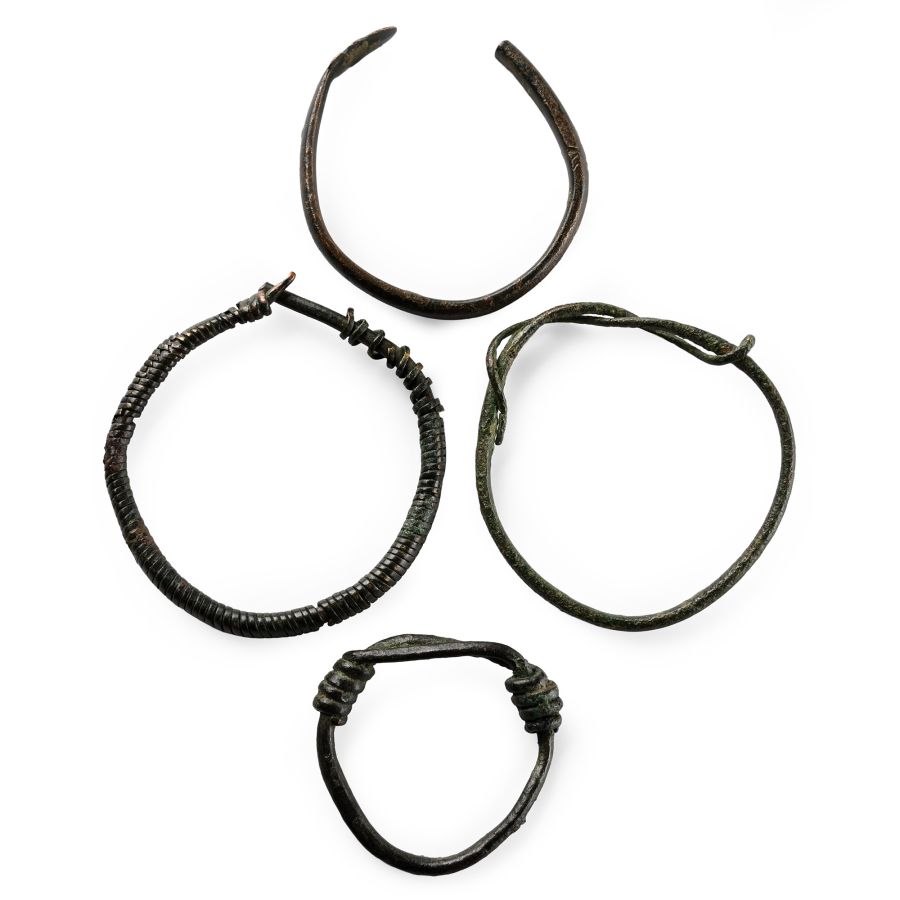
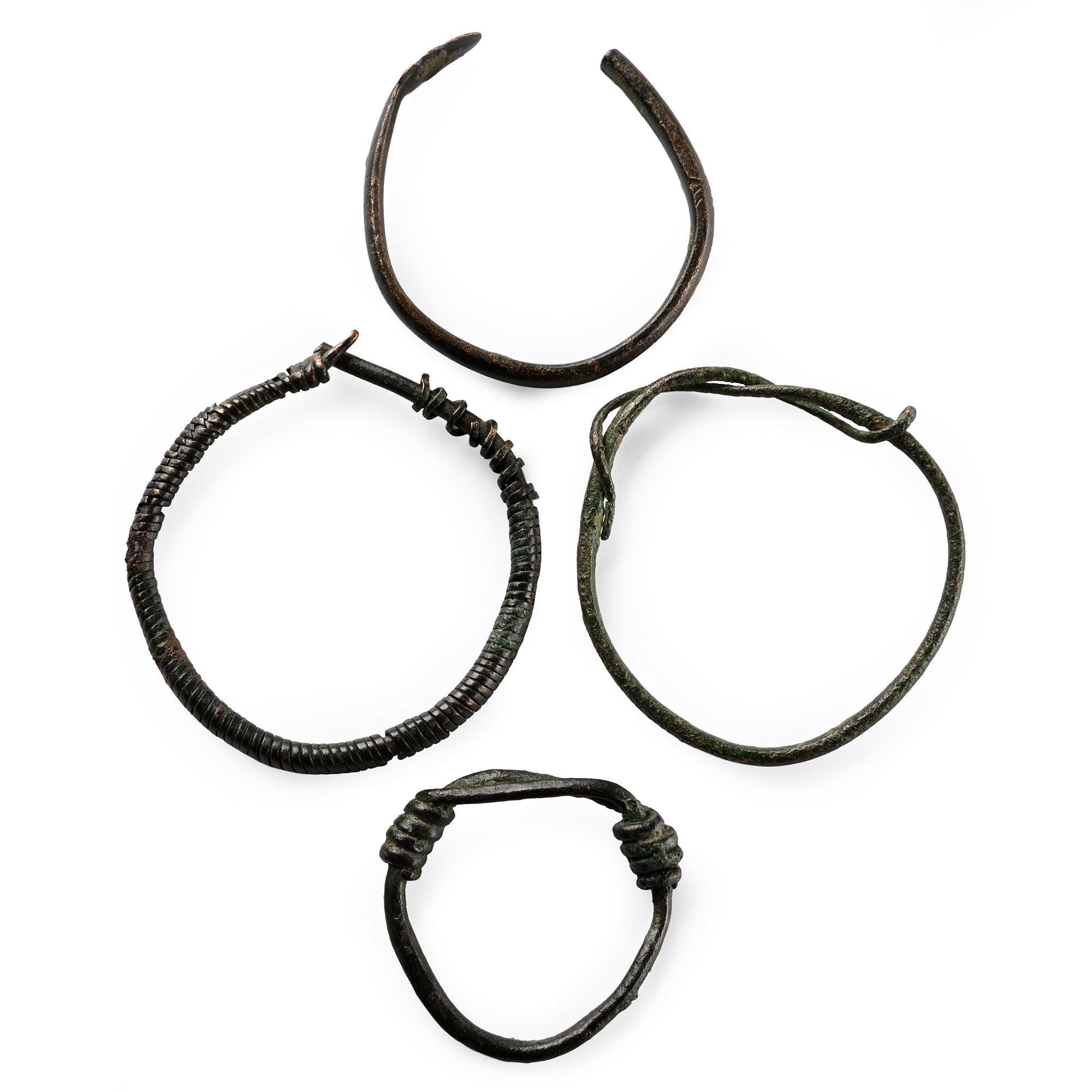
Roman Bronze Bracelet Group
1ST-4TH CENTURY A.D.
1 1/8 - 1 3/4 in. (19.1 grams total, 29-44 mm).
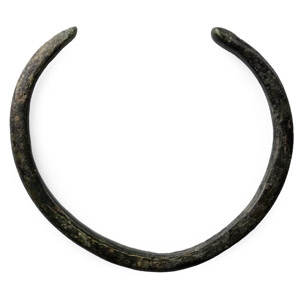
Comprising two annular bracelets with coiled section, one with the ends wound about the shank, and a penannular bracelet with snake-head terminal. [4, No Reserve]
Provenance
Ex German art market, 2000s.
Acquired from an EU collector living in London.
From the collection of a Surrey, UK, gentleman.
This lot is accompanied by an illustrated lot declaration signed by the Head of the Antiquities Department, Dr Raffaele D'Amato.
VETTING:
TimeLine Auctions follows a vetting process to ensure the authenticity and legality of all items, reinforcing our commitment to integrity and responsible trading. Each antiquity, antique, and coin lot undergoes thorough examination by a vetting committee of at least ten external specialists, professional trade association members, scientists, and archaeologists: Our Vetting Process
AUCTIONS:
TimeLine is a leading auction house specialising in antiquities, ancient art, collectables, natural history, coins, medals, and books. Our auctions offer museums, collectors, historians, and enthusiasts the opportunity to acquire unique and historically significant pieces.
RELATED LOTS
-
Roman Bronze Wolf's Head Terminal
1st-2nd century A.D.Sold for (Inc. bp): £98
A terminal depicting a wolf's head with fierce expression, fur detailing to the neck and snout, possibly a knife pommel. 17.4 grams, 27 mm
Fine condition.
Property of a North West London gallery; formerly in a 1980s collection. From the private collection of John Meredith, acquired since the 1990s; thence by descent. This lot is accompanied by an illustrated lot declaration signed by the Head of the Antiquities Department, Dr Raffaele D'Amato. -
Roman Bronze Military Diploma Fragment Issued Under Antoninus Pius to Auxiliaries Stationed in Moesia Superior
22 April 157 A.D.Sold for (Inc. bp): £780
The edge of a diploma with eight partial lines of text to one side, and six partial lines to the other side; the restored text to the point of textual overlap between obverse and reverse; full stop is used for subscript dot: remains of letter with uncertain reading: Tabella I extrinsecus (obverse): [imp(erator) caes(ar) divi hadriani f(ilius) divi traiani] [part(hici) nepos divi ne]RVA.[e pron(epos) t(itus) aelius] [hadrianus anto]NINVS AVG(ustus) PIVS [pont(ifex) max(imus) trib(unicia) pot(estate) xx i]MP(erator) II CO(n)S(ul) IIII P(ater) P(atriae) [equitib(us) et peditib(us) q]VI MILIT(averunt) IN ALIS [ii quae appell(antur) i claudia] N.OVA MISCELL(anea) [et i gallor(um) flaviana et c]OHORT(ibus) X [v gallor(um) et pannonior(um) et v hisp]ANOR(um) [et i montanor(um) et i antioch(ensium) sagit]T.AR(iorum)1 [et i cretum sagittar(ia) et III campestr(is) c(ivium)] R(omanorum) et ii gallor(um) macedon(ica) et iii britton(um) vet(eranorum) et i aug(usta) lusitanor(um) et i pannonior(um) vet(eranorum) et sunt in moesia sup(eriore)] etc Tabella I intus (reverse): [... et sunt in moesia superior(e) sub] [c]VRTIO. [iusto leg(ato) xxv stip(endis) emer(itis) dimis(sis)] [h]ON(esta) M.[ission(e) quor(um) nomina subscr(ipta)] SVNT C.[ivit(atem) Roman(am) qui eor(um) non haber(ent)] [d]EDIT ET [conub(ium) cum uxorib(us)] [qu]A{s=B} {t=I}VN[c habuis(sent) cum est civit(as) is dat(a) aut cum is] Q.VA{s=C} POST(ea) [duxiss(ent) dumtax(at) singulis] etc on tabella II intus. 7.33 grams, 42 mm
Acquired on the UK art market. Property of a gentleman collector. Accompanied by a copy of an illustrated transliteration report by Dr Ittai Gradel. This lot is accompanied by an illustrated lot declaration signed by the Head of the Antiquities Department, Dr Raffaele D'Amato.
Text reconstruction following Eck-Pangerl, ‘Moesia und seine Truppen. Neue Diplome für Moesia und Moesia Superior’, Chiron 38 (2008), 369-77 – all these fragments naming Curtius Iustus go back to a constitutio dated 23. April 157 (see Eck-Pangerl for discussion: they list nine copies, including a complete one; this is the second largest number known of any constitutio; yet another – the tenth - copy published by Eck-MacDonald-Pangerl in ZPE 165 (2008), 237-9). -
Roman Silver Spoon Property of the God Faunus Cranus
4th century A.D.Sold for (Inc. bp): £3,640
Shallow oval bowl with a coiled handle and a duck or swan head facing outwards, Latin inscription 'DEIFAVNI CRANI', '(Property) of the god Faunus Cranus’. 32 grams, 91 mm
UK private collection, 1990s. with Artemission, London, UK. Private collection, London, UK. This lot is accompanied by an illustrated lot declaration signed by the Head of the Antiquities Department, Dr Raffaele D'Amato.
Professor Dr phil. Peter Rothenhöfer writes: 'In RIB the inscription is categorized as 'religious dedication'; this must be rejected as we would expect the Dative case: deo Fauno ... - for the god Faunus ... But we read the genitive case: dei Fauni Crani: (property of) the God Faunus Cranus. This indicates that all these spoons were used (or intended to be used) during religious ceremonies (connected with meals) probably in a sanctuary of Faunus Cranus. The use of deus (= god) and the Celtic epitheton Cranus indicates a provincial cult with strong indigenous elements.'