
Loading, please wait...
LOT 0710
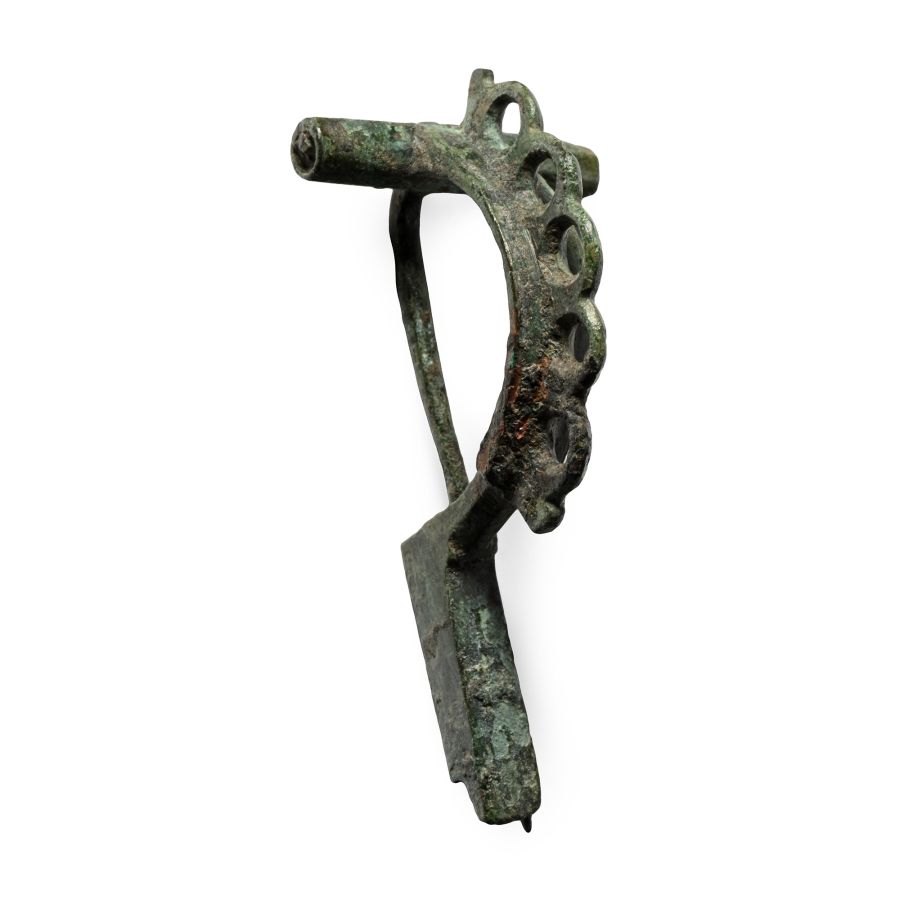
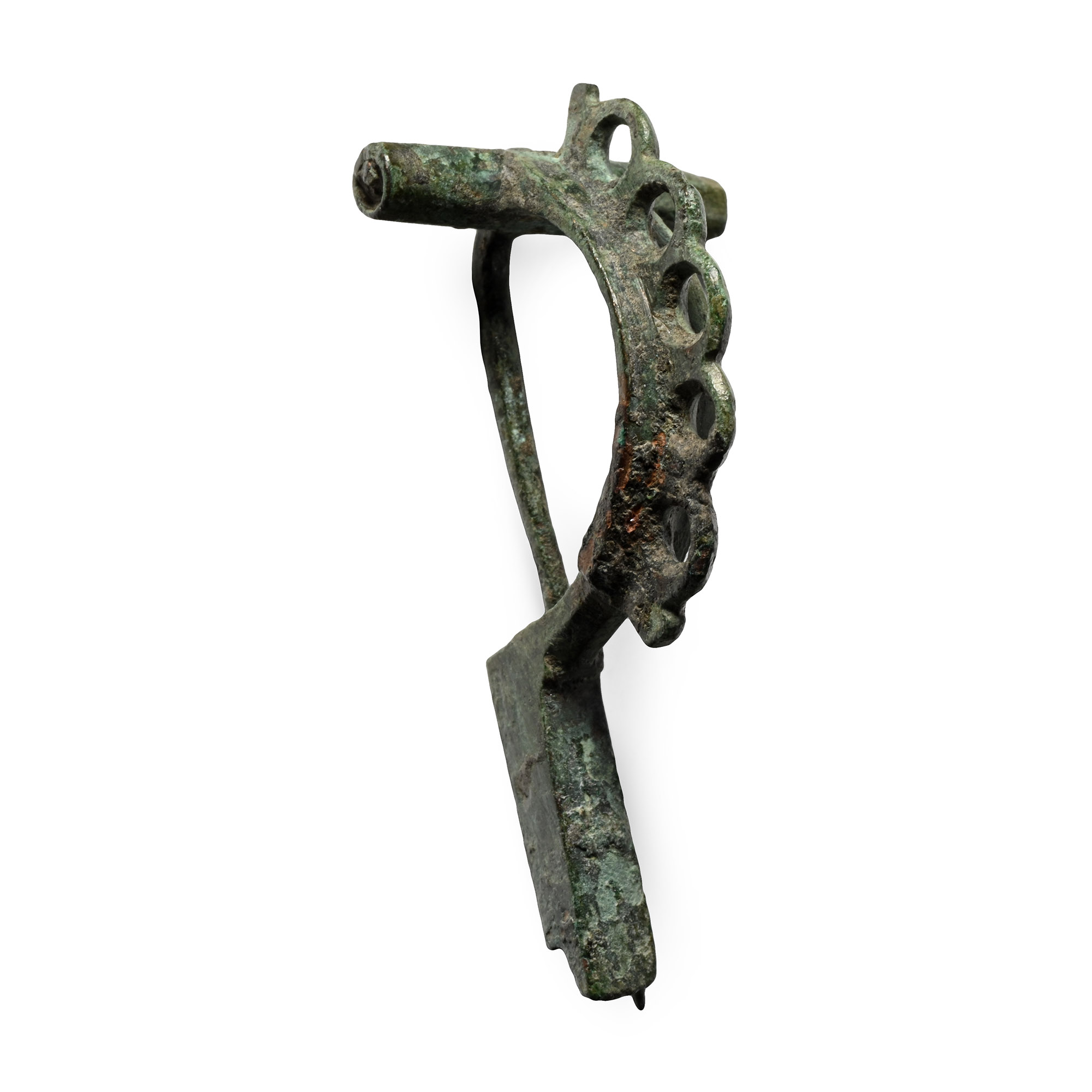
Roman Bronze Bow Brooch
3RD CENTURY A.D.
1 7/8 in. (8.7 grams, 48 mm).
P-shaped type with short crossbar, long bow with five integral loops to the median rib, rectangular foot; catch and hinged pin to reverse [No Reserve]
ProvenanceFrom the private collection of Mr Brian Edwards, New Malden, Surrey, UK, formed from the late 1970s-early 1980s; thence by descent.
LiteratureCf. Hattatt, R., Ancient Brooches and Other Artefacts, Oxford, 1989, item 1675, for type.
CONDITIONTimeLine Auctions follows a vetting process to ensure the authenticity and legality of all items, reinforcing our commitment to integrity and responsible trading. Each antiquity, antique, and coin lot undergoes thorough examination by a vetting committee of at least ten external specialists, professional trade association members, scientists, and archaeologists: Our Vetting Process
AUCTIONS:
TimeLine is a leading auction house specialising in antiquities, ancient art, collectables, natural history, coins, medals, and books. Our auctions offer museums, collectors, historians, and enthusiasts the opportunity to acquire unique and historically significant pieces.
-
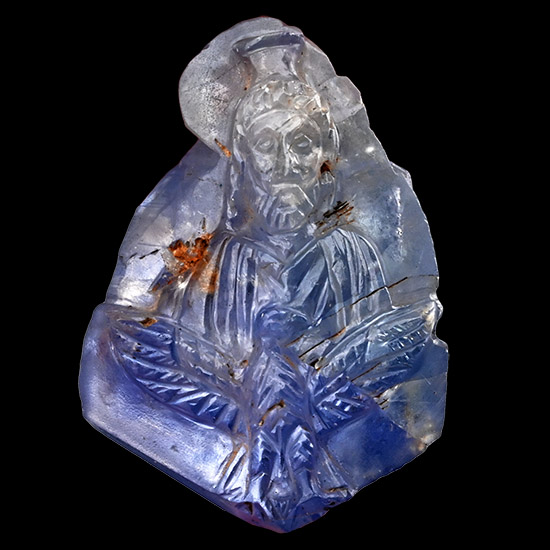
Roman Sapphire Cameo with Bust of Serapis Later Converted to Saint John the Evangelist
Circa 2nd-3rd century A.D., reworked 6th-7th century A.D.Sold for (Inc. bp): £7,800
Carved in the half-round on a sapphire crystal showing striations on the reverse, depicting the upper body of Serapis/St John with modius and pleated tunic, eagle with spread wings placed on the chest. 5.06 grams, 23 mm
Acquired circa 1980. Property of a Middlesex gentleman. This lot has been checked against the Interpol Database of stolen works of art and is accompanied by search certificate number no.13351-255640.
This is a prime example of late antique or early medieval spolia, where a pagan motif was converted into a Christian one with minimal mental or manual adaptation into a visual fusion of Serapis and Saint John. During the Roman Empire, especially in the 2nd and 3rd centuries AD, depictions of the 'bust of the God Serapis standing on an eagle' were extremely popular. The eagle symbolised Jupiter-Serapis, as well as Roman power. When the Empire became Christian, this combination was immediately recognised as the Evangelist John, accompanied by his symbol, the eagle. The modius (kalathos) symbolised fertility and dominion over the underworld when placed on Serapis's head. However, it was often incorrectly (or deliberately) interpreted by Christian observers as an early form of a crown, halo, or priestly headdress. As sapphire is extremely difficult to work with, the modius was often left standing, emphasising the figure's imperial or divine dignity. There are documented cases of this kind. Most famous example: 'Gem of Serapis' (Cab. Méd., Paris), or the reinterpretation of depictions of Jupiter as God the Father. During the Christianisation process, pagan gods with beards and eagles (Jupiter/Serapis) were reclassified as John the Evangelist or Christ himself en masse. -
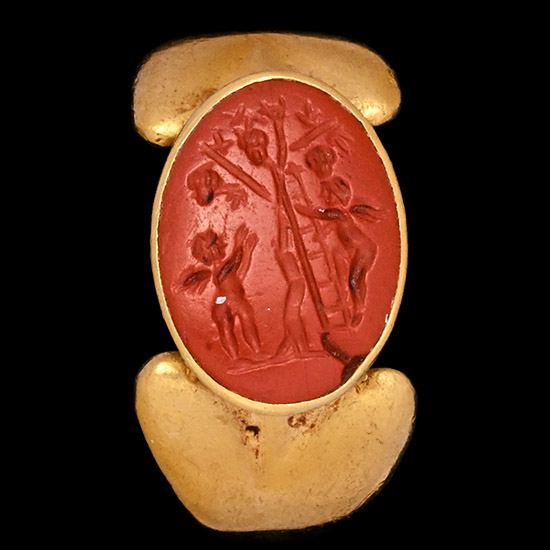
Roman Red Jasper Gemstone with Group of Amores Harvesting Grapes in Gold Ring
1st-2nd century A.D.Estimate: £4,500 - 5,500 (+bp*)
Opening Bid: £2,250
The hoop with flaring shoulders and an oval bezel set with a jasper intaglio engraved with a winged Amore (Erote) standing beneath a tree bearing grapevines, another Amore climbing up a ladder propped against the trunk; supplied with a museum-quality impression. 6.77 grams, 22.48 mm overall, 18.92 x 17.38 mm internal diameter (approximate size British R , USA 8 1/2, Europe 18 3/4, Japan 18)
Acquired on the European art market. This lot has been checked against the Interpol Database of stolen works of art and is accompanied by search certificate number no.13344-257956.
According to A. Furtwängler, the Amores are working on the olive harvest. The vintaging scenes, whether illustrating a realistic portrait of a vineyard or an abstract display of vintaging Erotes working among vine rinceaux, include realistic elements of agricultural practice. The tools and farming implements used, the method of viticulture employed, and the various stages of wine production need to be carefully observed. -
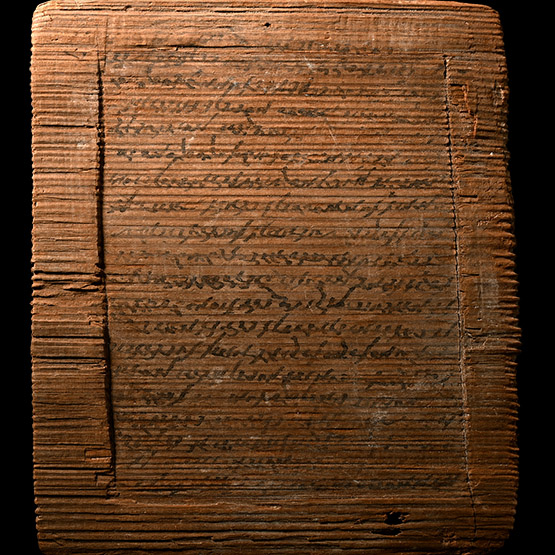
Roman Wooden Tablet with 'Pactum Dotis' Marriage Contract
First half of 4th century A.D.Sold for (Inc. bp): £4,160
Rectangular wooden tablet, probably cedarwood, the inner side with a recessed panel inscribed with 20 lines of inked text in Roman cursive script, two small holes, the bigger in the upper rim, the smaller in the centre of the lower rim; the flat outer side inscribed with 14 lines of inked text; in a good state of preservation with signs of age and parts of the text barely visible. 27 grams, 14 x 16.1 cm
Acquired by Albert Sfez in the early 1950s. Formerly the property of Monsieur Alain Sfez, a Belgian collector; acquired by gift from his father, Albert Sfez, in 1965. Acquired by a London dealer in 1973. From an important London collection since 1975; thence by descent. Accompanied by a copy of an illustrated academic report by Professor Dr phil. Peter Rothenhöfer.
Professor Dr Peter Rothenhöfer, Department of History (Zhuhai Campus) states: 'This important tablet shows that its use was apparently not restricted to the administrative sphere but widely spread in civic life and used for private purposes. As handwritten documents from the late 3rd and 4th century AD are quite rare, this tablet is generally of great importance for the history of Latin palaeography. The text is fluently written and shows a uniform typeface. Typical features of ancient writing can be observed: The text is continuously written without any separation between words (scriptio continua), sentences have no dots at the end.' Wax tablets written in Greek or Latin, were used by Romans as account registers (codices accepti et expensi); for transactions (for example, the tablets of the banker Lucius Caecilius Iucundus found in Pompeii); for lists of goods, inventories, and notes to be kept and archived; for Roman magistrates to annotate the salient events of their bureaucratic activities; for writing letters; for drawing up legal texts of various kinds: legacies, declarations of births and citizenship, reports of trials and diplomata militaria.
