
Loading, please wait...
_900x900.jpg "Roman Bronze Bear Fitting")
_200x200.jpg "Roman Bronze Bear Fitting")
.jpg "Roman Bronze Bear Fitting")
LOT 0116
Roman Bronze Bear Fitting
1ST-4TH CENTURY A.D.
2 1/8 in. (108 grams, 53 mm).
A bronze furniture fitting formed as a square base with gusseted profile, a bear cub crouching on the upper face with one forepaw raised; open to the rear and underside.
ProvenanceAcquired in the 1990s.
Collection of a Suffolk, UK, gentleman.
TimeLine Auctions follows a vetting process to ensure the authenticity and legality of all items, reinforcing our commitment to integrity and responsible trading. Each antiquity, antique, and coin lot undergoes thorough examination by a vetting committee of at least ten external specialists, professional trade association members, scientists, and archaeologists: Our Vetting Process
AUCTIONS:
TimeLine is a leading auction house specialising in antiquities, ancient art, collectables, natural history, coins, medals, and books. Our auctions offer museums, collectors, historians, and enthusiasts the opportunity to acquire unique and historically significant pieces.
LOT 0116
Roman Bronze Bear Fitting
Estimate £500 - 700€580 - 810 (for guidance only)$680 - 950 (for guidance only)
-
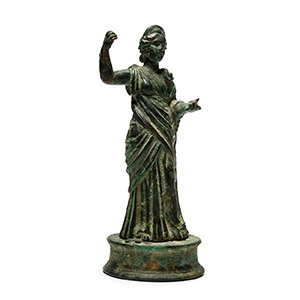
Roman Statuette of the Goddess Fortuna
1st-2nd century A.D.Estimate: £2,000 - 3,000 (+bp*)
Opening Bid: £1,000
A bronze statuette of the goddess Fortuna, modelled in the round standing on a circular plinth base, her feet emerging from beneath her floor length robes, her hair held in a chignon at the back of the head and crowned with a diadem. 205 grams total, 13 cm high including stand
Acquired London art market in early 1960s. From the private collection of the late Walter Steinberg, London, UK. This lot has been checked against the Interpol Database of stolen works of art and is accompanied by search certificate no.11633-199467.
The cult of Fortuna was associated with the round of the agricultural year, the wheel of time and the changing fortunes of the individual, both bad and good. The Rota Fortunae (wheel of fortune) is a symbol of the changeable nature of one's luck and was already a recognised idiom by the time of Cicero, writing in the 1st century B.C. -
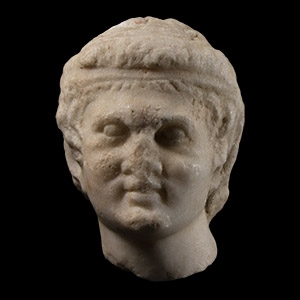
Roman Marble Head of a Satyr
1st-3rd century A.D.Estimate: £4,000 - 6,000 (‡+bp*)
Opening Bid: £1,111
A marble bust of a youthful satyr of Praxitelic type with fillet to the brow, tousled hair and rounded facial features with stern expression. 519 grams, 88 mm
Acquired early 1990s. Ex private American collection; thence by descent. Private Swiss collection since 1998. This lot has been checked against the Interpol Database of stolen works of art and is accompanied by search certificate no.11632-199025.
The head appears to be a copy of the Praxitelian type known as 'The Satyr pouring a Drink'. The head, realised with sensitivity, but technically and stylistically academic, could be dated to the first half of the 2nd century A.D. -
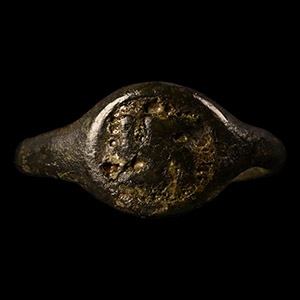
Roman Enamelled Ring with Fylfot
3rd-4th century A.D.Sold for (Inc. bp): £312
A bronze ring composed of a D-section hoop with overlapping arms, the discoid bezel displaying a fylfot with remains of an enamelled field. 2.17 grams, 22.62 mm overall, 19.94 mm internal diameter (approximate size British Q, USA 8, Europe 17.49, Japan 16)
Private collection formed since the 1940s. UK art market. Property of an Essex gentleman.
