
Loading, please wait...
LOT 1088
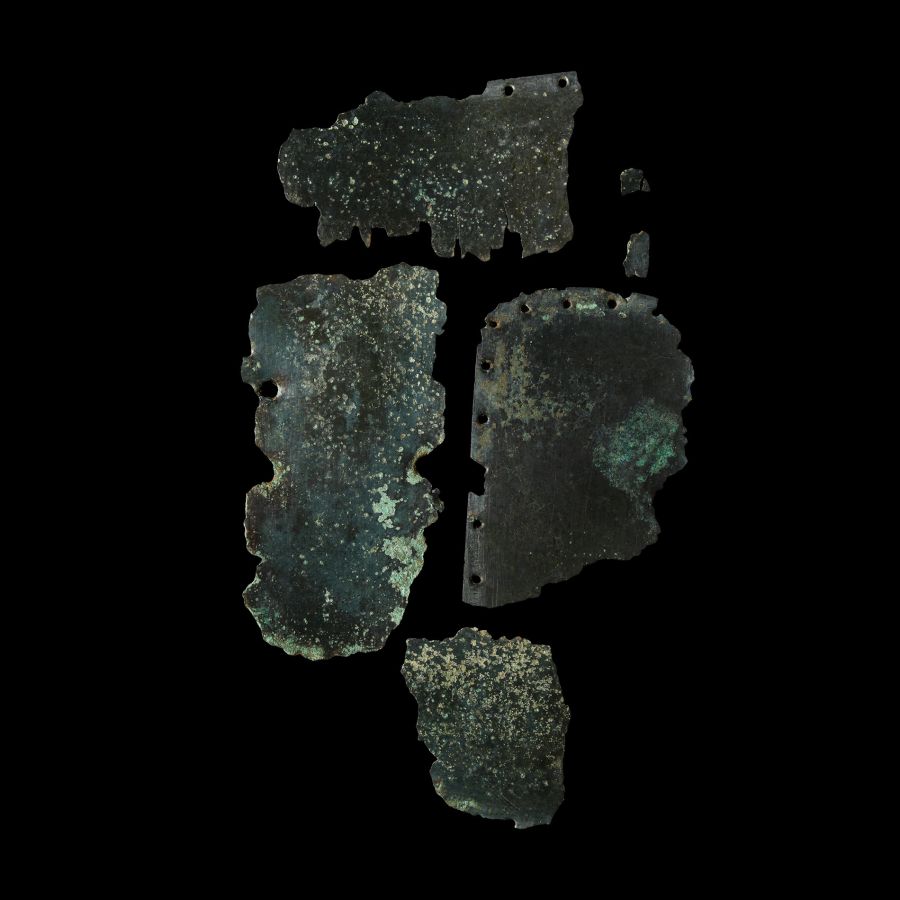
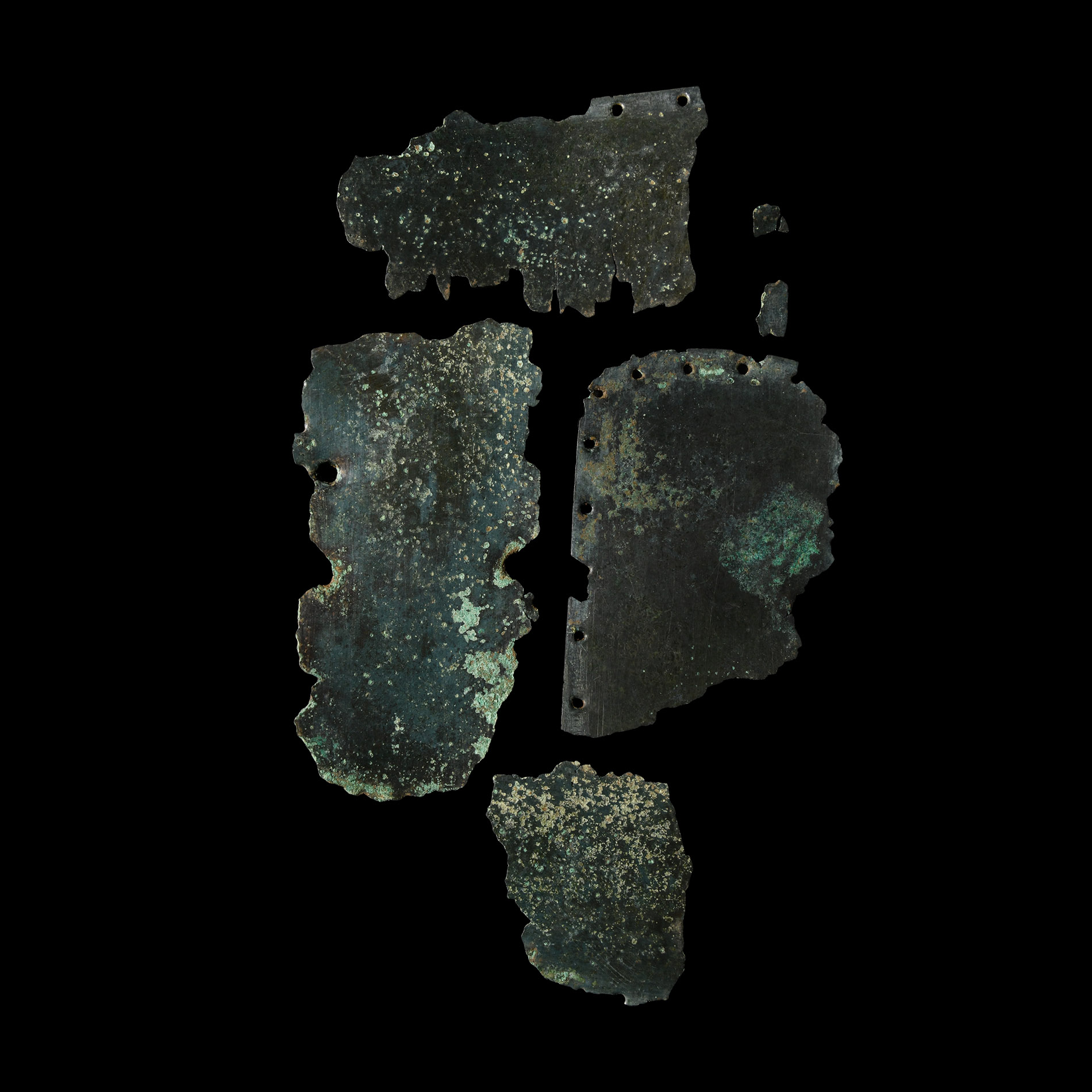
Roman Bronze Armour Sections for Limbs
3RD-4TH CENTURY A.D.
2 3/8 - 4 3/4 in. (54 grams total, 6-12 mm).
Comprising four large plate sections from a segmented armour for arm (manica) or leg, three with pierced attachment holes to the edges, rounded extremity. [4, No Reserve]
ProvenanceFound Northern Europe.
UK private collection.
Acquired from Redhouse Antiques Centre, York, 2005.
Property of a Nottinghamshire gentleman.
Cf. Bishop, M.C. & Coulston, J.C.N., Roman military equipment, from the Punic wars to the fall of Rome, London, 2006, p.101, fig.58 (manica from Carlisle); fig.86 (manicae from Newstead and Carnuntum); D'Amato,R., Negin, A., Roman Heavy Cavalry (1), Cataphractarii & Clibanarii, 1st century BC-5th Century AD, Oxford, 2018, pp.38-39 (samples of limb armour from Dura Europos,Pochlarn and Siena Private Collection, the last presumably from the Danube).
FootnotesOn the Adamclisi monument, at least thirteen Roman legionaries and three standard-bearers have the right arm covered by an armoured sleeve (manica). It is likely that this laminated protection of the arm, derived from that worn by the gladiators, was introduced in the Imperial army in the early first century A.D., and extended to the legionaries fighting during the Dacian Wars. Domitian’s militia had already experienced the importance of protecting the arms from enemy falces. Modern scholars however do not consider this the only and exclusive reason for the introduction of this part of equipment to the Roman army between 21 and 70 A.D.
The armoured sleeve can often be seen on weaponry trophies of 1st century A.D., not only on those linked with the revolt of Sacrovir, like that of Scafa, but also those related to the civil wars, like the armoury assemblage of Split, where the manica is even furnished with laminated gauntlet. This combat item can also be seen on legionary tombstones like those of Sextus Valerus Severus and Gaius Annius Salutus, both from Mainz; and legionaries of Legio XXII Primigenia, who were based in Mogontiacum between 43-70 A.D. Their tombstones show manicae as part of the decorative edge of weaponry surrounding the inscription of the tombstone. Severus' manica shows eleven plates and a hand shaped section of four plates. As suggested by Paul Brown all this clearly places the manica as being used by Roman legions around 21-70 A.D., with a widespread use throughout the empire at the time of the Dacian Wars.
In the following period its use continued: a monument of Legio XIII Gemina, from Apulum (now Alba Julia) still shows a legionary of early third century in lorica segmentata combined with a manica like his predecessors of Adamclisi. Several specimens have been found in all the territories of the Empire, especially in England (Carlisle, Newstead), Austria (Carnuntum), Spain (Santa Marina de Leon), and of course in Romania (Ulpia Sarmizegetusa Trajan). However, we cannot exclude that our fragments are related to the limb armour of Roman heavy cavalryman, the cataphractarius or clibanarius. The peculiarity of the pieces is that they had rounded edges, and were certainly fixed to a leather backing. Also Ammianus (XVI,8) speaks about the lamminarum circuli (circles of laminated sheets) protecting the Roman heavy cavalrymen of the Imperial Guard.
TimeLine Auctions follows a vetting process to ensure the authenticity and legality of all items, reinforcing our commitment to integrity and responsible trading. Each antiquity, antique, and coin lot undergoes thorough examination by a vetting committee of at least ten external specialists, professional trade association members, scientists, and archaeologists: Our Vetting Process
AUCTIONS:
TimeLine is a leading auction house specialising in antiquities, ancient art, collectables, natural history, coins, medals, and books. Our auctions offer museums, collectors, historians, and enthusiasts the opportunity to acquire unique and historically significant pieces.
-
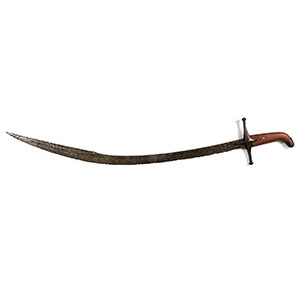
Polish Iron Sabre
17th century A.D.Sold for (Inc. bp): £2,470
Single-edged cutting blade, comprising a cross-shaped hand guard, the blade with a wide curvature widening towards the point, three grooves on the blunt side; later replaced wooden handle with Persian pommel and cross guard. 709 grams, 89.5 cm
Ex private collection of Mr M.B., Mainz, Germany, since the 1980s. Acquired from the above, 2004. This lot has been checked against the Interpol Database of stolen works of art and is accompanied by search certificate number no.11940-210918.
This sabre blade belongs to no. IIa of Zablocki's classification with a blade of variable curvature and double-edged pronounced yelmen. These sabres were used in the 17th and in the first half of 18th century A.D. -
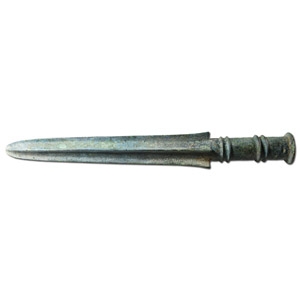
Chinese Bronze Military Flag or Banner Finial
Circa 5th-3rd century B.C. or laterSold for (Inc. bp): £468
Composed of a socketted blade divided into six sections with sharp grooves, the shaft with four circumferential bands. 873 grams, 34 cm
Ex old English collection. London art market, pre 2000. Property of a London, UK, gentleman.
The Chinese, having adopted the use of chariot from the west, judging by the monuments and literature used it primarily for archery combat, as evidenced by the absence of spearheads in chariot burials of the Yin Kingdom. But already from the early Zhou Dynasty chariot warriors used a spear. Massive Yin spears were the weapon of dense infantry formations. The shape of our specimen, probably used as standard finial, recalls that of a spear from Zhongzhoulu, Luoyang, Prov. Henan, dated at the 5th-4th centuries B.C., and of two spears from the Zheng fortress of Xinzheng Country, dated to the 4th-3rd century B.C. -
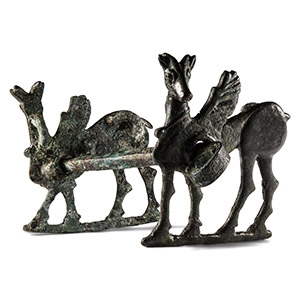
Luristan Bronze Horse Bit
9th-8th century B.C.Sold for (Inc. bp): £910
The cheekpieces formed as winged deer with horns and small ears, a circular opening to the body for the bar to pass through, two loops and studs to the reverse; the bar with looped circular terminals. 543 grams, 17.5 cm
Ex old English collection. London art market, pre 2000. Property of a Lonodon, UK, gentleman.
The most admirable horse bits ever created by man are undoubtedly those from Luristan, a province which extended along the valleys that make up the central part of the Zagros mountains. Worked in cast bronze with the lost wax process, they almost always had a rigid cannon in round or square bars which were flattened and rolled up around themselves at the ends, but their exceptional feature were the figural side bars. The local metalsmiths, in a period of time between 1200 and 700 B.C. managed to create an infinite number of typologies: horses, oxen, ibex, roosters and various mythological animals.
