
Loading, please wait...
_900x900.jpg "Roman Bronze Antinous Balsamarium")
_200x200.jpg "Roman Bronze Antinous Balsamarium")
.jpg "Roman Bronze Antinous Balsamarium")
LOT 0119
Roman Bronze Antinous Balsamarium
2ND-3RD CENTURY A.D.
4 in. (300 grams, 10 cm).
Comprising the bust of Antinous or Bacchus (Greek Dionysus); the head modelled in the round, hair with voluminous waves, semi-naturalistic facial features, muscular neck and chest, two loops at the sides for the handle, silver inlaid eyes restored with black glass pupils.
ProvenanceAcquired on the German art market before 2000.
From an EU collection before 2020.
Cf. Facsády A., ‘Antropomorf Bronz "Balsamarium" Aquincumból (An antropomorphic Balsamarium from Aquincum’)’ in Archaeologiai Értesítő, 139 (2014), pp.157–169, fig.1 or 4, for the type.
FootnotesThe balsamarium (ointment or balsam container), is a modern term reflecting the Roman use of relatively small vessels as containers for aromatic oils, or storing and dispensing cosmetic liquids and/or scented powdered substances. These vessels were produced in the first three centuries of the Roman Empire in a variety of forms, including busts and animal shapes. The present balsamarium testifies to the power of imperial imagery and its dissemination across the empire, as the vessel portrays Antinous, Emperor Hadrian's ‘favourite’, whose untimely death in a boating accident led to his deification. The general facial characteristics of our figure are consistent with the stylistic portrait features of late antiquity and the personal features of Antinous, here appearing with large almond-shaped eyes, set into slightly upturned, incised pupils.
CONDITIONTimeLine Auctions follows a vetting process to ensure the authenticity and legality of all items, reinforcing our commitment to integrity and responsible trading. Each antiquity, antique, and coin lot undergoes thorough examination by a vetting committee of at least ten external specialists, professional trade association members, scientists, and archaeologists: Our Vetting Process
AUCTIONS:
TimeLine is a leading auction house specialising in antiquities, ancient art, collectables, natural history, coins, medals, and books. Our auctions offer museums, collectors, historians, and enthusiasts the opportunity to acquire unique and historically significant pieces.
-
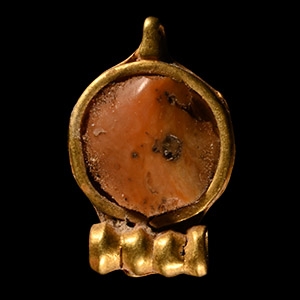
Roman Gold Pendant with Coral
3rd-5th century A.D.Sold for (Inc. bp): £176
Comprising a ribbed loop; round setting with an inset pink coral cabochon, small loop below. 0.74 grams, 13 mm
From a late Japanese specialist collector, 1970-2000s. -
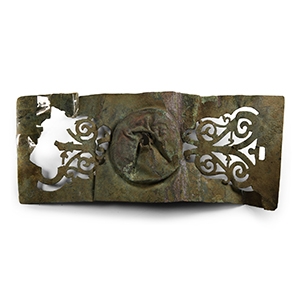
Large Roman Bronze Military Mount
2nd-3rd century A.D.Estimate: £150 - 200 (+bp*)
Opening Bid: £80
Composed of a central domed boss and openwork volutes to the sides; for a sword belt or a chariot. 69 grams, 14 cm wide
Good condition, very rare
Acquired 1960s-1990s. Late Alison Barker collection, a retired London barrister. -
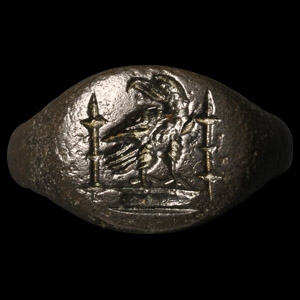
Roman Bronze Military Ring with Eagle Between Standards
Circa 2nd-4th century A.D.Sold for (Inc. bp): £416
With a narrow hoop expanding at the shoulders, oval bezel with a large eagle standing on a pedestal and facing back, a military stand to each side. 4.00 grams, 20.33 mm overall, 17.94 mm internal diameter (approximate size British M 1/2, USA 6 1/4, Europe 13.09, Japan 12)
From the collection of a High Wycombe, Buckinghamshire, UK, gentleman, circa 2000.
