
Loading, please wait...

LOT 0829
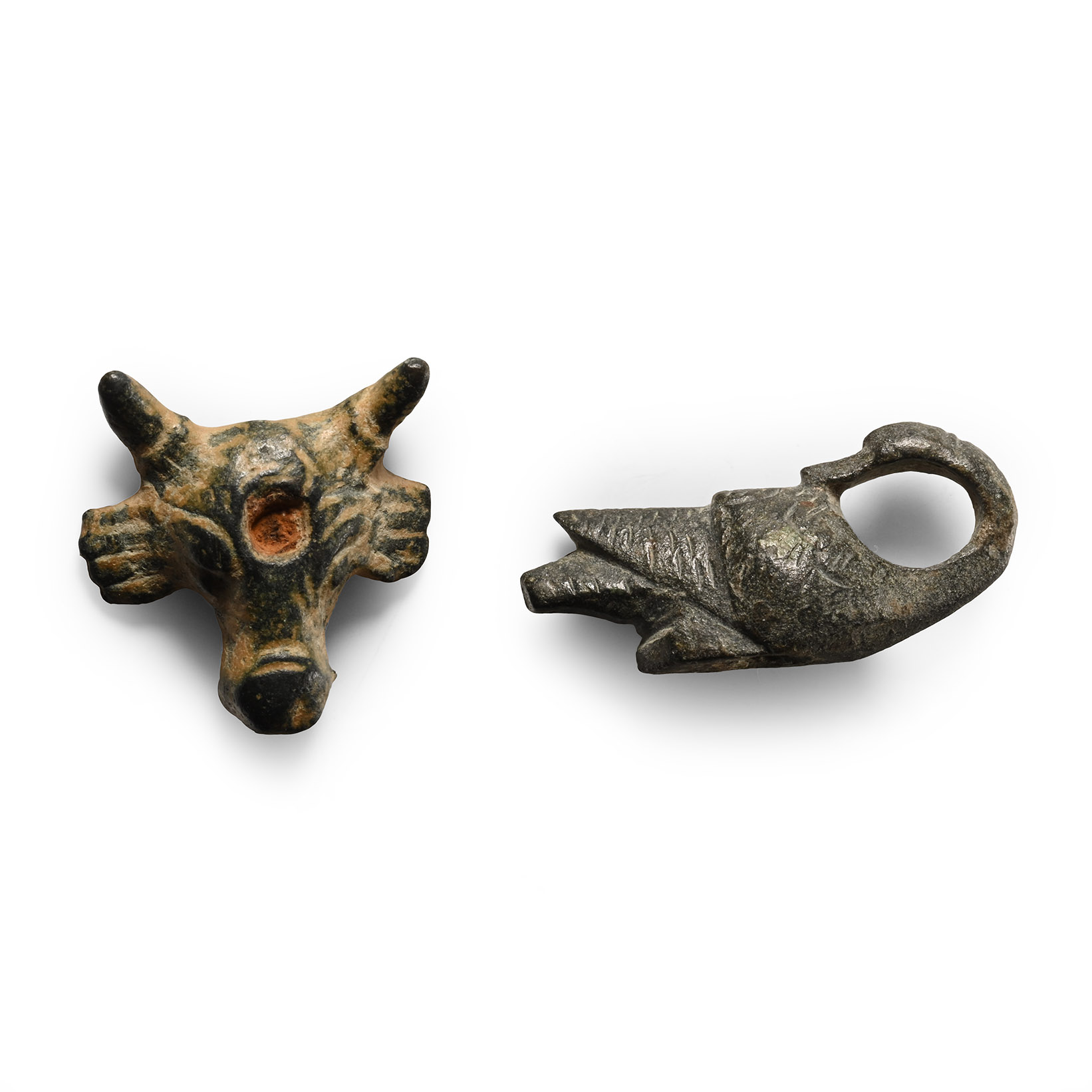
Roman Bronze Animal Weight Group
1ST-2ND CENTURY A.D.
1 - 1 3/8 in. (35.3 grams total, 25-36 mm).
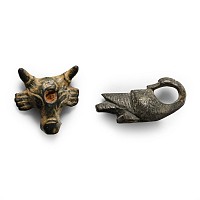
Comprising: a bull-head amulet with socket to the brow to accept a cabochon; swan with head turned back to meet the wing. [2]
ProvenanceFrom the private collection of Mr K.A., acquired in the 1990s-early 2000s.
This lot is accompanied by an illustrated lot declaration signed by the Head of the Antiquities Department, Dr Raffaele D'Amato.
Cf. Megaw, J.V.S., ‘A bronze bull’s head in Glasgow and its Affiliations’ in Proceedings of the society of Antiquarians in Scotland, Edinburgh, 1957-1958, vol.XCI, pp.179-182, pl.XCI, for a similar bull’s head amulet.
CONDITIONTimeLine Auctions follows a vetting process to ensure the authenticity and legality of all items, reinforcing our commitment to integrity and responsible trading. Each antiquity, antique, and coin lot undergoes thorough examination by a vetting committee of at least ten external specialists, professional trade association members, scientists, and archaeologists: Our Vetting Process
AUCTIONS:
TimeLine is a leading auction house specialising in antiquities, ancient art, collectables, natural history, coins, medals, and books. Our auctions offer museums, collectors, historians, and enthusiasts the opportunity to acquire unique and historically significant pieces.
LOT 0829
Roman Bronze Animal Weight Group
Estimate £150 - 200€170 - 230 (for guidance only)$200 - 270 (for guidance only)
-
Roman Green Glass Necklace Bead String
2nd-3rd century A.D. and laterSold for (Inc. bp): £91
Restrung group of mainly spherical and biconical glass beads. 10.4 grams, 40 cm
Acquired from Coincraft, London, UK. From the private collection of Kenneth Machin (1936-2020), Buckinghamshire, UK; his collection of antiquities and natural history was formed since 1948; thence by descent. Accompanied by a Coincraft certificate of authenticity. This lot is accompanied by an illustrated lot declaration signed by the Head of the Antiquities Department, Dr Raffaele D'Amato. -
Life-Size Roman Statue Foot of a Young Athlete
1st century B.C.-2nd century A.D.Sold for (Inc. bp): £13,000
Comprising the left foot and ankle with finely modelled anatomical detailing, filled with lead and originally attached to a base from the sole of the foot. 5.73 kg, 22 cm
From a London, UK, collection that was formed the 1980s. Acquired from Alan Darer, Mayfair, London, UK, 2016. From the private collection of a Beckenham, UK, lady. Accompanied by an academic report by Dr Raffaele D’Amato. This lot has been checked against the Interpol Database of stolen works of art and is accompanied by search certificate number no.12783-240373. This lot has been cleared against the Art Loss Register database, and is accompanied by an illustrated lot declaration signed by the Head of the Antiquities Department, Dr Raffaele D'Amato.
The small proportions of the foot could suggest that it originally belonged to a statue of a boy, young god or athlete. One of the possible candidates can be Apollo or Narcissus: many of their statues show a similar position of the left foot (Reinach, 1930, pp.100-104). -
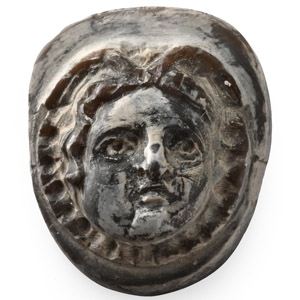
Roman Stone Cameo with Head of Medusa
2nd-3rd century A.D.Sold for (Inc. bp): £312
Ellipsoid with front-facing high-relief carved Medusa head enclosed with a pair of stylised joined serpents. 1.47 grams, 15 mm
Ex London, UK, art market, late 1990s. From a private UK collection. This lot is accompanied by an illustrated lot declaration signed by the Head of the Antiquities Department, Dr Raffaele D'Amato.
