
Loading, please wait...
LOT 0757
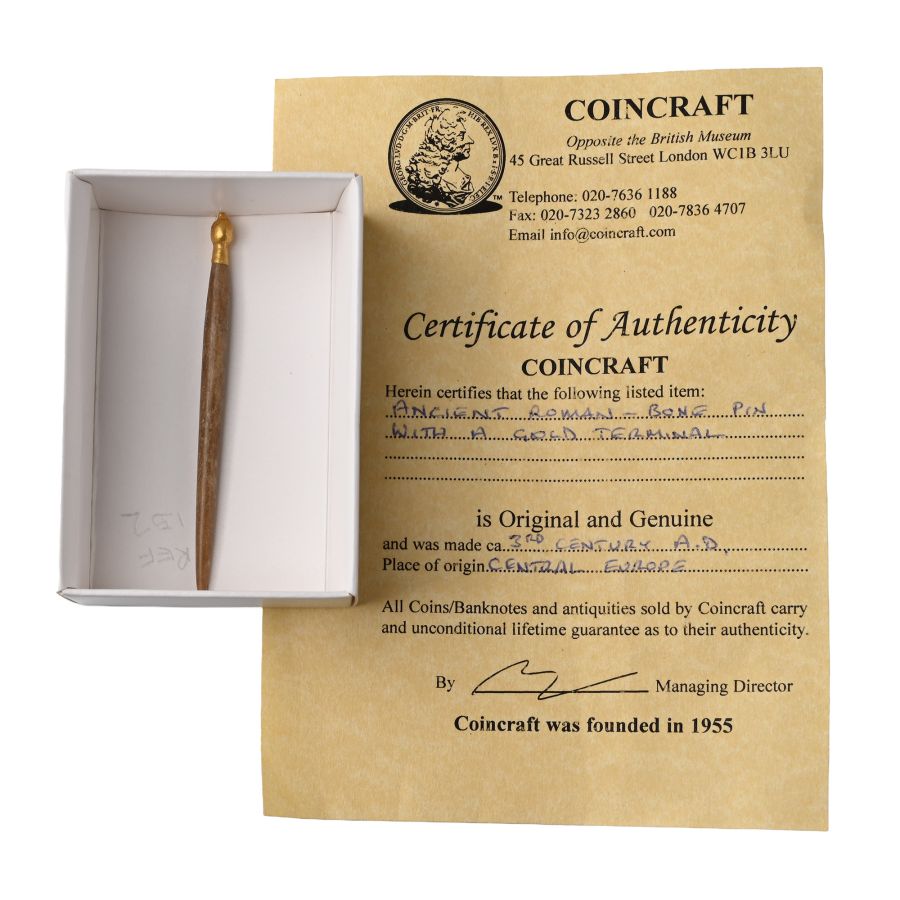
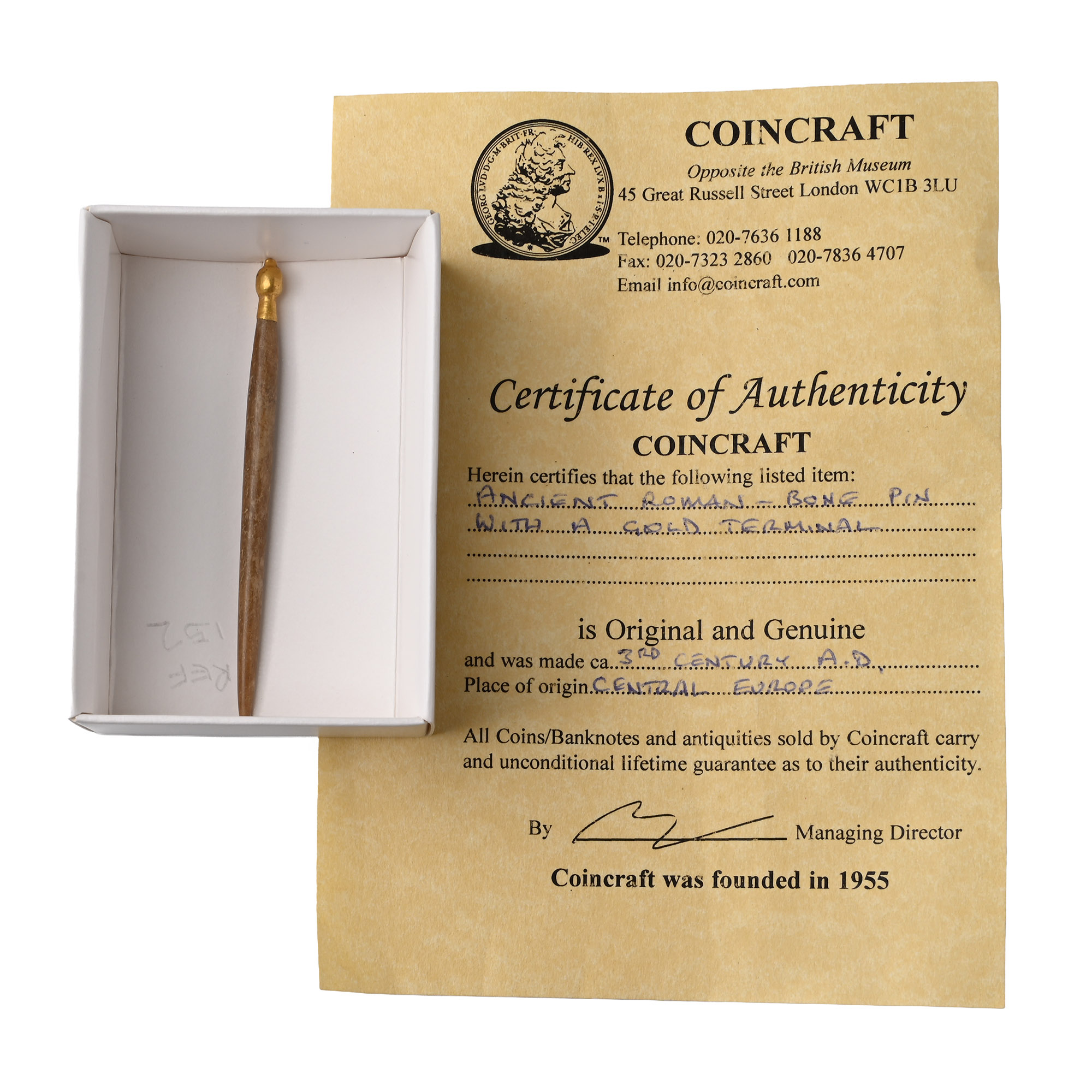
Roman Bone Pin with Gold Terminal
3RD CENTURY A.D.
3 in. (1.99 grams, 74 mm).
Round in section and tapering to each end, with knop finial and applied gilding. [No Reserve]
ProvenanceAcquired from Coincraft, London, UK.
From the private collection of Kenneth Machin (1936-2020), Buckinghamshire, UK; his collection of antiquities and natural history was formed since 1948; thence by descent.
Accompanied by a Coincraft certificate of authenticity.
This lot is accompanied by an illustrated lot declaration signed by the Head of the Antiquities Department, Dr Raffaele D'Amato.
TimeLine Auctions follows a vetting process to ensure the authenticity and legality of all items, reinforcing our commitment to integrity and responsible trading. Each antiquity, antique, and coin lot undergoes thorough examination by a vetting committee of at least ten external specialists, professional trade association members, scientists, and archaeologists: Our Vetting Process
AUCTIONS:
TimeLine is a leading auction house specialising in antiquities, ancient art, collectables, natural history, coins, medals, and books. Our auctions offer museums, collectors, historians, and enthusiasts the opportunity to acquire unique and historically significant pieces.
-
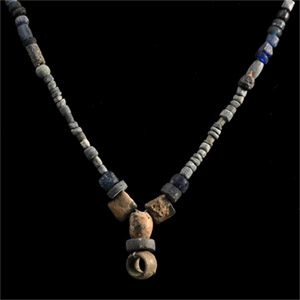
Roman Blue Glass and Stone Bead Necklace String
1st-4th century A.D. and laterSold for (Inc. bp): £39
Composed of variously shaped beads, central feature composed of tabular, annular, and ellipsoid beads; restrung. 21 grams, 41 cm
From the London, UK, art market in the 1990s. This lot is accompanied by an illustrated lot declaration signed by the Head of the Antiquities Department, Dr Raffaele D'Amato.
Such necklaces testify to the popularity of glass ornaments across the Roman Empire. Roman jewellery at first followed trends set by the Etruscans, using gold and glass beads, but with the extension of the Empire and the adoption of different styles from Greece, Egypt and North Africa, jewellery designs became increasingly various and elaborate. Each bead of this beautiful necklace is unique in shape, lustre and speckling, creating a mosaic-like impression. Blue glass beads can be grouped into opaque mid-blue and deep translucent cobalt blue types. -
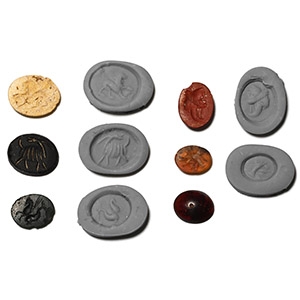
Roman Gemstone Collection
2nd-3rd century A.D.Estimate: £400 - 600 (+bp*)
Opening Bid: £222
Including profile bust, advancing lion, two fish and other types; each supplied with a museum-quality impression. 2.9 grams total, 9-13 mm
From the collection of a gentleman, acquired on the London art market in the 1990s. This lot is accompanied by an illustrated lot declaration signed by the Head of the Antiquities Department, Dr Raffaele D'Amato. -
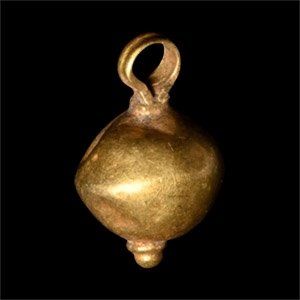
Roman Gold Pendant
1st-4th century A.D.Sold for (Inc. bp): £124
Hollow spherical pendant with applied granule at the base. 0.27 grams, 10 mm
From the collection of a late Japanese collector, 1970s. This lot is accompanied by an illustrated lot declaration signed by the Head of the Antiquities Department, Dr Raffaele D'Amato.
