
Loading, please wait...
LOT 0731
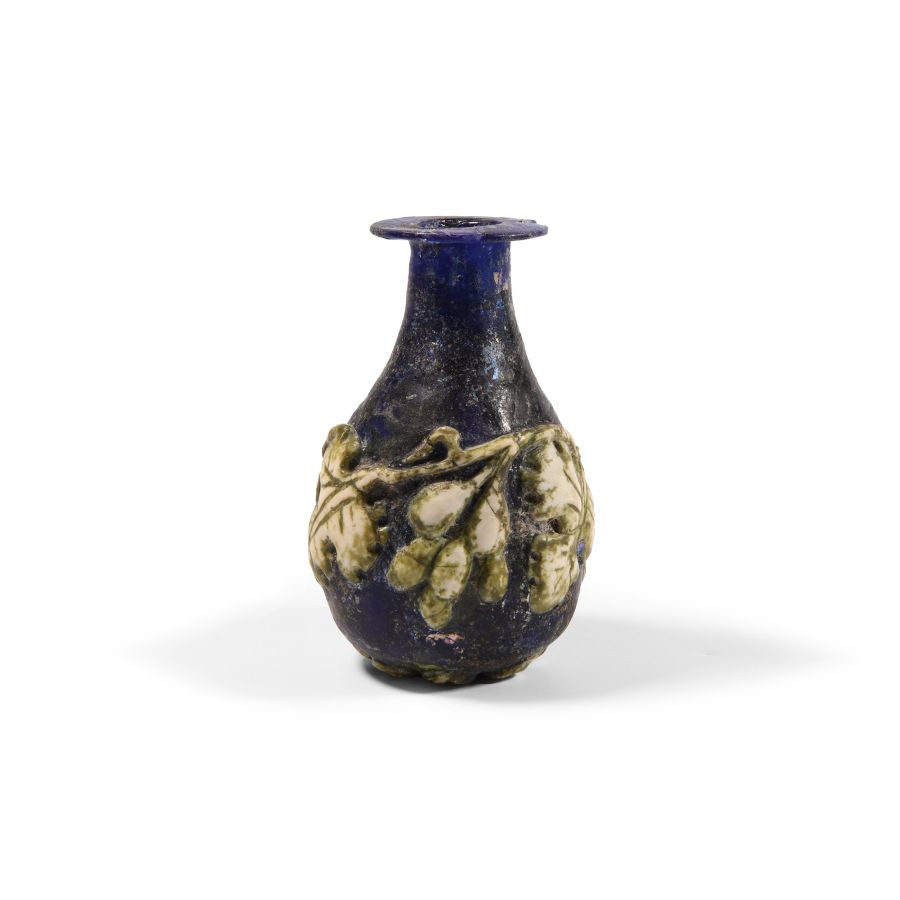
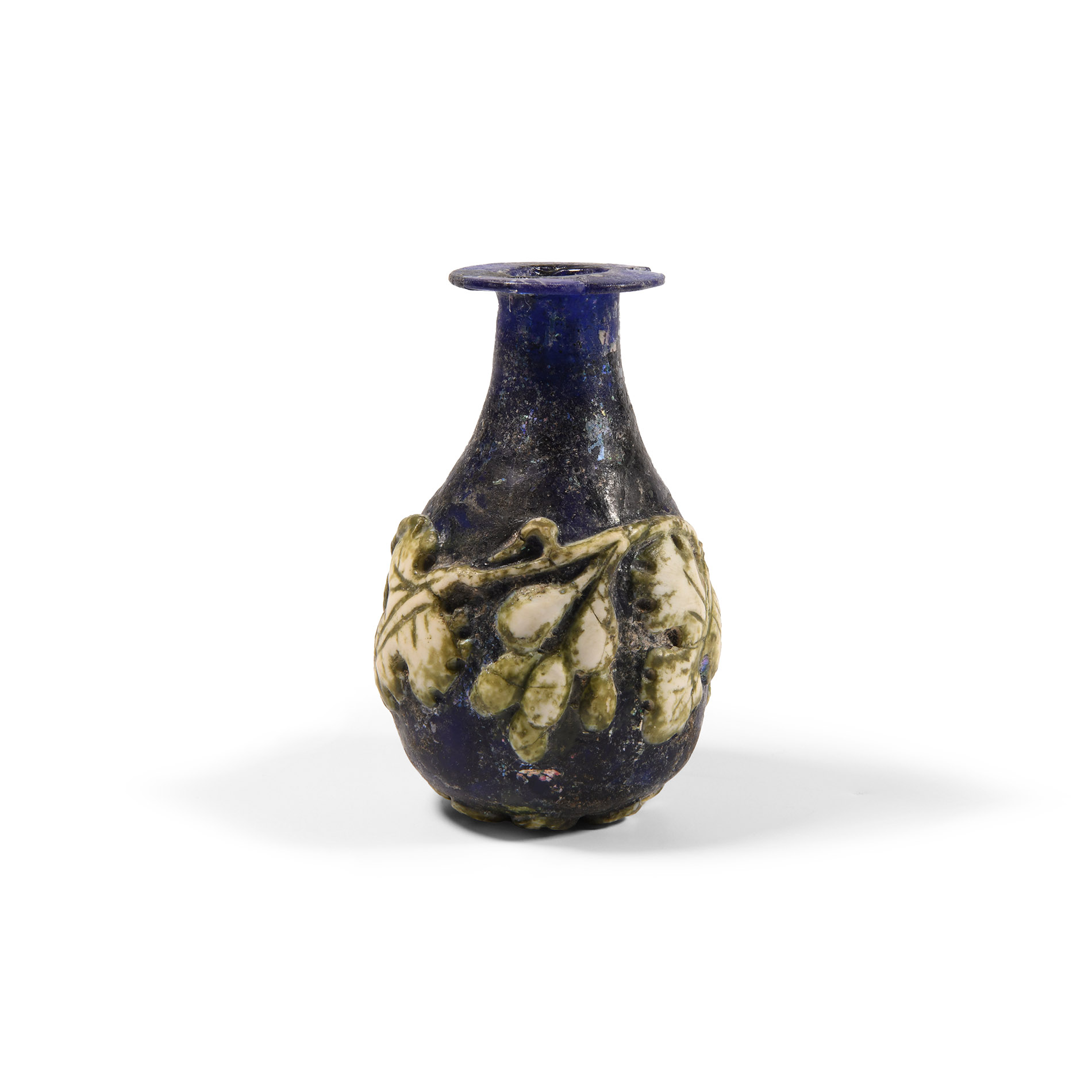
Roman Blue Glass Vessel with Vine Leaf Design
EARLY 1ST CENTURY A.D. AND LATER
4 3/4 in. (189 grams, 12 cm high).
A blue glass bottle of piriform shape with iridescent surfaces, decorated with later applied fruiting vines in high-relief, a stylised leaf to the vessel base; restored; rim chipped.
ProvenanceAcquired in the 1970s.
English private collection.
Cf. Lightfoot, C.S., Ancient Glass in the National Museums of Scotland, Edinburgh, 2007, items 226, 270, for type; Whitehouse, D., Roman Glass in the Corning Museum of Glass, vol.2, New York, 2001, item 649, for technique.
CONDITIONTimeLine Auctions follows a vetting process to ensure the authenticity and legality of all items, reinforcing our commitment to integrity and responsible trading. Each antiquity, antique, and coin lot undergoes thorough examination by a vetting committee of at least ten external specialists, professional trade association members, scientists, and archaeologists: Our Vetting Process
AUCTIONS:
TimeLine is a leading auction house specialising in antiquities, ancient art, collectables, natural history, coins, medals, and books. Our auctions offer museums, collectors, historians, and enthusiasts the opportunity to acquire unique and historically significant pieces.
LOT 0731
Roman Blue Glass Vessel with Vine Leaf Design
Estimate £800 - 1,000€930 - 1,160 (for guidance only)$1,080 - 1,350 (for guidance only)
-
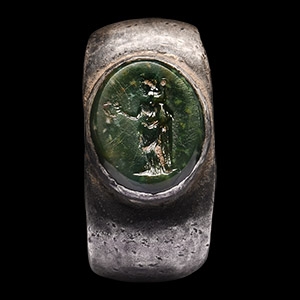
Roman Silver Ring with Goddess Gemstone
2nd-3rd century A.D. or laterSold for (Inc. bp): £390
A silver ring composed of a convex ellipsoid hoop, expanding at the shoulders to a raised oval bezel with collar, set with a green jasper intaglio gemstone engraved with the image of a goddess, carrying a staff and a laurel crown. 8.43 grams, 23.53 mm overall, 19.80 mm internal diameter (approximate size British M 1/2, USA 6 1/4, Europe 13.09, Japan 12)
Acquired in the late 1990s-2000. Property of an East London gentleman.
The ring presents similarities with the type II, variant 1 of the Ruseva-Slokoska classification. Many rings with images of divinities were found by the archaeologists as votive offerings to the divinities engraved on the bezel. It is difficult to interpret which divinity is represented in this ring, but the sceptre and the laurel crown could hint at it being Hera or Juno. -
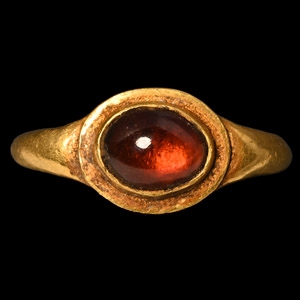
Roman Gold Ring with Garnet Cabochon
1st-3rd century B.C.Sold for (Inc. bp): £650
A gold ring with raised oval bezel inset deep red cabochon garnet. 1.25 grams, 14.67 mm overall, 12.36 mm internal diameter
Acquired early 1990s. Ex private American collection; thence by descent. Private collection since 1998. -
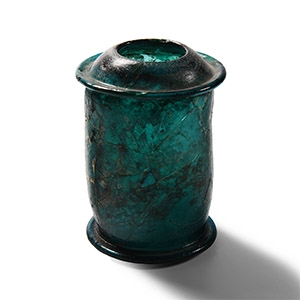
Roman Turquoise Glass Pyxis
1st-4th century A.D.Estimate: £500 - 700 (‡+bp*)
Opening Bid: £250
A vibrant green-blue glass pyxis with a broadly barrel-shaped body, everted foot and shoulder, domed inverted neck; areas of iridescence; repaired. 42 grams, 85 mm high
Acquired early 1990s. Ex private American collection; thence by descent. Private collection since 1998.
Originally used principally by women to hold cosmetics, jewellery or even poisonous substances, some pyxides have even been identified as ink pots. Most surviving examples are Green terracotta examples.
