
Loading, please wait...
LOT 0915
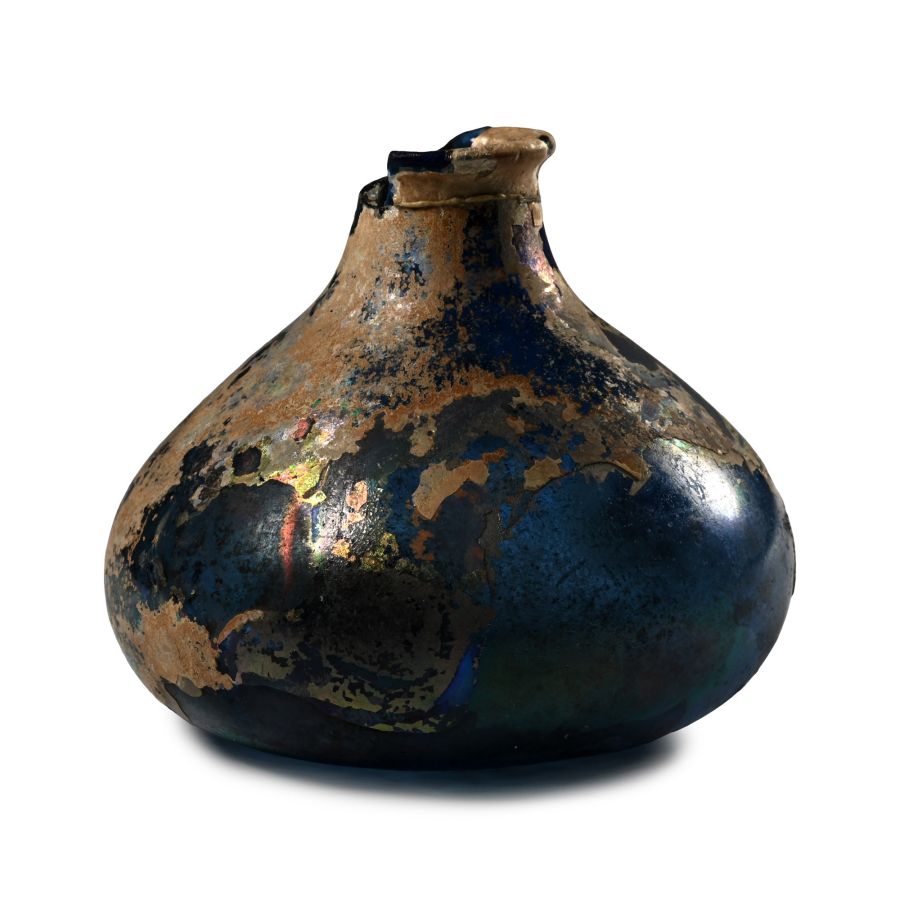
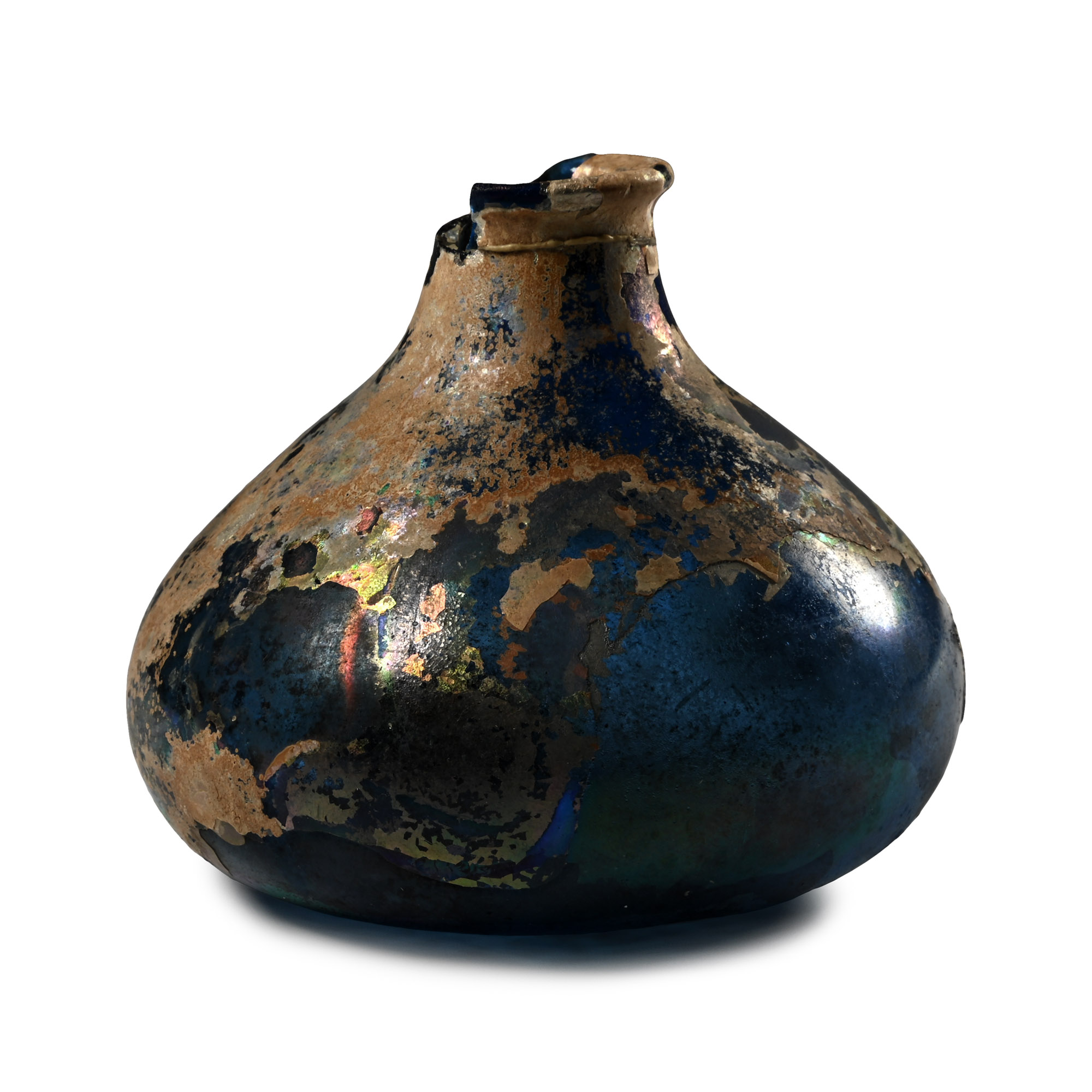
Roman Blue Glass Vessel with Iridescence
1ST CENTURY A.D.
2 1/2 in. (30 grams, 63 mm).
Miniature glass jar with bulbous body, dimple base, short neck and flaring rim. [No Reserve]
ProvenanceEx Louis-Gabriel Bellon (c.1819-1899), France.
Private collection, Europe.
This lot is accompanied by an illustrated lot declaration signed by the Head of the Antiquities Department, Dr Raffaele D’Amato.
Cf. Auth, H., Ancient Glass at the Newark Museum, Newark, 1976, p.221 (no.462), for similar.
FootnotesGlobular jars such as this one have been found in many later 1st-early 2nd century contexts in Britain, central and Northern France, and the Netherlands.
Louis-Gabriel Bellon was a prominent French collector of antiquities in the 19th century, renowned for his discerning taste and extensive knowledge of ancient art. His collection, which included Greek, Roman, and Egyptian artifacts, was widely regarded as one of the most significant of its time. Bellon's dedication to the study and preservation of antiquities contributed to the broader understanding of ancient cultures during his era. Pieces from his collection remain highly sought after, reflecting his exceptional eye for quality and historical significance.
TimeLine Auctions follows a vetting process to ensure the authenticity and legality of all items, reinforcing our commitment to integrity and responsible trading. Each antiquity, antique, and coin lot undergoes thorough examination by a vetting committee of at least ten external specialists, professional trade association members, scientists, and archaeologists: Our Vetting Process
AUCTIONS:
TimeLine is a leading auction house specialising in antiquities, ancient art, collectables, natural history, coins, medals, and books. Our auctions offer museums, collectors, historians, and enthusiasts the opportunity to acquire unique and historically significant pieces.
-

Roman Silver Lidded Pyxis with Mercury, Fortuna, Minerva, Juno and Mars
1st-2nd century A.D.Sold for (Inc. bp): £1,690
Tubular in construction with domed lid, sidewall with repoussé arcade frieze depicting Mercury with caduceus, Fortuna with cornucopia, Mars with spear, Minerva with helmet, shield and spear, Juno enthroned; some restoration. 33 grams, 67 mm
Acquired from Trinity Antiques, UK, before 2009. Property of a Bedfordshire, UK, private collector. Accompanied by an illustrated collector's identification tag. This lot has been cleared against the Art Loss Register database, and is accompanied by an illustrated lot declaration signed by the Head of the Antiquities Department, Dr Raffaele D’Amato. -
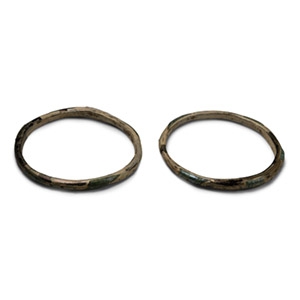
Roman Iridescent Glass Bangle Pair
3rd-4th century A.D.Sold for (Inc. bp): £85
Each a slender D-section hoop with some iridescent surface. 10.3 grams total, 60 mm each
From an old English collection. Acquired from Helios Gallery in 2011. Ian Wilkinson collection, Nottinghamshire, UK, formed since 1985. This lot is accompanied by an illustrated lot declaration signed by the Head of the Antiquities Department, Dr Raffaele D’Amato.
The mass production of glass in ancient Rome prompted the development of glass jewellery of unique qualities. The ancient Romans considered jewellery to be an essential accessory, being a public display of the wealth of high social classes. Recent excavations have provided better information on the use of glass for necklaces and bracelets, and in some cases it has been possible to understand the exact arrangement of the jewellery. -
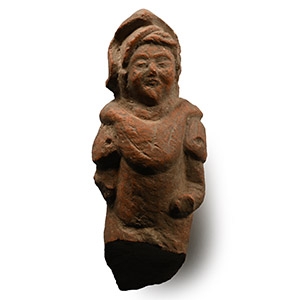
Romano-British Terracotta Figural Patera Handle of Dadophoros
3rd-4th century A.D.Sold for (Inc. bp): £98
Columnar in form with anthropomorphic detailing modelled in the round; figure with a loose Persian-style hood over his thick hair, wearing a military cloak, left arm bent at his side. 97 grams, 97 mm
Found fieldwalking in North Norfolk, UK, circa 2008. Ian Wilkinson collection, Nottinghamshire, UK, formed since 1985. This lot is accompanied by an illustrated lot declaration signed by the Head of the Antiquities Department, Dr Raffaele D’Amato.
The dadophoroi were torch-bearers who accompanied Mithras in his ceremonial travels. They are named as 'Cautes' who holds a burning torch point-upwards, whereas 'Cautopates' holds one pointing down.
