
Loading, please wait...
LOT 0677
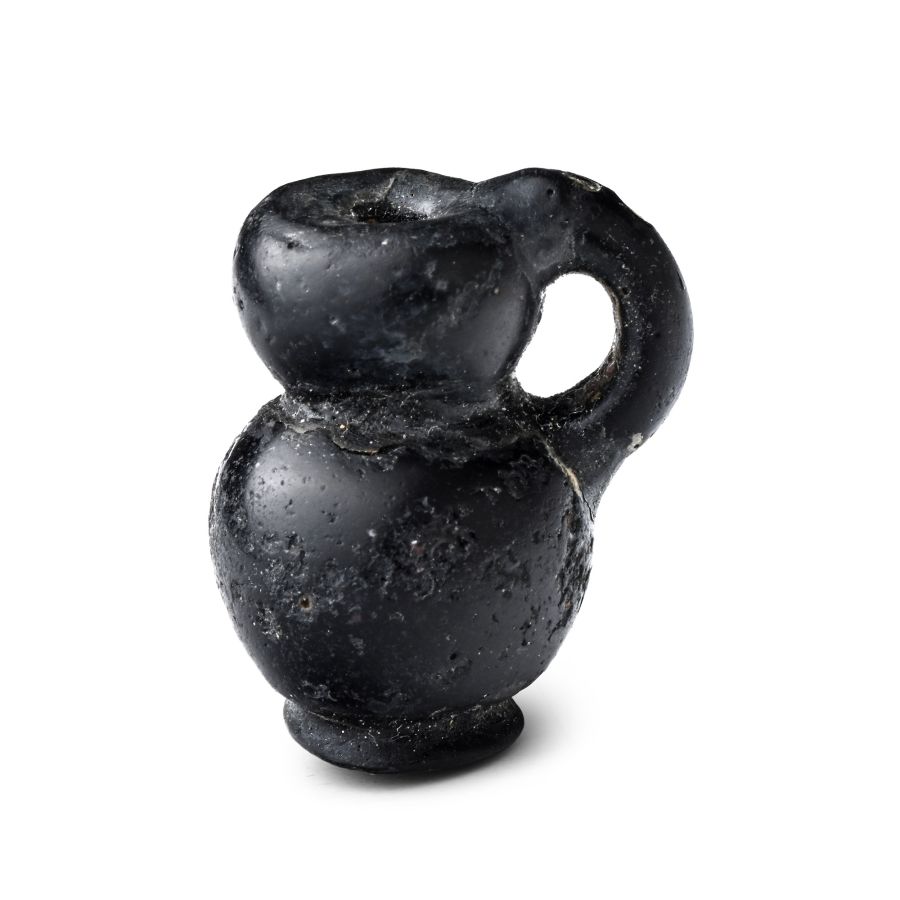
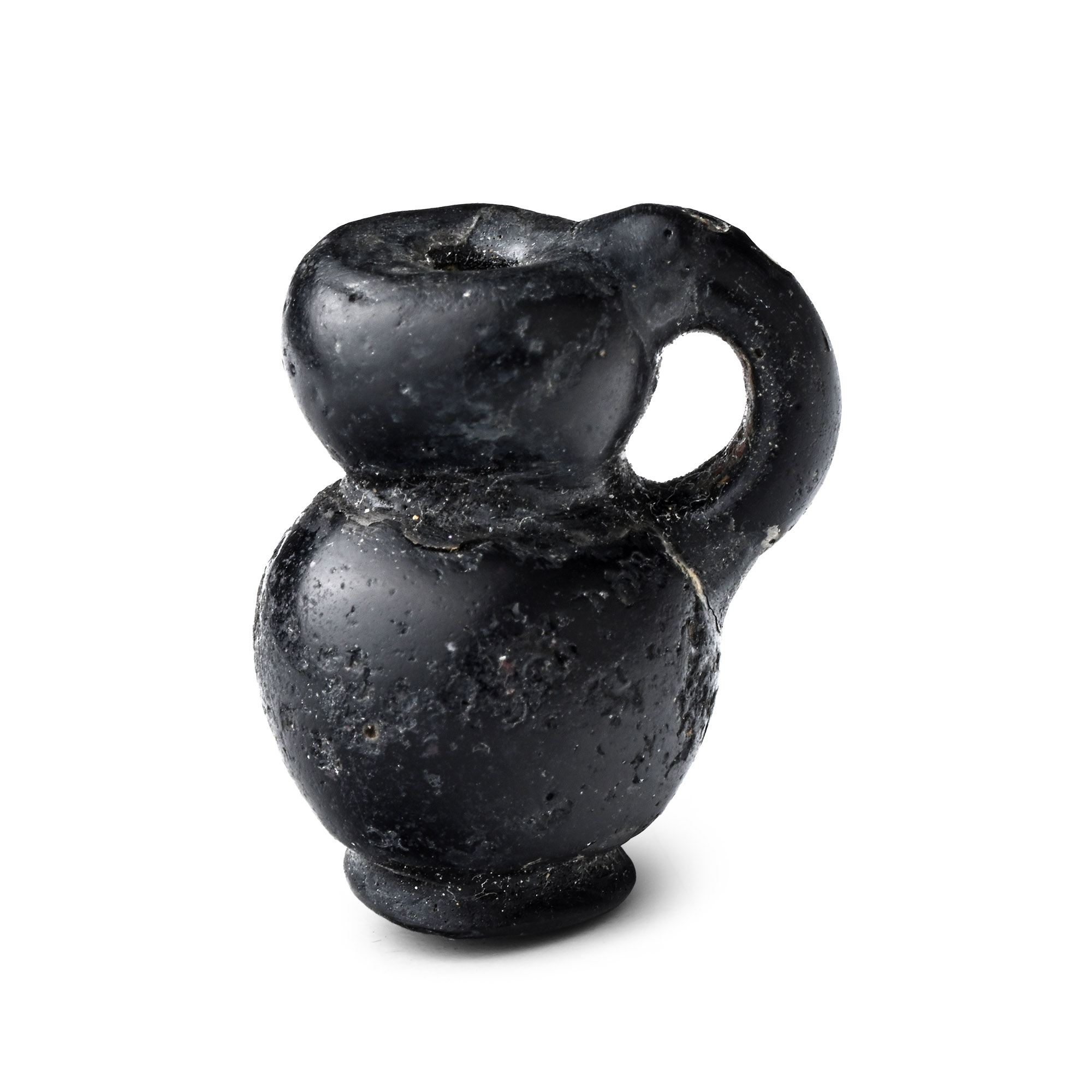
Roman Black Glass Juglet Pendant
1ST-4TH CENTURY A.D.
7/8 in. (5.56 grams, 21 mm).
Modelled as a miniature juglet with a bulbous body and a strap handle, pierced longitudinally.
ProvenanceEx the private collection of the late Mr S.M., London, UK, 1970s-2000s.
Accompanied by a previously illustrated catalogue card with provenance.
TimeLine Auctions follows a vetting process to ensure the authenticity and legality of all items, reinforcing our commitment to integrity and responsible trading. Each antiquity, antique, and coin lot undergoes thorough examination by a vetting committee of at least ten external specialists, professional trade association members, scientists, and archaeologists: Our Vetting Process
AUCTIONS:
TimeLine is a leading auction house specialising in antiquities, ancient art, collectables, natural history, coins, medals, and books. Our auctions offer museums, collectors, historians, and enthusiasts the opportunity to acquire unique and historically significant pieces.
LOT 0677
Roman Black Glass Juglet Pendant
Estimate £100 - 140€120 - 160 (for guidance only)$140 - 190 (for guidance only)
-
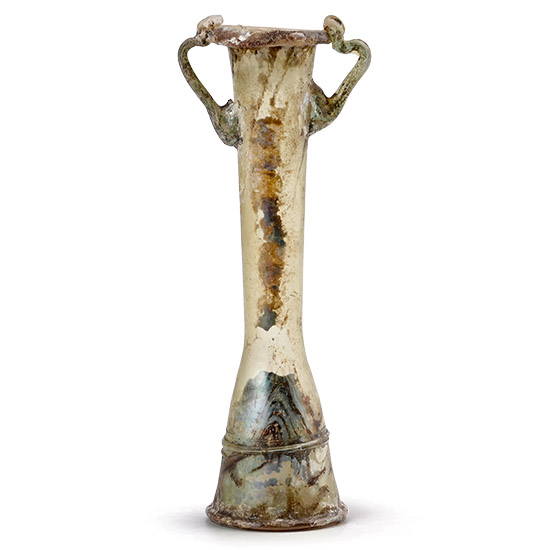
Roman Green Glass Twin-Handled Kohl Bottle
Circa 4th-5th century A.D.Sold for (Inc. bp): £325
Conical body with applied trail, tall tubular neck with rolled rim and two applied handles. 25 grams, 12.2 cm
Acquired from Shirley Warren Antique Glass, Surrey, UK, in 1992 with reference no.K30. From the collection of a Bedfordshire, UK, lady. Accompanied by a copy of the Shirley Warren invoice no.2272 dated 21 November 1992 (£330.00). -
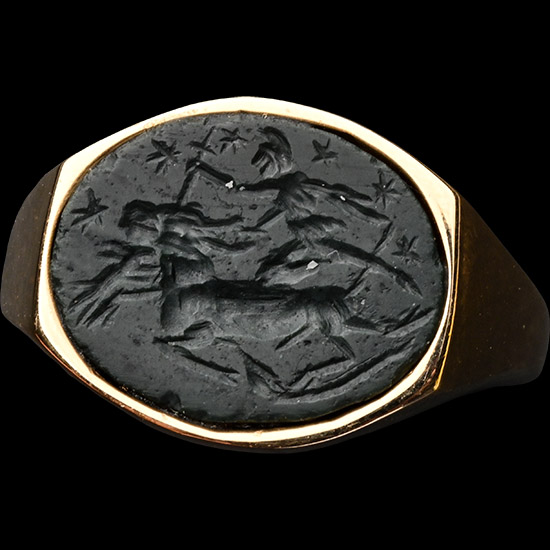
Roman Jasper Gemstone with Mithraic Tauroctony in Gold Ring
3rd century A.D.Sold for (Inc. bp): £3,900
An oval intaglio depicting Mithras, a snake and a dog killing a bull, six stars on the field; set in a later gold ring; supplied with a museum-quality impression. 9.93 grams, 23.61 mm overall, 18.88 mm internal diameter (approximate size British R 1/2, USA 8 3/4, Europe 19.38, Japan 18)
English private collection. Reportedly acquired several decades ago in Covent Garden, London, still mounted in its original, heavily corroded iron ring; removed from this setting and remounted in a gold ring in recent years by the owner, a commercial airline pilot. This lot has been checked against the Interpol Database of stolen works of art and is accompanied by search certificate number no.13325-28218.
The interpretation of the Mithraic tauroctony has long been the subject of scholarly debate. The Belgian historian of religions and orientalist Franz Cumont (1868–1947) was the first to propose that the scene should be understood as an astral allegory rather than a purely mythological episode. More recently, David Ulansey developed this hypothesis by interpreting the tauroctony as a symbolic representation of the precession of the equinoxes. In his reading, Mithras—identified with the constellation Perseus—embodies the supreme cosmic power capable of moving the sphere of the fixed stars, while the slaying of the bull symbolises the transition from one cosmic age to another, expressing Mithras' dominion over the celestial order itself. -
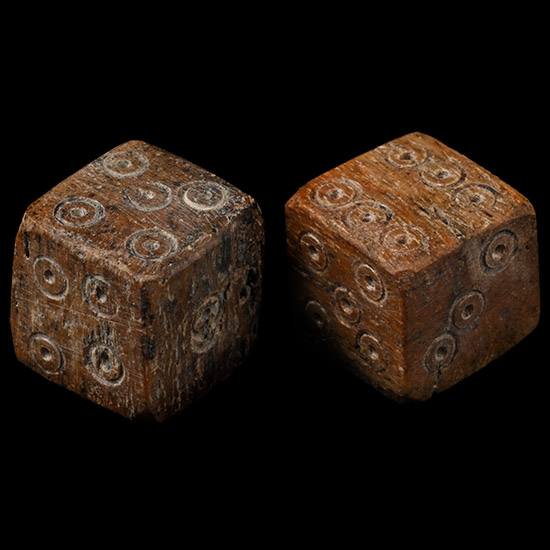
Roman Bone Gaming Dice Pair
Circa 1st-4th century A.D.Sold for (Inc. bp): £247
Pair of cuboid dice with ring-and-dot markings disposed 1:6, 2:5, 3:4. 4.2 grams total, 10 mm each
Ex Cambridgeshire, UK, collection, 1990s.
