
Loading, please wait...
_900x900.jpg "Roman Banded Glass Pyxis")
_200x200.jpg "Roman Banded Glass Pyxis")
.jpg "Roman Banded Glass Pyxis")
LOT 0888
Roman Banded Glass Pyxis
1ST CENTURY A.D.
2 3/8 in. (87 grams, 60 mm).
Drum-shaped in profile with stepped rim; repaired.
ProvenanceAcquired in the late 1980s.
Private collection, thence by descent.
Private collection, since the late 1990s.
TimeLine Auctions follows a vetting process to ensure the authenticity and legality of all items, reinforcing our commitment to integrity and responsible trading. Each antiquity, antique, and coin lot undergoes thorough examination by a vetting committee of at least ten external specialists, professional trade association members, scientists, and archaeologists: Our Vetting Process
AUCTIONS:
TimeLine is a leading auction house specialising in antiquities, ancient art, collectables, natural history, coins, medals, and books. Our auctions offer museums, collectors, historians, and enthusiasts the opportunity to acquire unique and historically significant pieces.
LOT 0888
Roman Banded Glass Pyxis
Estimate £350 - 450€410 - 520 (for guidance only)$470 - 610 (for guidance only)
-
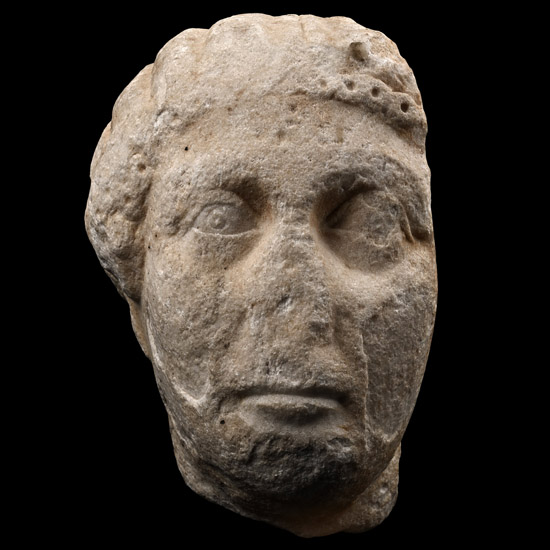
Roman Marble Head of a Woman
3rd-4th century A.D.Estimate: £5,000 - 7,000 (+bp*)
Opening Bid: £2,400
Carved in three-quarter view, with hair dressed in a chignon with frontal band and wavy segments; soft facial features with much detailing remaining to the proper right eye and mouth; likely a frieze fragment; mounted on an old collector's display stand with typed label 'Marble, woman's head / Egypt / C.25-100 A.D. / Cat.No. 6169'. 8.45 kg, 39 cm high
Acquired in trade from the San Franciscanum Museum, Israel, prior to 1980. with Archaeologia, pre 1983, Switzerland and Canada. Accompanied by an academic report by Dr Raffaele D’Amato. This lot has been checked against the Interpol Database of stolen works of art and is accompanied by search certificate number no.12964-242755.
The arrangement of the hair is characteristic of female portraits dating between the late Severan and Tetrarchic periods. The head, due to the treatment of the hair, finds comparisons with a female portrait in the Museo Nazionale Romano, depicting an elderly woman of the Antonine era, and with another female portrait in the same museum, dated to the third decade of the 3rd century A.D., reworked in the Tetrarchic period, and which showed a Severan so-called Nest Frisur hairstyle. The sculpture in question can therefore be dated between the full 3rd century A.D. and the first decades of the 4th century A.D. based on the hairstyle, the shape of eyes and eyebrows. -
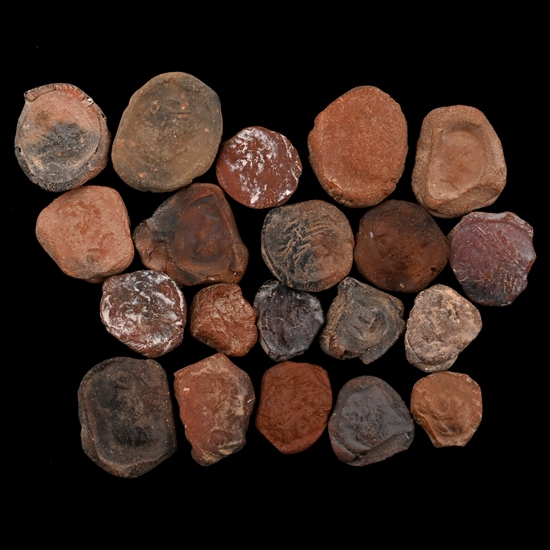
Roman Terracotta Bullae, Tesserae or Token Group
3rd century B.C.-1st century A.D.Sold for (Inc. bp): £72
A mixed group of ceramic bullae, tesserae or theatre tokens bearing low-relief motifs, mainly consisting of profile busts of deities. 31 grams total, 14-23 mm
From the private collection of a European gentleman (1942-2024), formed since the 1970s.
The term 'tessera' was used in Roman times to convey the Greek term σύμβολον (token). Small tiles are known as tokens, often shaped like coins, made of metal (copper, lead, iron), clay, bone, wood, or glass, stamped as well as engraved. The tokens, however, are not exclusively coin-shaped, as the Latin term 'tessera' suggests by etymologically referring to a square or at least a four-sided shape and confirmed in several cases by material remains of the past. Tokens and tesserae seem to have been used both in Athens and Rome for the distribution of goods. According to written sources, the term token is identified with credentials of the official authorities. They have also been interpreted as tokens of identity, as entrance tickets to theatre performances, tribunals or assemblies of citizens, archival material of seal engraving, as pawns in games, Charon’s obols and even as amulets. -
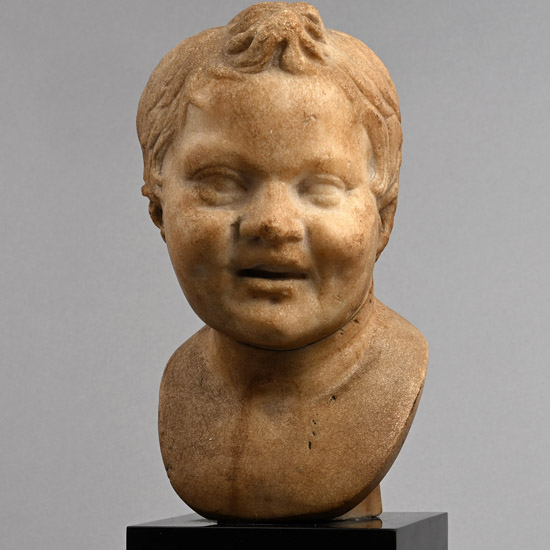
Roman Marble Head of Cupid on Georgian Pedestal
1st-2nd century A.D.Estimate: £18,000 - 24,000 (‡+bp*)
Opening Bid: £9,000
Carved in the round as a bust of a child with short hair combed into a peak, fleshy features, lips slightly parted in a smile, fitted to an 18th century marble pedestal; mounted on a display stand with collection note 'Buste d'Enfant / Epoque Romaine / 1er Siècle'. 6.12 kg total, 30 cm including stand
Collection of B. Poindessault (1935-2014), France, acquired before October 1975. Oger & Blanchet Enchères, Paris, 2014. German private collection, Cologne. Private collection, acquired in 2015. Accompanied by an academic report by Dr Marina Mattei. Accompanied by a copy of an Art Loss Register certificate, no.S000104583. Accompanied by a copy of French passport no.167453. This lot has been checked against the Interpol Database of stolen works of art and is accompanied by search certificate number no.12931-246329.
The finely sculpted head represents a young child, probably intended as Eros (Cupid). Such depictions were produced in numerous variations to illustrate the stages of childhood and the capacity of children to undertake meaningful or symbolic actions. The softly modelled features and gentle expression recall the celebrated work of Boethos, The Boy Strangling the Goose, as well as the widespread images of Eros and the Erotes found throughout Graeco-Roman sculpture and painting. In Graeco-Roman art, representations of children occupied an important and evolving role. Initially, youthful figures were portrayed as miniature adults, but from the 4th century BC onwards - particularly during the Hellenistic and Roman periods - artists began to study children’s anatomy more closely, reproducing their characteristic proportions and expressions with naturalistic sensitivity. The figure of Eros, the constant companion of Aphrodite, became the quintessential model of the child in ancient art, identifiable by his traditional attributes of wings and bow. As evidenced by numerous statuettes and wall paintings unearthed at Pompeii, scenes of childhood were among the most popular subjects for adorning the gardens and interiors of wealthy Roman villas. These figures appear in lively and varied activities - playing, working, performing, or interacting with animals such as birds, hares, and dolphins - celebrating both the charm and vitality of early life within an idealised artistic vision.
