
Loading, please wait...
_900x900.jpg "Roman Banded Agate Lion Attack Gemstone")
_200x200.jpg "Roman Banded Agate Lion Attack Gemstone")
.jpg "Roman Banded Agate Lion Attack Gemstone")
LOT 0196
Roman Banded Agate Lion Attack Gemstone
CIRCA 2ND CENTURY A.D.
1/2 in. (1.55 grams, 14 mm).
With intaglio scene of a lion attacking an ibex; supplied with a museum-quality impression.
ProvenanceFrom the collection of a Swiss gentleman formed in Europe from 1970-1980s; thence by descent from the family in London.
CONDITIONTimeLine Auctions follows a vetting process to ensure the authenticity and legality of all items, reinforcing our commitment to integrity and responsible trading. Each antiquity, antique, and coin lot undergoes thorough examination by a vetting committee of at least ten external specialists, professional trade association members, scientists, and archaeologists: Our Vetting Process
AUCTIONS:
TimeLine is a leading auction house specialising in antiquities, ancient art, collectables, natural history, coins, medals, and books. Our auctions offer museums, collectors, historians, and enthusiasts the opportunity to acquire unique and historically significant pieces.
LOT 0196
Roman Banded Agate Lion Attack Gemstone
Estimate £200 - 300€230 - 350 (for guidance only)$270 - 410 (for guidance only)
-
.jpg)
Agate Gemstone with Galley
Roman, circa 1st century B.C. or laterSold for (Inc. bp): £910
With intaglio warship with oars extended, hero on deck with crested helmet, spear and shield, perhaps Ulysses; supplied with a museum-quality impression. 0.84 grams, 14 mm
From the collection of a Swiss gentleman formed in Europe from 1970-1980s; thence by descent from the family in London. -
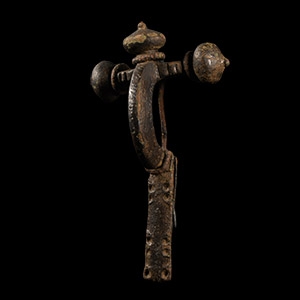
Roman 'Midlands' Bronze Decorated Crossbow Brooch
4th-5th century A.D.Sold for (Inc. bp): £169
With onion-knop terminals, carinated bow with linear decoration and a separate collar to the base of the bow; wide footplate with pellet decoration; catch-plate and repaired pin to the reverse. 78.6 grams, 92 mm
Found UK. Acquired from Stonegate Antiques, York, 2008. Property of a Nottinghamshire gentleman. -
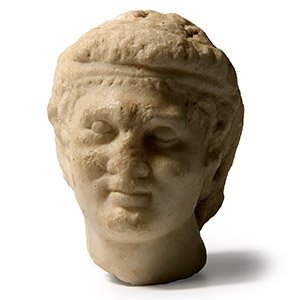
Roman Marble Head of a Satyr
1st-3rd century A.D.Sold for (Inc. bp): £3,380
Of Praxitelic type with fillet to the brow, tousled hair and rounded facial features with stern expression. 519 grams, 88 mm
Acquired early 1990s. Ex private American collection; thence by descent. Private Swiss collection since 1998. This lot has been checked against the Interpol Database of stolen works of art and is accompanied by search certificate no.11632-199025.
The head appears to be a copy of the Praxitelian type known as 'the Pouring Satyr'. The head, realised with sensitivity, but technically and stylistically academic, could be dated to the first half of the 2nd century A.D.
