
Loading, please wait...
LOT 0663
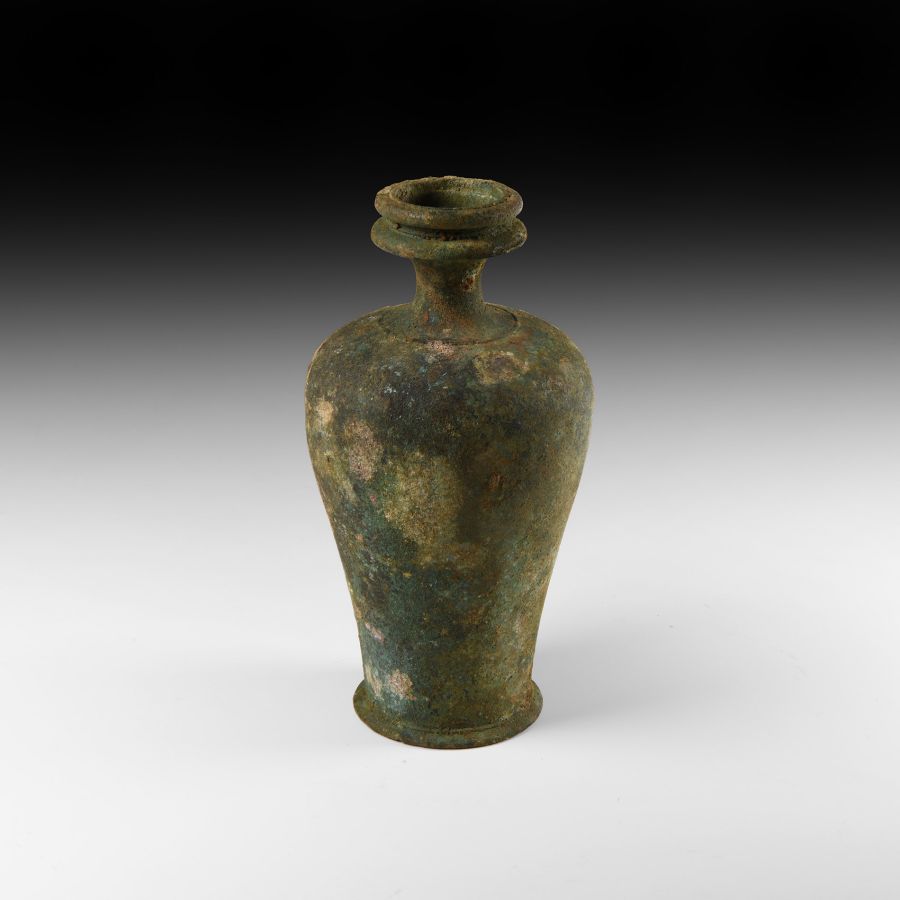
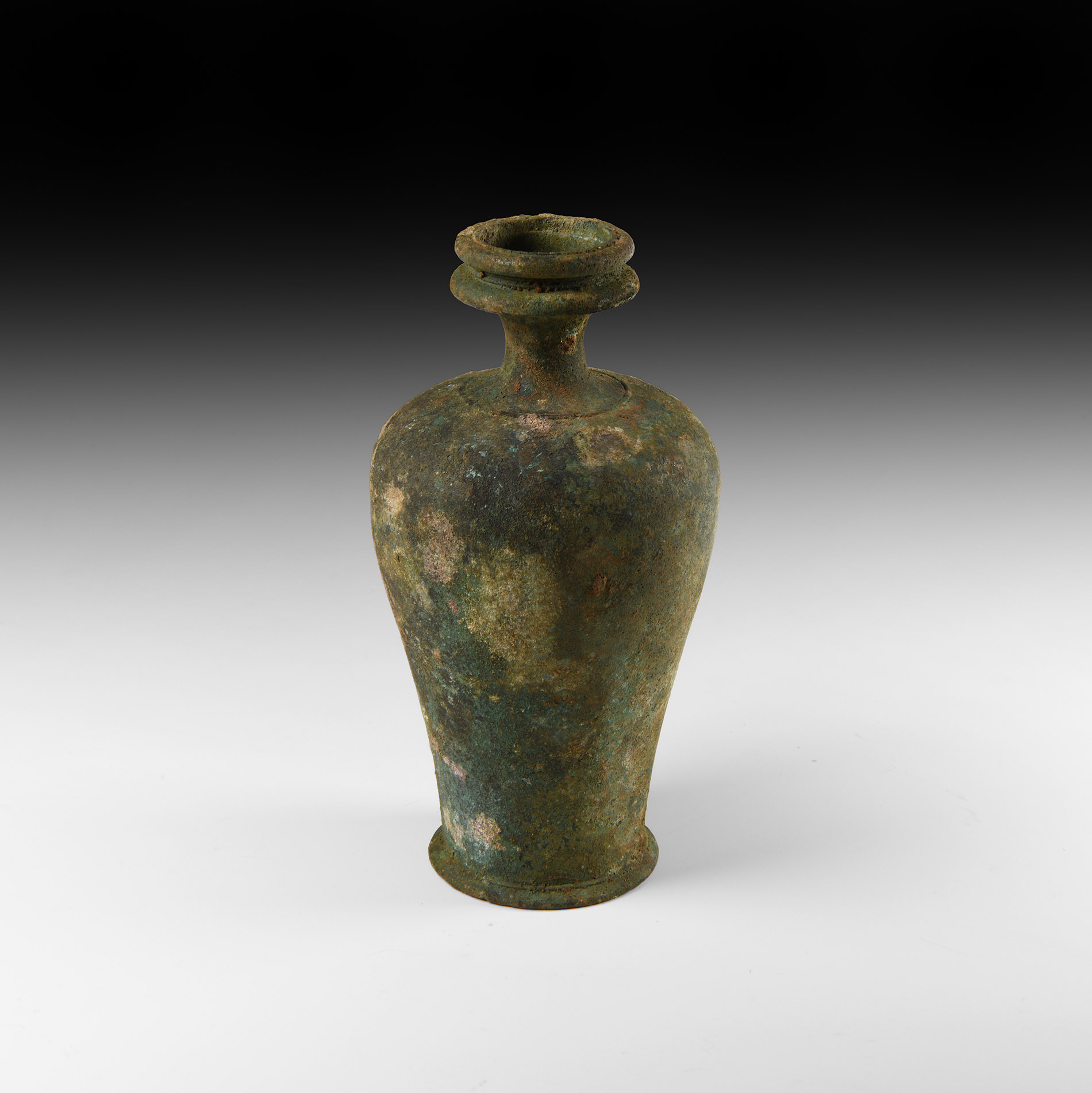
Roman Balsamarium with Spool-Type Mouth
1ST-2ND CENTURY A.D.
4 3/4 in. (207 grams, 12 cm high).
A piriform bronze balsamarium with a broad rounded shoulder, slender waisted neck and squat, spool-type mouth.
ProvenanceFrom the collection of the late Dr D.G., Surrey, UK.
LiteratureCf. Marin, E., Longae Salonae, Split, 1994, no.2, p.154, volume II, for a similar balsamarium.
FootnotesSuch vessels, with their high-bellied body, are similar to examples from Palestine, Pompeii, Phocis, Brigetio and Salona. They are not fitted with handles, meaning that they were not part of a portable set.
CONDITIONTimeLine Auctions follows a vetting process to ensure the authenticity and legality of all items, reinforcing our commitment to integrity and responsible trading. Each antiquity, antique, and coin lot undergoes thorough examination by a vetting committee of at least ten external specialists, professional trade association members, scientists, and archaeologists: Our Vetting Process
AUCTIONS:
TimeLine is a leading auction house specialising in antiquities, ancient art, collectables, natural history, coins, medals, and books. Our auctions offer museums, collectors, historians, and enthusiasts the opportunity to acquire unique and historically significant pieces.
-
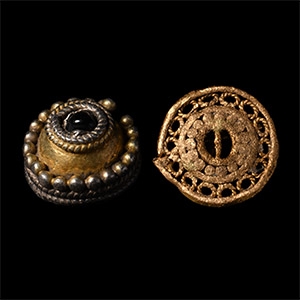
Roman and Other Artefact Group
Circa 2nd-3rd century A.D. and laterSold for (Inc. bp): £78
A pair of decorative artefacts comprising: a gold flat-section openwork disc with filigree annulets and pellets; a domed silver-gilt 'stud' with striptwist borders and pellet granules, set with a possible garnet stone at the apex. 4.37 grams total, 14 mm each
Essex gallery, early 2000s. -
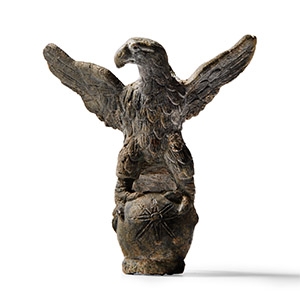
Roman Military Eagle Staff Terminal
2nd-3rd century A.D.Sold for (Inc. bp): £11,050
A free-standing bronze imperial or military eagle terminal from a staff or a sceptre, modelled in the round in a dynamic pose standing on a globe, wings spread, head turned to the right, semi-naturalistic anatomical and feather detailing; the globe bearing an incised eight-armed stylised Macedonian star; sub-triangular lug to back of the neck; collar to globe with hollow underside. 166 grams, 88 mm high
with Bonham's, London, Knightsbridge, UK, 16 May 2002, lot 301. Accompanied by a copy of the relevant Bonhams catalogue pages. Accompanied by an academic report by Dr Raffaele D'Amato. This lot has been checked against the Interpol Database of stolen works of art and is accompanied by search certificate number no.11582-198947
In the Roman world, the eagle was associated with the god Jupiter or Zeus, king of the Olympian gods, and was seen as ‘the symbol and agent of apotheosis after death’. An eagle was released from the top of an emperor’s funeral pyre to signal the journey of the soul towards heaven. A sacred attribute of Jupiter, this eagle terminal may have been attached to a sceptre of the statue of the god. Eagles were also the principal standard of the legions, and became the military symbol for excellence. -
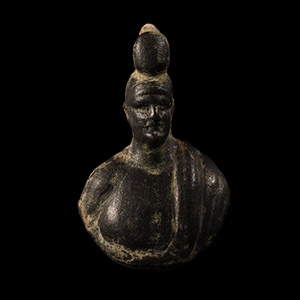
Roman Mount with Flavian Emperor
Late 1st century A.D.Estimate: £300 - 400 (+bp*)
Opening Bid: £150
A copper-alloy appliqué protome in the form of the Flavian Emperor Vespasian, frontal bust in half relief, wearing an exomis leaving his right shoulder uncovered, solid suspension ring to the top of the head. 52.3 grams, 60 mm
Acquired 1969-1999. London collection of the late Mr S.M., thence by descent.
The realism in the details is remarkable and was achieved through fine modelling. This protome was perhaps set in a medallion to decorate the lower terminal of a fulcrum, an S-shaped couch attachment almost always made of metal which was fastened to the side of a wooden headboard to serve as an elbow-rest on a couch (kline).
