
Loading, please wait...
LOT 0769
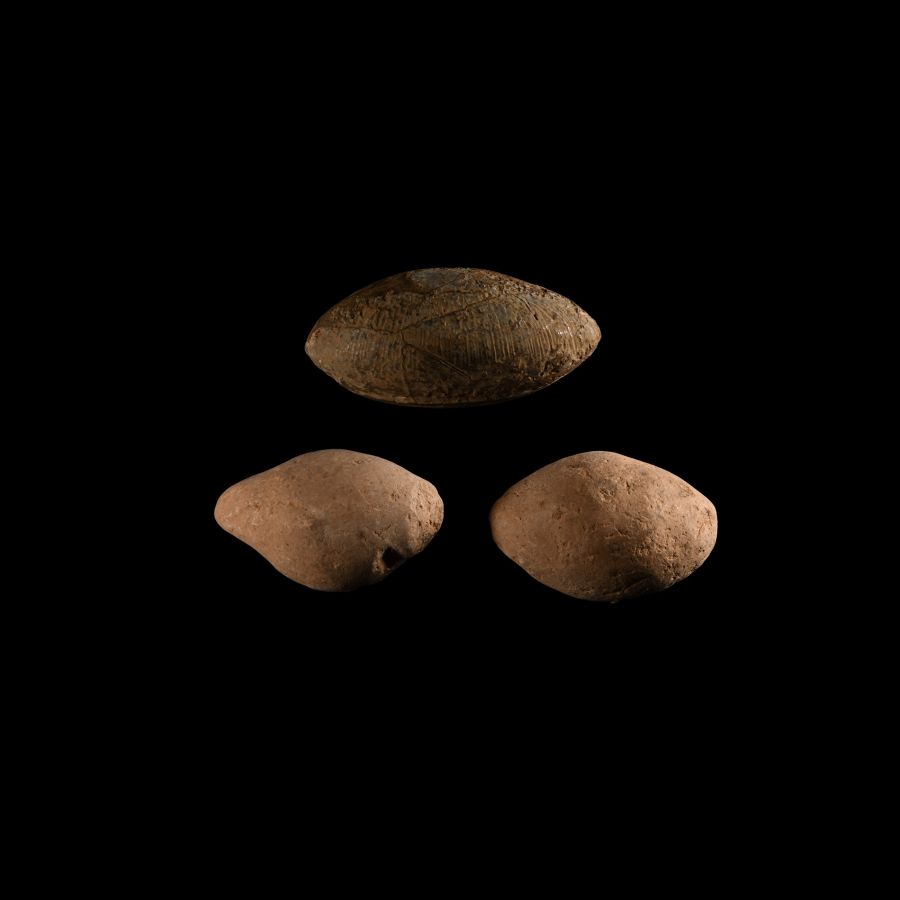
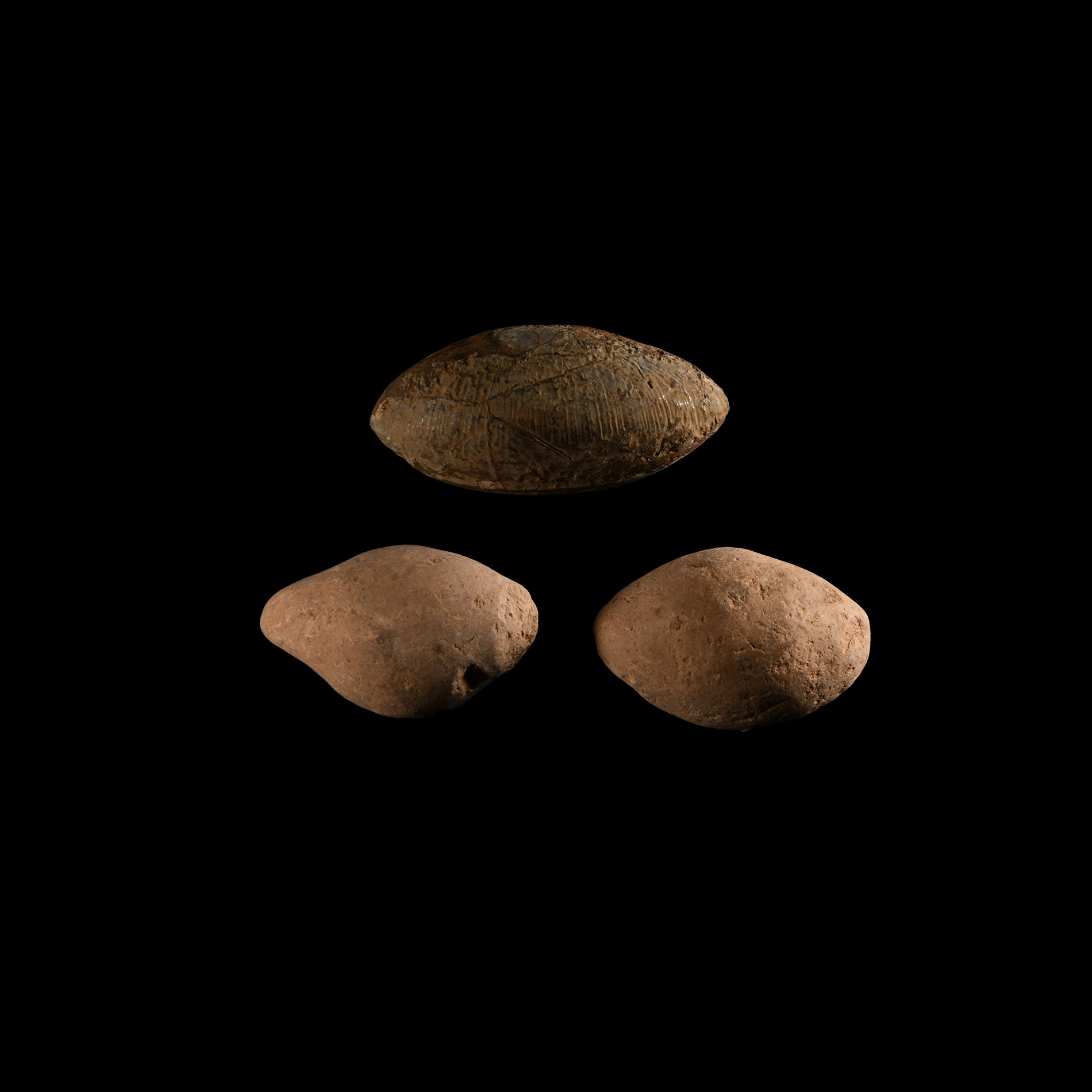
Roman Baked Clay Slingshot Group
1ST CENTURY A.D.
2 - 2 1/2 in. (167 grams total, 50-65 mm).
Comprising three lentoid-section glandes. [3, No Reserve]
ProvenanceEx Simmons Gallery, London E11, UK, in the 1990s.
From a North London collection.
Cf. Marchant, D.J., Roman weaponry in the province of Britain from the second century to the fifth century AD, Durham, 1991, fig.26, for similar.
FootnotesThe trio finds parallels with examples unearthed at Ham Hill, Somerset, UK. The sling (funda) with its lead missiles (plumbea pondera) was used by special funditores, illustrated on Trajan’s Column where they are simply dressed in broad tunics with no armour, but carry a shield. Their cloak, or sagulum acted as an ammunition bag. The effectiveness of the slingers was unquestionable and much appreciated, especially against elephants. Celsus, writing towards the end of the 2nd century A.D., described how a slingshot wound was more dangerous and harder to treat than one inflicted by an arrow.
CONDITIONTimeLine Auctions follows a vetting process to ensure the authenticity and legality of all items, reinforcing our commitment to integrity and responsible trading. Each antiquity, antique, and coin lot undergoes thorough examination by a vetting committee of at least ten external specialists, professional trade association members, scientists, and archaeologists: Our Vetting Process
AUCTIONS:
TimeLine is a leading auction house specialising in antiquities, ancient art, collectables, natural history, coins, medals, and books. Our auctions offer museums, collectors, historians, and enthusiasts the opportunity to acquire unique and historically significant pieces.
-
Roman Glass Flask
3rd-4th century A.D.Estimate: £200 - 300 (+bp*)
Opening Bid: £110
Of fusiform type with a rolled lip and thick rounded bottom. 30 grams, 26.5 cm high
Acquired 1980-2015. Ex Abelita family collection. -
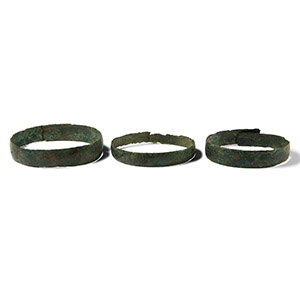
Roman Bronze Bracelet Group
1st-4th century A.D.Sold for (Inc. bp): £78
Comprising three flat-section bracelets with overlapping rounded terminals. 41 grams total, 61-68 mm
From the family collection of a Surrey gentleman since before 1960.
Bracelets were worn in Rome by ladies of rank, but it was considered a mark of effeminacy for civilian men to use such female ornaments (Suetonius, Caligula, 52; Nero, 30). The armillae (or psellia in Greek) were rings and bracelets worn by women in the Graeco-Roman world on both legs and arms. Homer mentions them (elikas) as being part of the hairstyle of the divine Aphrodite, thus giving an almost sacred character to these objects. There were different types, the most common consisting of a more or less thick metal wire, or a flat or cylindrical circle, like our examples. -
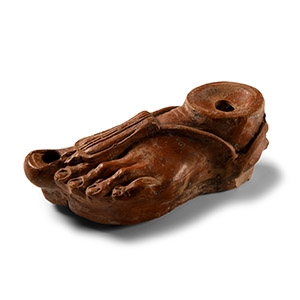
Roman Terracotta Foot Lamp
2nd century A.D.Sold for (Inc. bp): £3,380
Mould-made and shaped as a sandaled left foot, filling-hole surrounded by a ridge in the ankle area, the sandal with two leather straps tied together near the ankle, wick-hole in the big toe; inscription 'ƩΑΛΣΙϹ' to the base, heel chipped. 112 grams, 12.2 cm
With Gorny & Mosch, Auction 194, 14 December 2010, lot 505. This lot has been checked against the Interpol Database of stolen works of art and is accompanied by search certificate number no.11799-206830.
This lamp belongs to a type of plastic lamp made in Anatolia and widespread throughout the Eastern Empire. The sandaled foot was part of the classification of plastic lamps dedicated to the representation of the human body. These lamps were the luxuries of the poor, being brought to temples as votive offerings, however some took their place in the domestic lararia, or were kept by children as playthings.
