
Loading, please wait...
LOT 0636
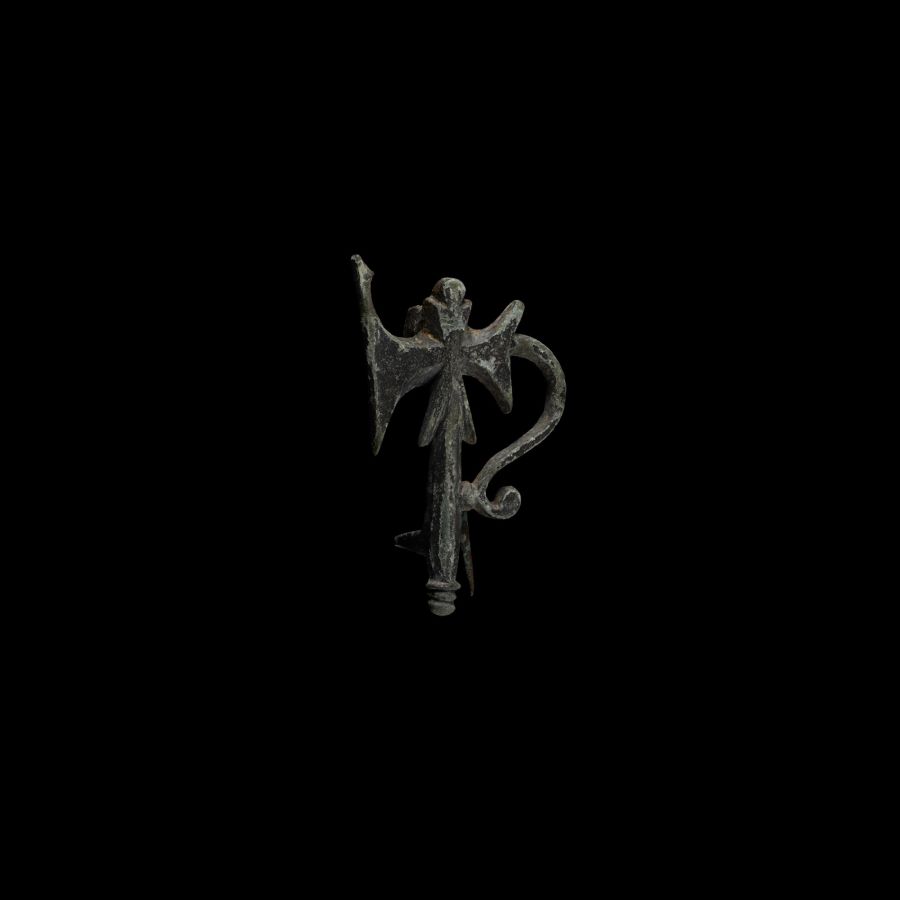
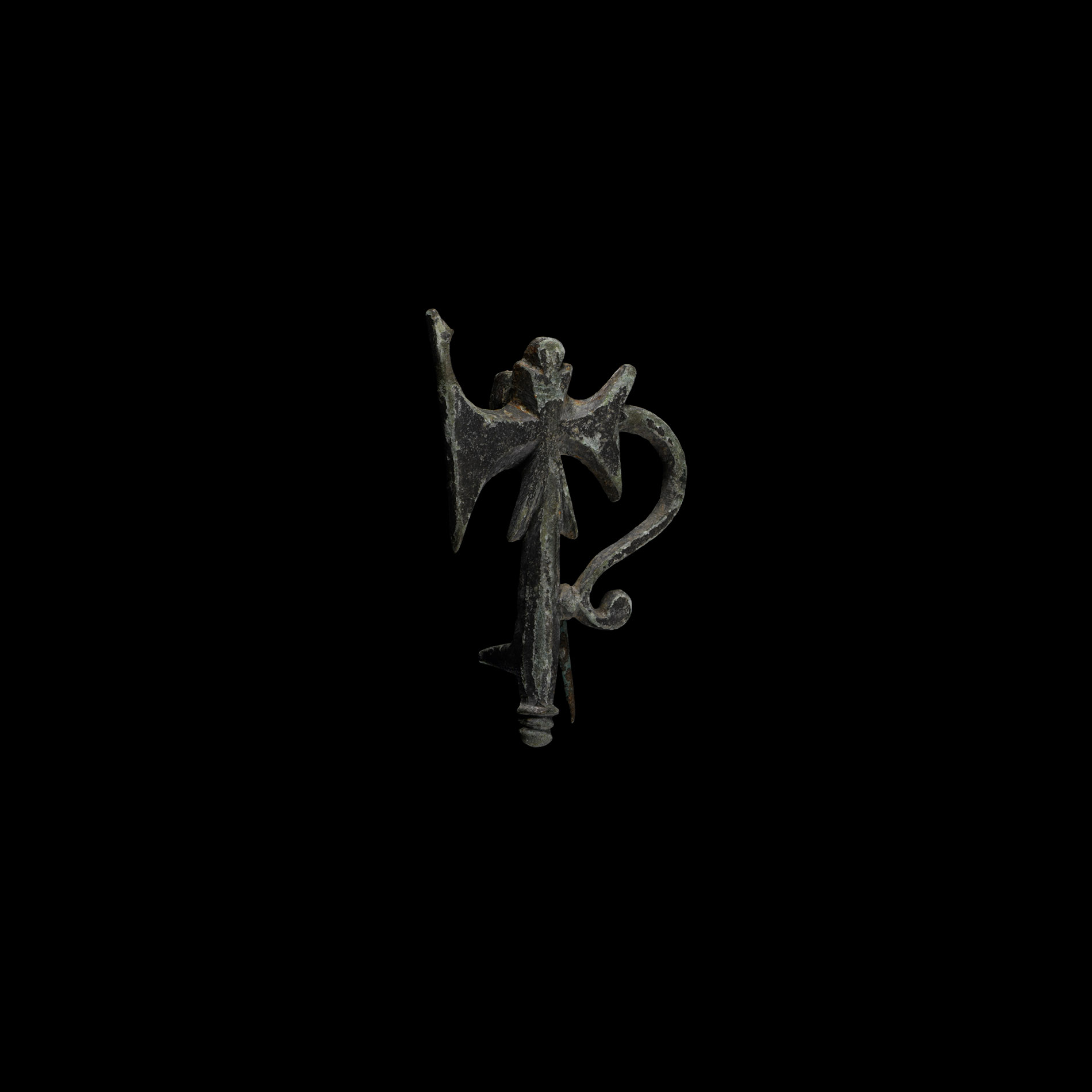
Roman Axe Plate Brooch
2ND-3RD CENTURY A.D.
1 7/8 in. (13.6 grams, 47 mm).
A bronze plate brooch formed as an axe, scrolled tendrils to socket and butt, slender handle; hinged pin and catch to the reverse.
ProvenanceAcquired before 2000.
From the collection of a European gentleman living in the UK.
Cf. Melchart, W., Antike Kostbarkeiten aus Osterreichischem privatbesitz, Wien, 1997, fig.22, for a very similar specimen.
FootnotesThe fibula, made for a military cloak, belongs to the type 28 of Jobst classification. Similar fibulae were widespread in the central part of the Limes between Germania Superior and Raetia.
CONDITIONTimeLine Auctions follows a vetting process to ensure the authenticity and legality of all items, reinforcing our commitment to integrity and responsible trading. Each antiquity, antique, and coin lot undergoes thorough examination by a vetting committee of at least ten external specialists, professional trade association members, scientists, and archaeologists: Our Vetting Process
AUCTIONS:
TimeLine is a leading auction house specialising in antiquities, ancient art, collectables, natural history, coins, medals, and books. Our auctions offer museums, collectors, historians, and enthusiasts the opportunity to acquire unique and historically significant pieces.
-
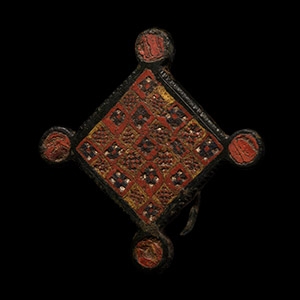
Roman Red Millefiori Plate Brooch
2nd-3rd century A.D.Sold for (Inc. bp): £715
A lozengiform plate brooch with sub-circular lugs to each corner and shallow decorative notching along each straight edge, the lugs with a red enamel fill, the centre displaying a millefiori panel composed of square tiles alternating between red squares within a yellow border and a dark blue cross with red centre in a red border; pin lug, pin and catchplate to reverse. 9.52 grams, 27 mm
Ex European collection. Acquired in the mid 1990s. Property of a Harrow, UK, gentleman. -
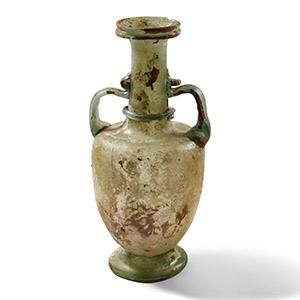
Large Roman Glass Amphora
1st-3rd century A.D.Estimate: £1,500 - 2,000 (+bp*)
Opening Bid: £750
An aqua-coloured glass amphora with broad rounded shoulder, cylindrical neck, gusseted rim, applied scrolling handles and applied trail to lower neck, ogival foot; iridescent surfaces. 228 grams, 20 cm high
French collection, 1960s-early 2000s. From an important Paris gallery, France. -
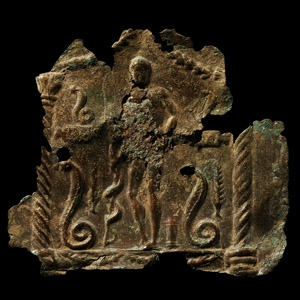
Roman Votive Plaque with Asclepius
2nd-3rd century A.D.Sold for (Inc. bp): £286
A sheet-bronze votive plaque fragment displaying repoussé ornament, likely the god Asclepius holding his snake-entwined staff beneath a columned arch, additional snakes raising their heads and necks beside and above him, other enigmatic symbols in the field. 2.67 grams, 52 mm
Acquired before 2000. From the collection of a European gentleman living in the UK.
Aesculapius, god of medicine, the Greek Asclepius, son of Apollo and a mortal, Coronis, is often accompanied by a snake, a symbol of wisdom and healing power. Aesculapius-Asclepius is also often represented with the staff having a snake wrapped around it.
