
Loading, please wait...
LOT 0737
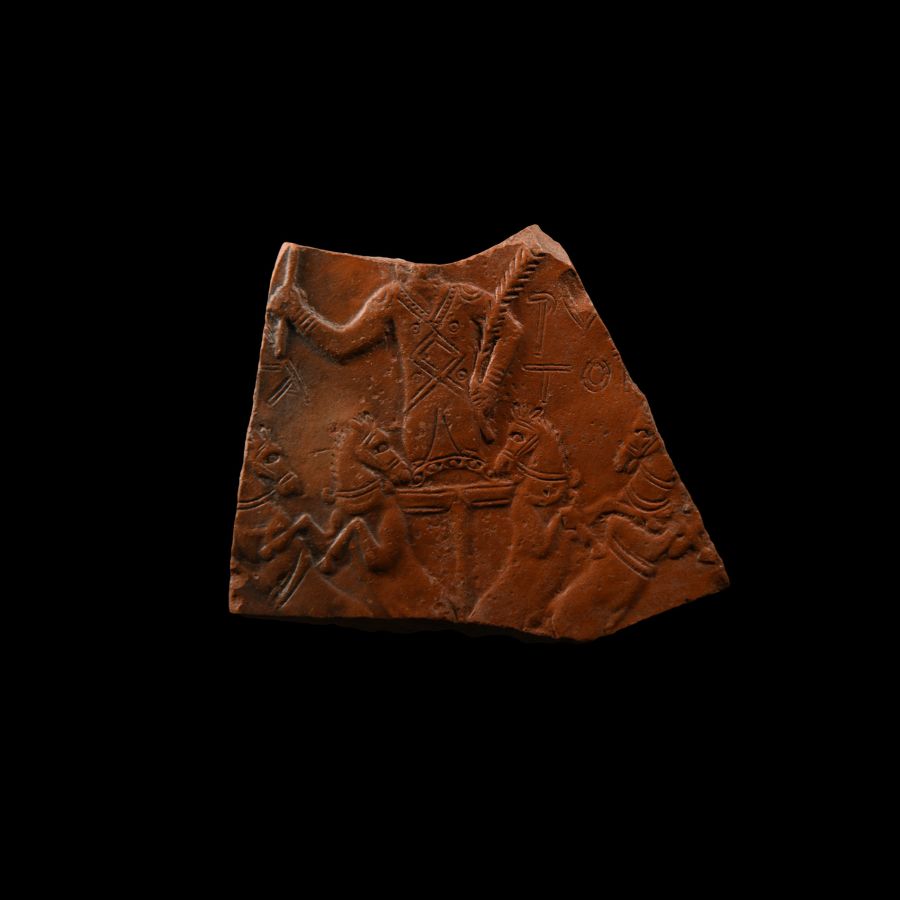
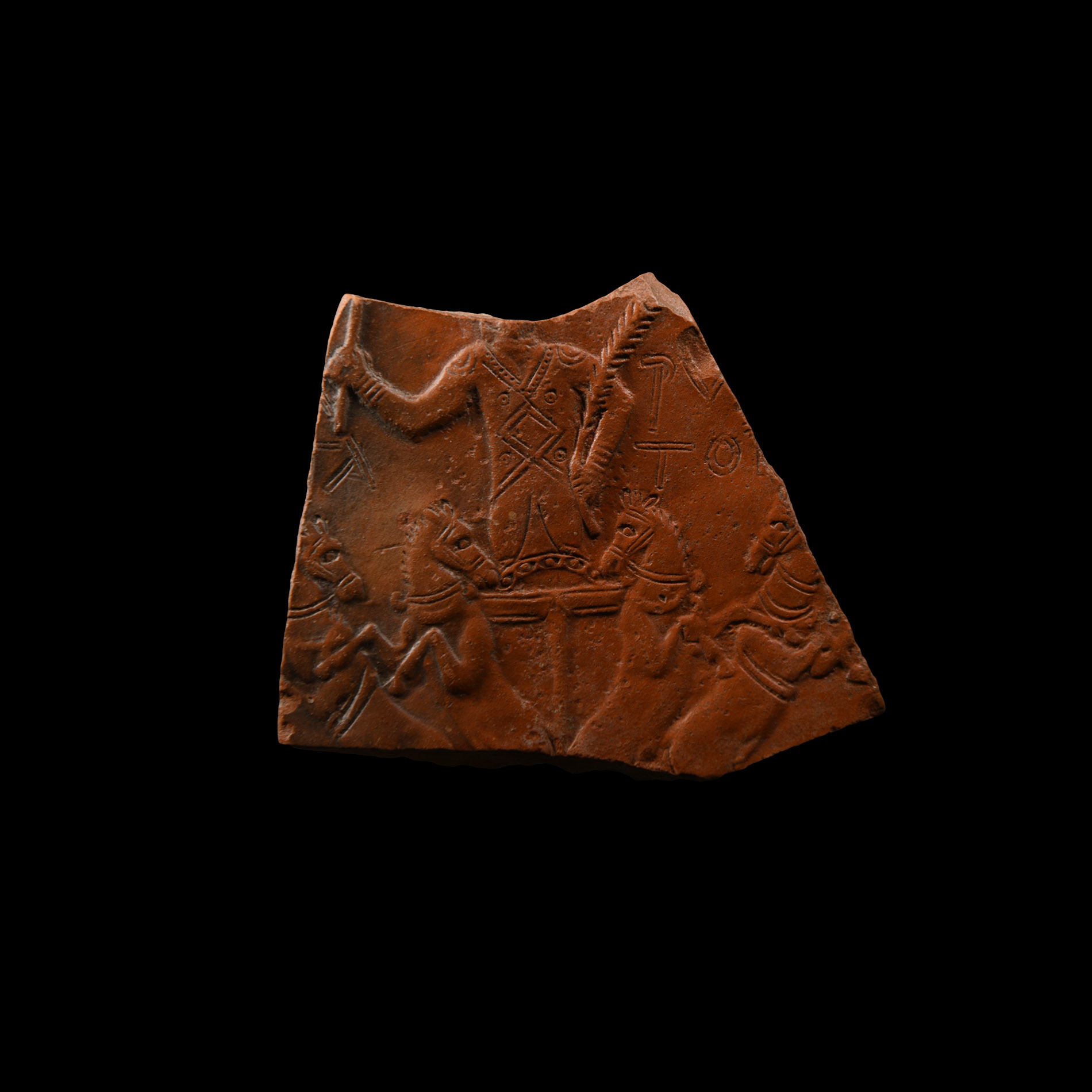
Roman Auriga in Quadriga Redware Sherd
4TH CENTURY A.D.
3 1/2 in. (74 grams, 90 mm).
A redware ceramic fragment with moulded low-relief decoration of a victorious Auriga (chariot-driver) standing in his chariot with four rearing horses yoked to it; geometric detail to his tunic, a frond in his bent left arm and a whip in his raised right hand; incised bilinear lettering '-TA' to the left and 'PV- / TO[V?]-' to the right in Greek letters; modern mounting loop to the reverse. [No Reserve]
ProvenanceAcquired 1960s-1990s.
From the late Alison Barker collection, a retired London barrister.
See Mordtmann, A., 'Das Denkmal des Porphyrius', in Mittheilungen des deutschen archäologischen Institutes, in Athen, vol. V, Athens, 1880, pp.295-308, for a detailed representation of the costume of the Auriga and the position of the victorious chariot driver; Vasiliev, A.A., 'The monument of Porphyrius in the hippodrome at Constantinople' in Dumbarton Oaks Papers Vol. 4, (1948), pp.27-49; for the style of pottery cf. Banck, A., Byzantine Art in the collections of the USSR, Leningrad-Moscow, 1966, fig.23, for a very similar pottery style.
FootnotesThe pottery fragment shows an image of a charioteer in the moment of victory, with his left hand carrying a palm branch. The iconography is visible in the monument of Porphyrios in Constantinople and the charioteers of the Baccano mosaics. The detailed representation of the Auriga shows the attributes of his work: he wears a close-fitting undershirt with sleeves (γυμναστικiον) and an ornamented sleeveless tunic over it, leaving the knees exposed as is typical for charioteers (αυριγαριον).
CONDITIONTimeLine Auctions follows a vetting process to ensure the authenticity and legality of all items, reinforcing our commitment to integrity and responsible trading. Each antiquity, antique, and coin lot undergoes thorough examination by a vetting committee of at least ten external specialists, professional trade association members, scientists, and archaeologists: Our Vetting Process
AUCTIONS:
TimeLine is a leading auction house specialising in antiquities, ancient art, collectables, natural history, coins, medals, and books. Our auctions offer museums, collectors, historians, and enthusiasts the opportunity to acquire unique and historically significant pieces.
-
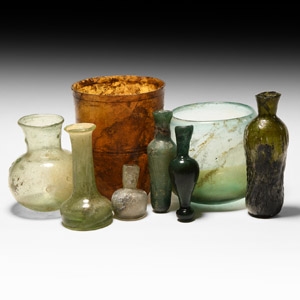
Roman Byzantine and Islamic Glass Vessel Collection
1st century A.D. and laterSold for (Inc. bp): £221
A group of eight glass vessels from the Roman, Byzantine and Islamic civilisations, of various types and dates: a pale green bulbous jar with a flared neck and rim, blobs to the neck and shoulder; a green bottle with waisted cylindrical body and short neck decorated with raised vertical ribs and hatching; a miniature piriform green bottle with globular foot and slightly flared neck; a clear glass miniature bottle of squat form, with a tubular neck and remains of iridescence to the internal surface; a pale green bottle with a squat body, long tubular neck and everted rim; a piriform green bottle with high shoulder and rounded base, tubular neck; a barrel-shaped pale blue vessel with inverted rim; an amber-brown coloured vessel of carinated form, wheel-cit bands to the equator and rim. 387 grams total, 40-97 mm
Acquired 1960s-1990s. From the late Alison Barker collection, a retired London barrister. -
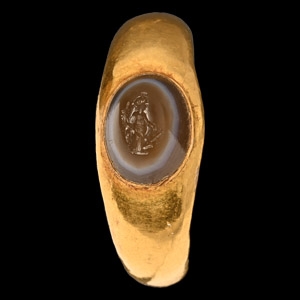
Roman Gold Ring with Fortuna Gemstone
1st-2nd century A.D.Estimate: £2,000 - 3,000 (‡+bp*)
Opening Bid: £1,000
A hollow-formed gold finger ring with inset banded agate cabochon, intaglio standing Fortuna. 2.22 grams, 21.90 mm overall, 15.21 mm internal diameter (approximate size British E 1/2, USA 2 1/2, Europe 3, Japan 3)
Acquired early 1990s. Ex private American collection; thence by descent. Private Swiss collection since 1998. This lot has been checked against the Interpol Database of stolen works of art and is accompanied by search certificate no.11619-199018. -
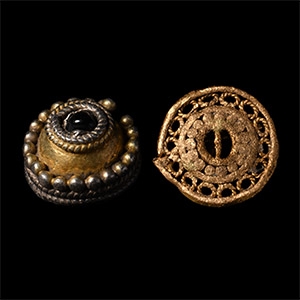
Roman and Other Artefact Group
Circa 2nd-3rd century A.D. and laterSold for (Inc. bp): £78
A pair of decorative artefacts comprising: a gold flat-section openwork disc with filigree annulets and pellets; a domed silver-gilt 'stud' with striptwist borders and pellet granules, set with a possible garnet stone at the apex. 4.37 grams total, 14 mm each
Essex gallery, early 2000s.
