
Loading, please wait...
LOT 0745
Roman Artefact Group
CIRCA 1ST-5TH CENTURY A.D.
1 1/4 - 3 5/8 in. (150 grams total, 33-92 mm).
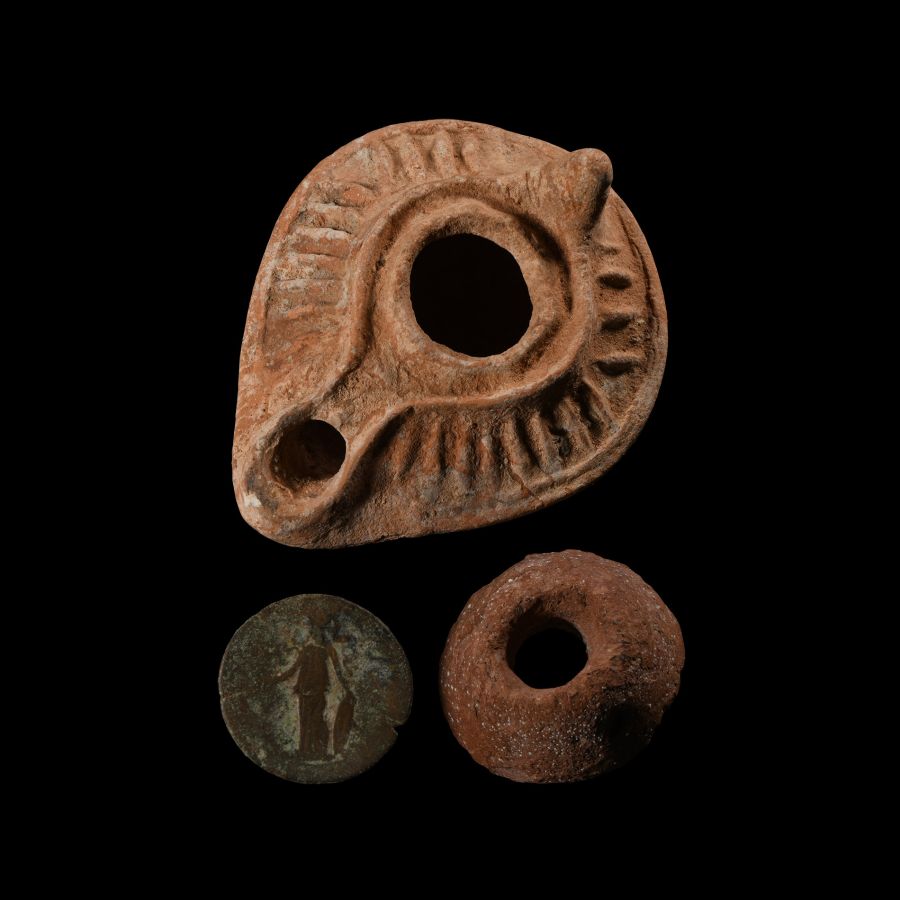
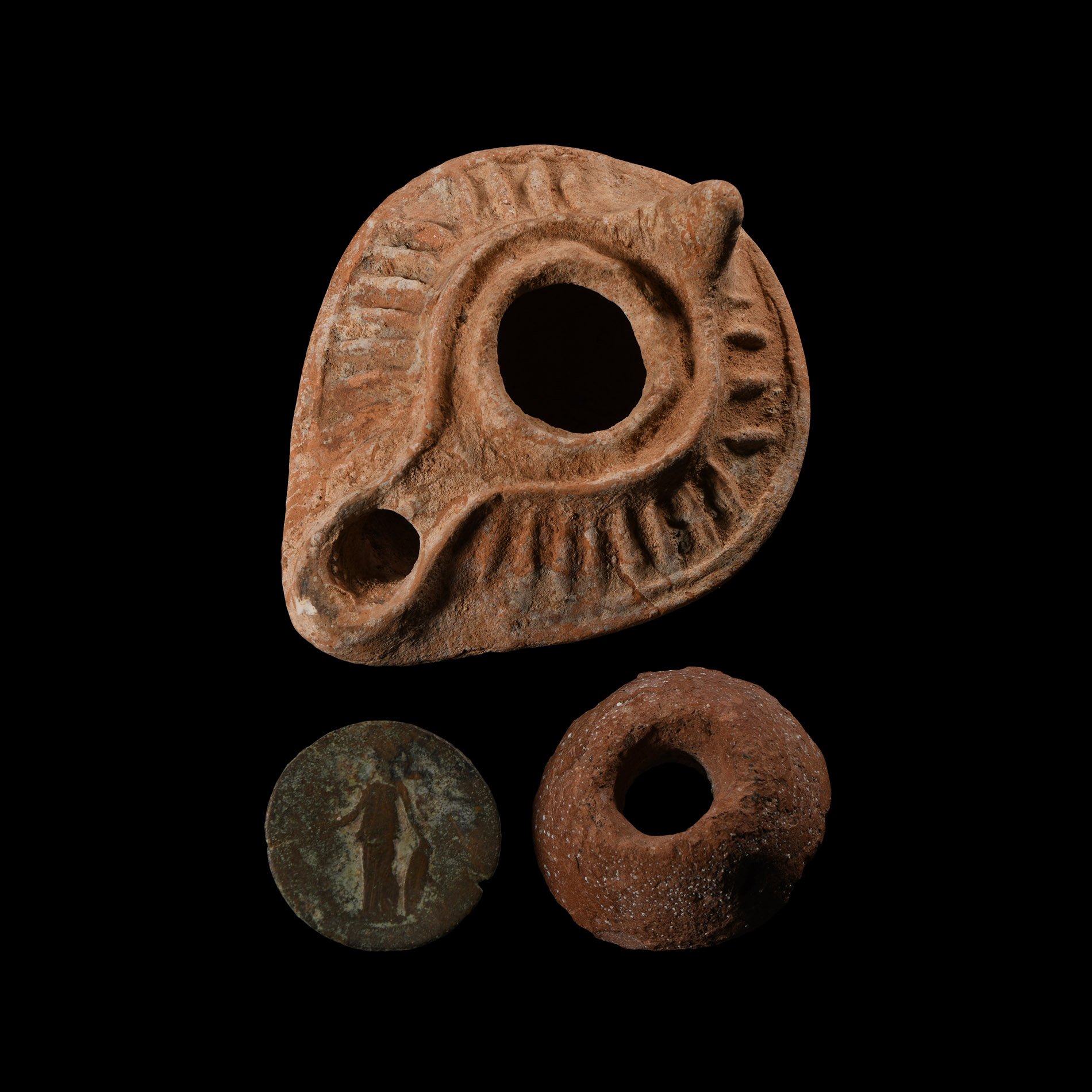
A trio of artefacts comprising: a Roman copper-alloy coin, likely a sestertius, with worn designs to obverse and reverse, the reverse likely portraying the goddess Minerva leaning on a shield and wearing a helmet; a stone loom weight of conoid form, dated c.100 A.D. and discovered in Egypt; a Roman ceramic oil lamp dated c.500 A.D., piriform in plan with raised borders to the central opening and nozzle, decorative ribbing to the shoulder, conical handle and basal ring. [3, No Reserve]
ProvenanceFrom an old UK collection.
From the private collection of Alf Baxendale (1941-2016) part 2, keen Egyptologist, member of the Egyptology Society, trustee of the Amarna Trust; thence by descent.
Accompanied by two identification display cards.
Accompanied by a copy of his obituary published in Horizon, The Amarna Project and Amarna Trust newsletter, Issue 18, 2017, p.21, by Barry John Kemp, CBE, FBA, Professor Emeritus of Egyptology at the University of Cambridge and directing excavations at Amarna in Egypt.
TimeLine Auctions follows a vetting process to ensure the authenticity and legality of all items, reinforcing our commitment to integrity and responsible trading. Each antiquity, antique, and coin lot undergoes thorough examination by a vetting committee of at least ten external specialists, professional trade association members, scientists, and archaeologists: Our Vetting Process
AUCTIONS:
TimeLine is a leading auction house specialising in antiquities, ancient art, collectables, natural history, coins, medals, and books. Our auctions offer museums, collectors, historians, and enthusiasts the opportunity to acquire unique and historically significant pieces.
-
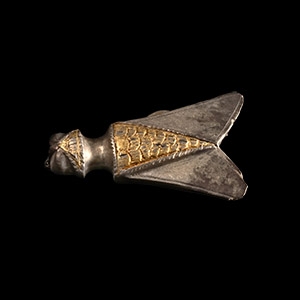
Roman Silver-Gilt Cicada Brooch
4th-5th century A.D.Sold for (Inc. bp): £494
A silver-gilt brooch in form of cicada with hollow-formed D-section head and neck, flat triangular wings; the head with bulbous eyes above a waisted neck; granule detailing to the head; pin-lug and catch-wire to the reverse. 3.82 grams, 23 mm
Acquire in the 1990s. Ex Cambridgeshire, UK, collection.
This type of brooch was popular among the Hunnic tribes, as well as in Roman Pannonia and Illyricum before the arrival of the Huns. Early Hunnic designs from Pannonia may have borrowed from late Roman types. With the arrival of new populations due to migration from the east, a new material culture developed, described as the Danubian or Ponto-Danubian style, as many of its features appear in the Pontic region as well. Although the exact meaning of the cicada brooch is not known to us, it is possible that it retained its ancient symbolism of rebirth or regeneration of the soul. -
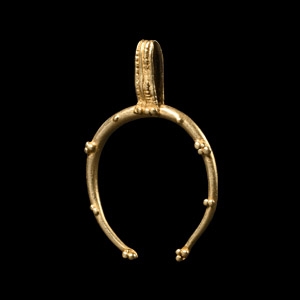
Roman Gold Lunula Pendant
1st-4th century A.D.Sold for (Inc. bp): £364
A crescentic gold lunula pendant with granule clusters to the terminals and body, granulated suspension loop. 1.78 grams, 28 mm
Acquired before 2000. From the collection of a European gentleman living in the UK. -
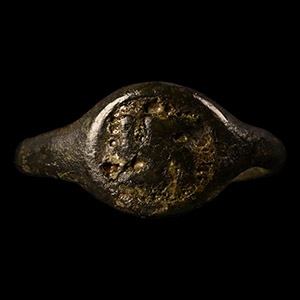
Roman Enamelled Ring with Fylfot
3rd-4th century A.D.Sold for (Inc. bp): £312
A bronze ring composed of a D-section hoop with overlapping arms, the discoid bezel displaying a fylfot with remains of an enamelled field. 2.17 grams, 22.62 mm overall, 19.94 mm internal diameter (approximate size British Q, USA 8, Europe 17.49, Japan 16)
Private collection formed since the 1940s. UK art market. Property of an Essex gentleman.
