
Loading, please wait...
LOT 0775
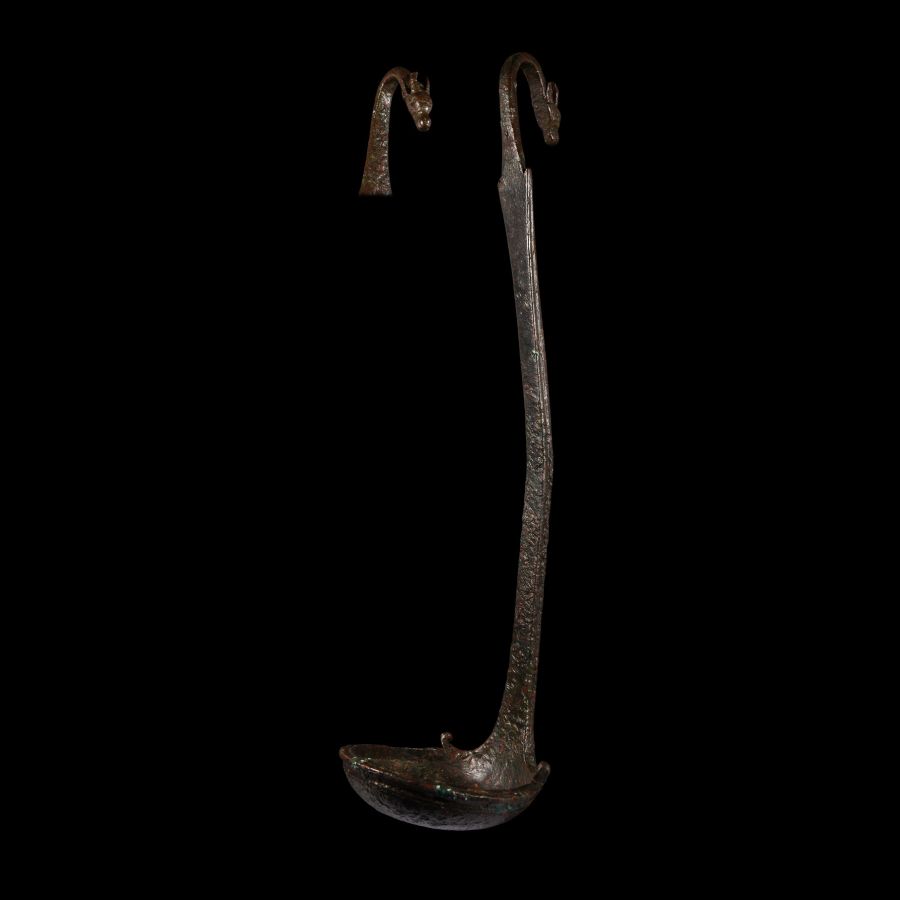
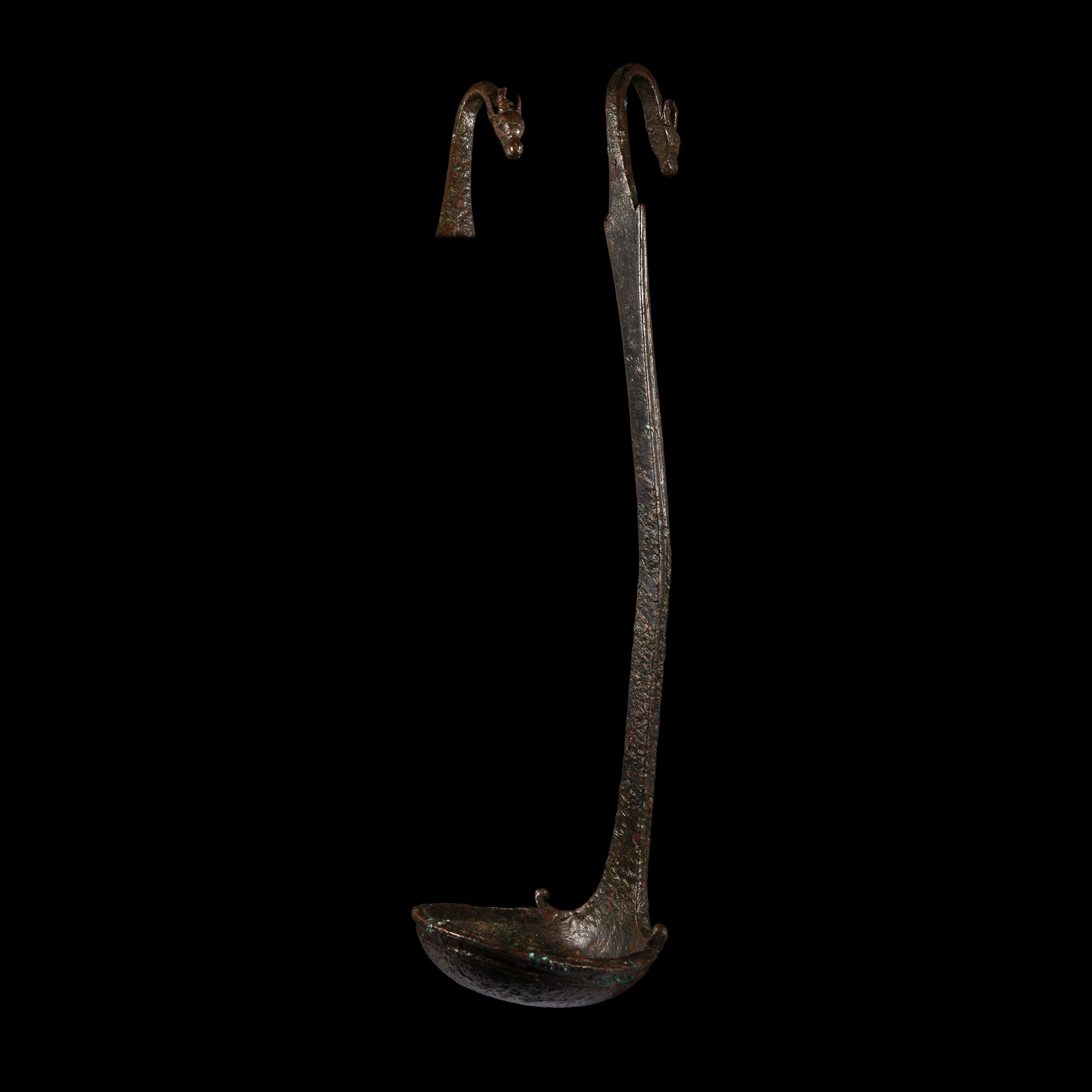
Roman Animal-Headed Ladle
CIRCA 2ND CENTURY A.D.
9 7/8 in. (147 grams, 25 cm).
A bronze ladle (simpulum) with broad bowl featuring two spurs to the rim flanking the junction with the handle, carinated band below the rim, concentric rings to the base; flat-section handle with gussets to the edges and rear, hooked ibex-head finial.
ProvenanceAcquired 1980-2015.
Ex Abelita family collection.
Cf. Tassinari, S., La Vaisselle de Bronze, Romaine et Provinciale, au Musée des Antiquités Nationales, XXIXe supplément de Gallia, Paris, 1975, items 40-3, for ladles with similar animal-head finials; cf. also Boucher, S., Inventaire des Collections Publiques Françaises - 17 Vienne: Bronzes Antiques, Paris, 1971, pp.168-169, for similar specimens.
CONDITIONTimeLine Auctions follows a vetting process to ensure the authenticity and legality of all items, reinforcing our commitment to integrity and responsible trading. Each antiquity, antique, and coin lot undergoes thorough examination by a vetting committee of at least ten external specialists, professional trade association members, scientists, and archaeologists: Our Vetting Process
AUCTIONS:
TimeLine is a leading auction house specialising in antiquities, ancient art, collectables, natural history, coins, medals, and books. Our auctions offer museums, collectors, historians, and enthusiasts the opportunity to acquire unique and historically significant pieces.
LOT 0775
Roman Animal-Headed Ladle
Estimate £300 - 400€350 - 460 (for guidance only)$410 - 540 (for guidance only)
-
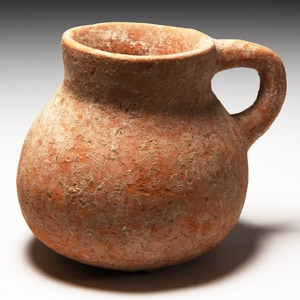
Roman Redware Handled Jug
1st-4th century A.D.Sold for (Inc. bp): £65
A squat coarse terracotta jug with thick rim and loop handle to the shoulder. 464 grams, 15 cm wide
Acquired 1980-2015. Ex Abelita family collection. -
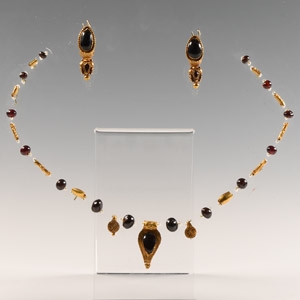
Roman Gold Necklace Element and Earring Set
2nd century A.D.Estimate: £3,000 - 4,000 (‡+bp*)
Opening Bid: £1,500
A suite of gold and garnet jewellery, comprising a matching pair of gold earrings, each composed of a hollow crescentic body tapering to slender coiled wire terminals, a suspension loop to each shoulder, large tear-shaped cell to front with granulated border, set with a polished garnet cabochon, gold bulbs below in the form of a bunch of grapes, adorned with smaller granules and three cells set with polished garnet cabochons; the necklace elements comprising graduated beads, alternating between roughly spherical polished garnets and sheet-gold beads of various types including gusseted, biconical and tubular, two floral filigree pendants flanking a central pendant ornamented with 'plaited' and plain filigree wire with granules to the outside, finial of trefoil bulbs, central corrugated cell set with a polished garnet cabochon; mounted on a custom-made perspex display base. 435 grams total, display stand: 30 x 23.5 cm (earrings: 38 mm each)
Ex private European collection, 1970s. with Genève Enchères, 14 December 2017, Lot 999. Accompanied by an academic report by Dr Raffaele D’Amato. This lot has been checked against the Interpol Database of stolen works of art and is accompanied by search certificate number no.11584-199015.
Beryls, used as small pendants, and not placed horizontally, characterised Roman necklaces of 2nd century A.D. A typical example is the necklace found in the grave of Crepereia Tryphaena. The contents of the grave are dated to the Antonine age based on the sarcophagus, the inscription and the hairstyle of the doll it contains. -
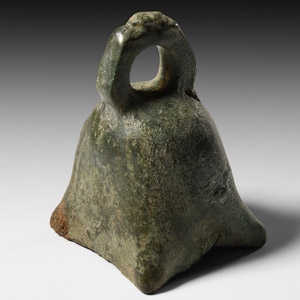
Roman Square-Shaped Bell
Circa 1st century A.D.Sold for (Inc. bp): £78
A bronze bell of quadrilateral form, with a rectangular cross-section at base, tapering to a rounded dome with large integral suspension loop with five facets to the outer face; clanger absent. 160 grams, 83 mm
Acquired before 2000. From the collection of a European gentleman living in the UK.
The Romans used bells in ritual and secular contexts, when they could be suspended from the necks of animals, worn for talismanic protection or as anklets by servants.
