
Loading, please wait...



LOT 0674
Roman and Other Glass Bead Necklace String
1ST-4TH CENTURY A.D. AND LATER
12 5/8 in. (12.48 grams, 32 cm).
Composed of small mixed blue annular beads interspersed by larger spherical beads, the central feature composed of larger beads, restrung to a Y-shape. [No Reserve]
ProvenanceFrom London, UK, gallery collection, 1990s.
CONDITIONTimeLine Auctions follows a vetting process to ensure the authenticity and legality of all items, reinforcing our commitment to integrity and responsible trading. Each antiquity, antique, and coin lot undergoes thorough examination by a vetting committee of at least ten external specialists, professional trade association members, scientists, and archaeologists: Our Vetting Process
AUCTIONS:
TimeLine is a leading auction house specialising in antiquities, ancient art, collectables, natural history, coins, medals, and books. Our auctions offer museums, collectors, historians, and enthusiasts the opportunity to acquire unique and historically significant pieces.
-
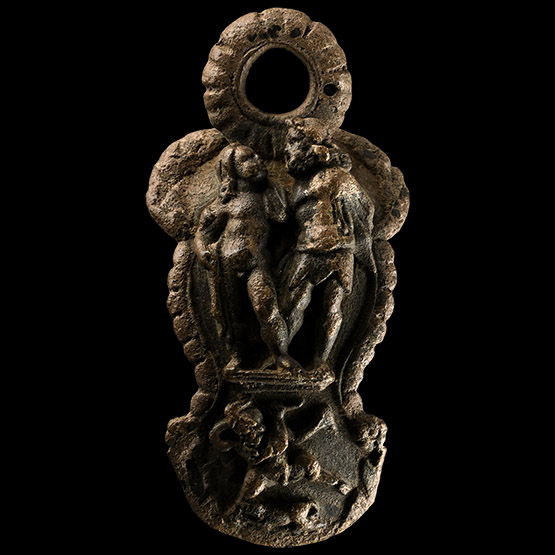
Roman Bronze Three-Dimensional Vessel Mount
2nd-3rd century A.D.Estimate: £3,000 - 4,000 (‡+bp*)
Opening Bid: £1,500
Comprising a plaque of three conjoined lobes with segmented border; at the top, a loop with segmented rim; vignette with a nude male with shoulder-length hair embracing a taller bearded figure with kilt and mantle to left shoulder (Hercules?); below, a satyr with horns and goat's legs beset by hunting dogs. 286 grams, 13.8 cm
Acquired in 1992. Private collection, thence by descent. Private collection, since the late 1990s. This lot has been checked against the Interpol Database of stolen works of art and is accompanied by a search certificate number no.12865-241702.
Vessel mounts of this form are not a commonly recovered artefact type and the presence of two figures instead one is a very singular feature. We can suppose that the mount was attached to a vessel of large dimensions and of a certain importance. -
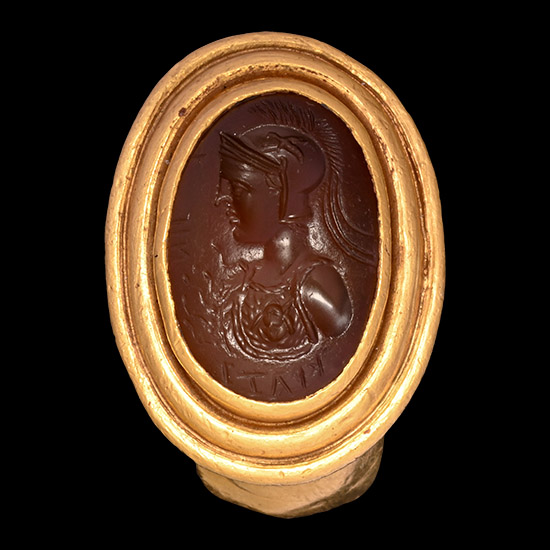
Large Roman Gold Ring with Carnelian Gemstone with Bust of the Goddess Athena and Inscription
1st century B.C.Sold for (Inc. bp): £5,720
Hollow-formed with flange rim and stepped bezel, inset intaglio profile bust of Athena in crested helmet; sinistrograde legend to bottom edge 'ΚΡΑΤΙΜΠ*'; supplied with a museum-quality impression. 20.80 grams, 33.33 mm overall, 22.23 mm internal diameter (approximate size British Z, USA 12 1/2, Europe 28.77, Japan 27)
with Bertolami Fine Arts, London, Auction 66, no.481. Private collection, England. This lot has been checked against the Interpol Database of stolen works of art and is accompanied by search certificate number no.13121-249538. -
.jpg)
Roman Bronze Hand-Standing Acrobat
1st-2nd century A.D.Sold for (Inc. bp): £7,800
A statuette of an acrobat on a round, drum-shaped base, standing on his hands, body arching slightly and legs together; wearing a loin cloth and cap decorated with floral pattern; eyes inlaid with silver. 162 grams, 12 cm high
Ex property of a Surrey collector; acquired in the early 1970s. This lot has been checked against the Interpol Database of stolen works of art and is accompanied by search certificate number no.13125-249637.
Acrobats in ancient Rome could perform at a number of venues; either in theatres, as 'gap fillers' between gladiatorial contests at the amphitheatre, at private parties or at impromptu street performances and fairs. A convivium was a dinner party with family, friends or associates. It was somewhat like a Greek symposium except that it was generally regarded as a chance to talk business or politics rather than philosophy and weighty matters. A commissatio was a wild drinking party. Prostitutes, jugglers, musicians, acrobats, actors and fire-eaters entertained guests at the banquets of wealthy Romans. From the descriptions given by Roman authors these banquets were lavish affairs with rose petals scattered on the floor, mechanical devices lowering acrobats and entertainers from the ceiling and slaves blew exotic scents into the room. The emperors also had special entertainment barges constructed on some of the ornamental lakes in the parks of Rome where acrobats entertained the guests.
