
Loading, please wait...
LOT 0752
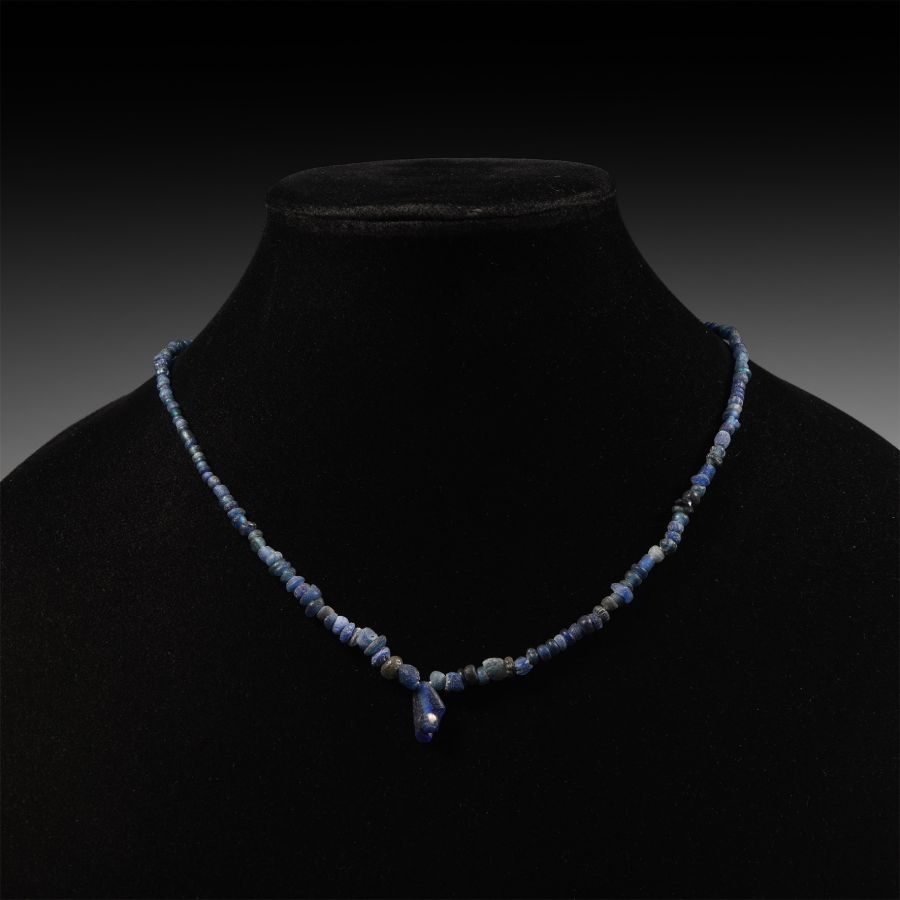
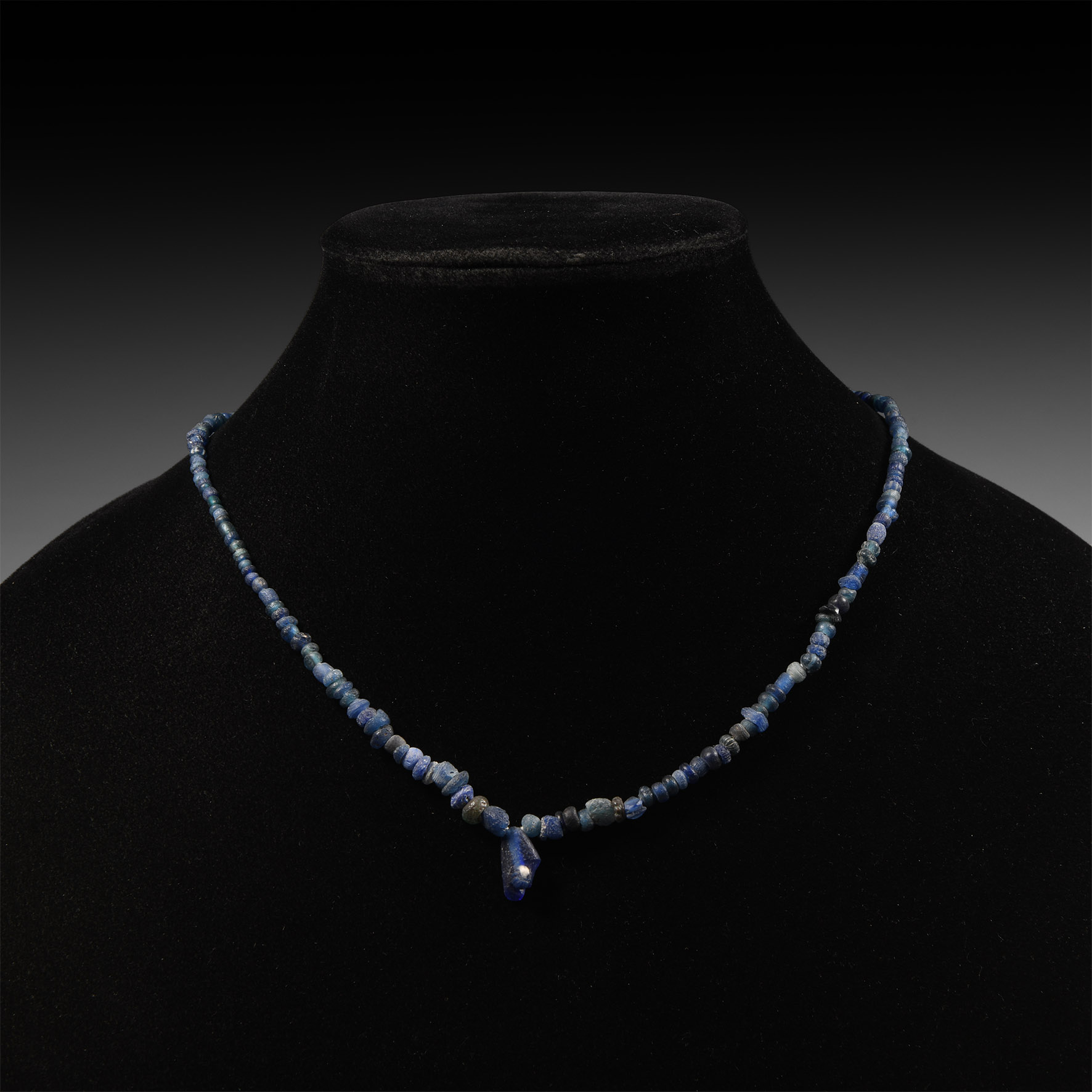
Roman and Other Bead Necklace
1ST CENTURY A.D. AND LATER
25 5/8 in. (9.54 grams, 65 cm long).
A restrung group of mainly opaque blue glass beads of various types. [No Reserve]
ProvenanceAcquired 1980-2015.
Ex Abelita family collection.
TimeLine Auctions follows a vetting process to ensure the authenticity and legality of all items, reinforcing our commitment to integrity and responsible trading. Each antiquity, antique, and coin lot undergoes thorough examination by a vetting committee of at least ten external specialists, professional trade association members, scientists, and archaeologists: Our Vetting Process
AUCTIONS:
TimeLine is a leading auction house specialising in antiquities, ancient art, collectables, natural history, coins, medals, and books. Our auctions offer museums, collectors, historians, and enthusiasts the opportunity to acquire unique and historically significant pieces.
-
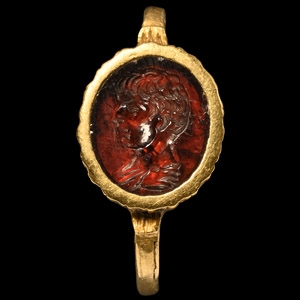
Roman Ring with Imperial Portrait
2nd century A.D. or laterSold for (Inc. bp): £2,470
A gold finger ring with narrow hoop, disc bezel with fluted rim, inset garnet intaglio male bust with Julian hairstyle. 4.68 grams, 25.34 mm overall, 23.40 mm internal diameter (approximate size British P 1/2, USA 7 3/4, Europe 16.86, Japan 16)
Acquired 1980-2015. Ex Abelita family collection. This lot has been checked against the Interpol Database of stolen works of art and is accompanied by search certificate no.11620-199234. -
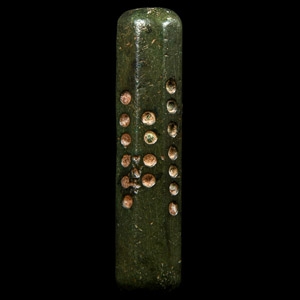
'The Uttoxeter' Roman Octagonal Rolling Dice
1st-4th century A.D.Sold for (Inc. bp): £3,120
An octagonal bronze 'Stabwuerfel' rolling dice with rounded terminals, drilled dot numbering rotating the rod clockwise: 1; 4-4; 3; 5; 2; 7; 4; 6; an additional single dimple to the end face of one terminal; all numbers are drilled at the centre of the rod with the exception of the number 8, which is split into two groups of 4, located at either end. 58 grams, 54 mm
Found whilst searching with a metal detector rear North Uttoxeter, East Staffordshire, UK, on Saturday 11th March 2017, by Martin Colclough. Accompanied by a copy of the British Museum's Portable Antiquities Scheme (PAS) report no. LANCUM-E6101C where it states: 'Stabwuerfel (germ. rod dice) are very rare in this country and this is the first one recorded on this database...This die will be marked a Find of Note for the area...and has been designated: Potential for inclusion in Britannia.'
The PAS report describes this find of note as being 'in extremely good condition'. The dots may once have had an enamel fill. -
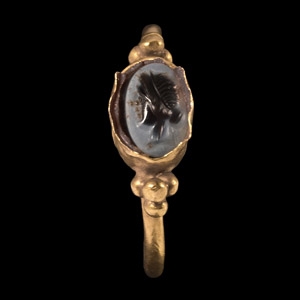
Roman Gold Ring with Portrait Gemstone
1st century B.C-2nd century A.D.Sold for (Inc. bp): £585
A nicolo gemstone with profile portrait bust, set in a 2nd century A.D. hollow-formed gold ring with granule clusters to the shoulders. 2.55 grams, 23.99 mm overall, 16.55 mm internal diameter (approximate size British M, USA 6, Europe 12.46, Japan 12)
UK private collection, since 1956. Formed in the 1950s by by Mr and Mrs S. Broukal, thence by decent. with Bonham's, London, New Bond Street, 30 November 2016, lot 155 [Part]. English private collection.
