Loading, please wait...

Use mousewheel to zoom in and out, click to enlarge

Details

LOT 0593

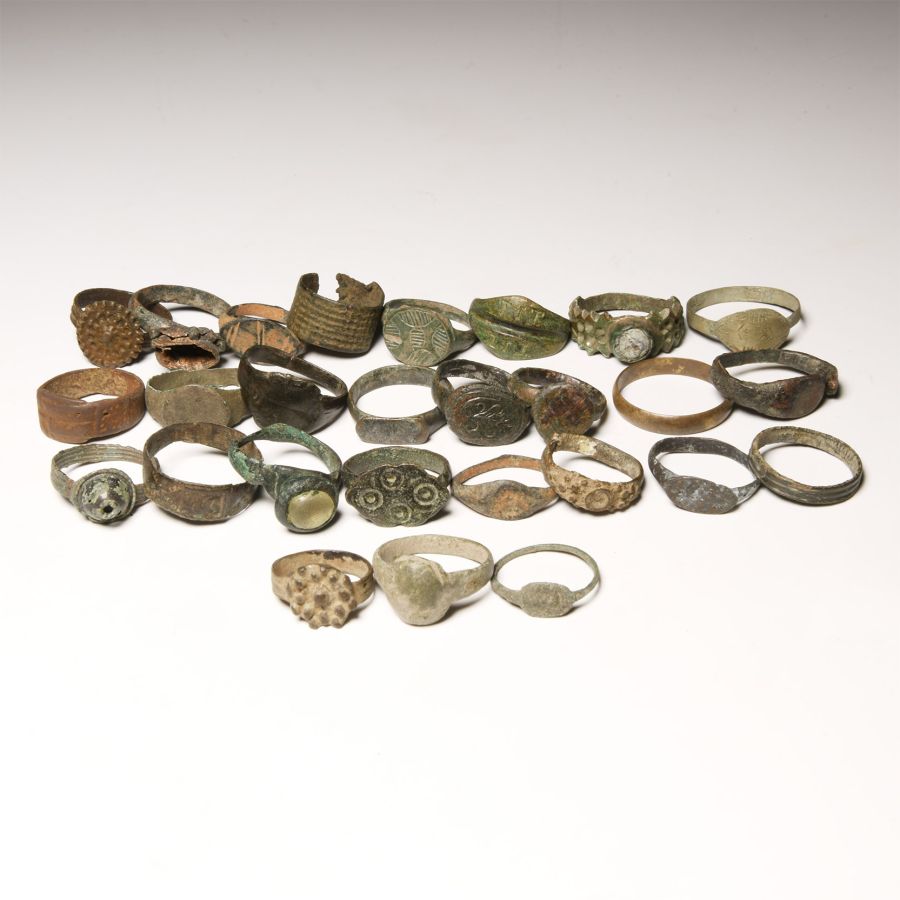
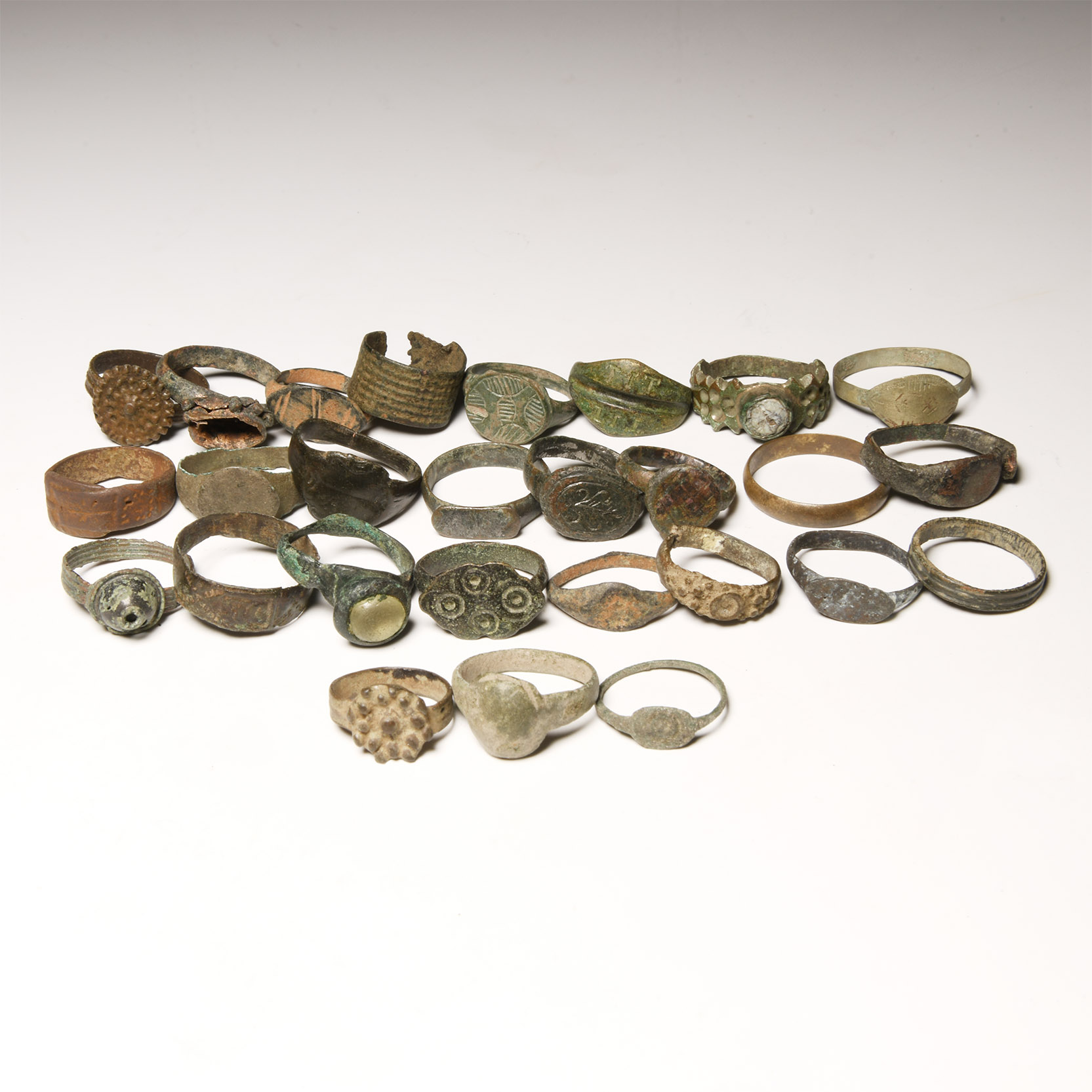
Roman and Later Bronze Ring Collection

1ST-19TH CENTURY A.D.

5/8 - 1 1/8 in. (75 grams total, 16-30 mm).

Featuring a range of ring sizes and types; the majority with decorative bezels displaying floral, geometric, buckle and other designs, including one inscribed 'TIT /TIT' over two lines. [27, No Reserve]

Provenance

Acquired on the UK art market.
Property of a Ruislip, UK, gentleman, by inheritance.

CONDITION

VETTING:

TimeLine Auctions follows a vetting process to ensure the authenticity and legality of all items, reinforcing our commitment to integrity and responsible trading. Each antiquity, antique, and coin lot undergoes thorough examination by a vetting committee of at least ten external specialists, professional trade association members, scientists, and archaeologists: Our Vetting Process


AUCTIONS:

TimeLine is a leading auction house specialising in antiquities, ancient art, collectables, natural history, coins, medals, and books. Our auctions offer museums, collectors, historians, and enthusiasts the opportunity to acquire unique and historically significant pieces.

LOT 0593

Roman and Later Bronze Ring Collection

Sold for (Inc. bp): £124

Print page

RELATED LOTS

  • Roman Bronze Bracelet Group
    Roman Bronze Bracelet Group
    1st-4th century A.D.

    Sold for (Inc. bp): £65

    Comprising four flat-section bracelets with overlapping rounded terminals. 68 grams total, 61-71 mm


    From the family collection of a Surrey gentleman since before 1960.

    Bracelets were worn in Rome by ladies of rank, but it was considered a mark of effeminacy for civilian men to use such female ornaments (Suetonius, Caligula, 52; Nero, 30). The armillae (or psellia in Greek) were rings and bracelets worn by women in the Graeco-Roman world on both legs and arms. Homer mentions them (elikas) as being part of the hairstyle of the divine Aphrodite, thus giving an almost sacred character to these objects. There were different types, the most common consisting of a more or less thick metal wire, or a flat or cylindrical circle, like our examples.

    Lot Details

  • Roman Marble Head of a Youth
    Roman Marble Head of a Youth
    1st century B.C.-1st century A.D.

    Sold for (Inc. bp): £4,420

    Naturalistically modelled in the round, large and deep eyes with a thoughtful expression under the heavy eyelids; lips lightly profiled and parted; the back and lower part roughly treated indicating that it was prepared to be installed in a hollow or part of a relief; mounted on a custom-made display base. 4.59 kg total, 25 cm high including stand


    Ex private Swiss collection, prior to the late 1980s. Acquired at Camels-Cohen Auction 228, Paris, France, 16 & 17 September 2003, lot 324. Private collection, Europe. Accompanied by an academic report by Professor Neritan Ceka. This lot has been checked against the Interpol Database of stolen works of art and is accompanied by search certificate no.11806-206511.

    The realistic style of treatment of the portrait and the preservation of classical features, in the examples of Cicero, Pompeius, or Agrippa, lead us to the last period of Roman republican portraiture, around the middle of the 1st century B.C. On the other hand, the frontal symmetry of the face, the serious expression of the eyes and the hair behind the neck, refer to the Greek sculpture of the Rigorous Style, from which the presentation of the portrait may have been inspired. These features could suggest also dating of the portrait to the last decades of the rule of the Julio-Claudian Dynasty in Rome, when there is a return to the realistic tradition of the portrait, as well as to the hairstyle with the parallel curls of the hair on the forehead in the figures, as in the portrait of Emperor Caligula (37-41 A.D.).

    Lot Details

  • Roman Bronze Horse Brooch
    Roman Bronze Horse Brooch
    Circa 2nd century A.D.

    Sold for (Inc. bp): £156

    Modelled in the round, the neck with small engraved lines indicating mane, narrow body, short tail, the forelegs forming the pin’s catch. 10.8 grams, 31 mm


    Acquired on the UK art market. Property of a Ruislip, UK, gentleman, by inheritance.

    The style of the animal is typical of the Pannonian area. It is different from similar fibulae in the western part of the empire, where there is more suggestion of movement. However, in general the head and body are modelled with realism, and the forelegs are acting as a wide flat catch-plate.

    Lot Details

Stay up-to-date with the latest from TimeLine Auctions by joining our mailing list