
Loading, please wait...
LOT 0560
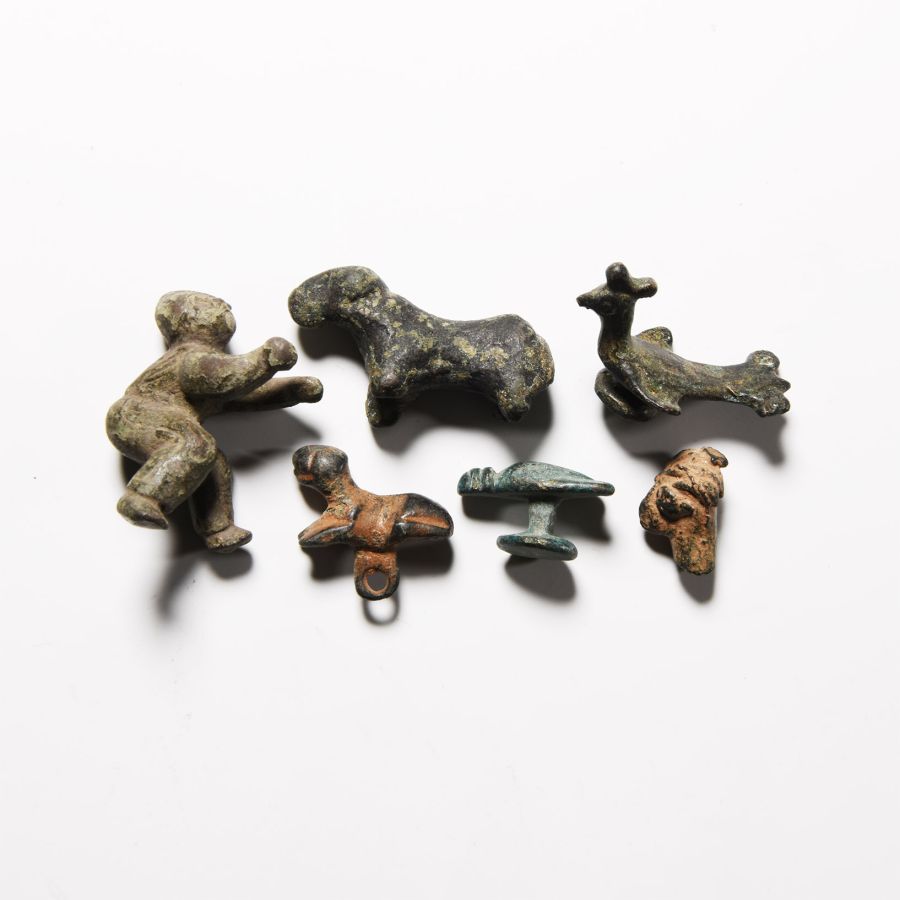
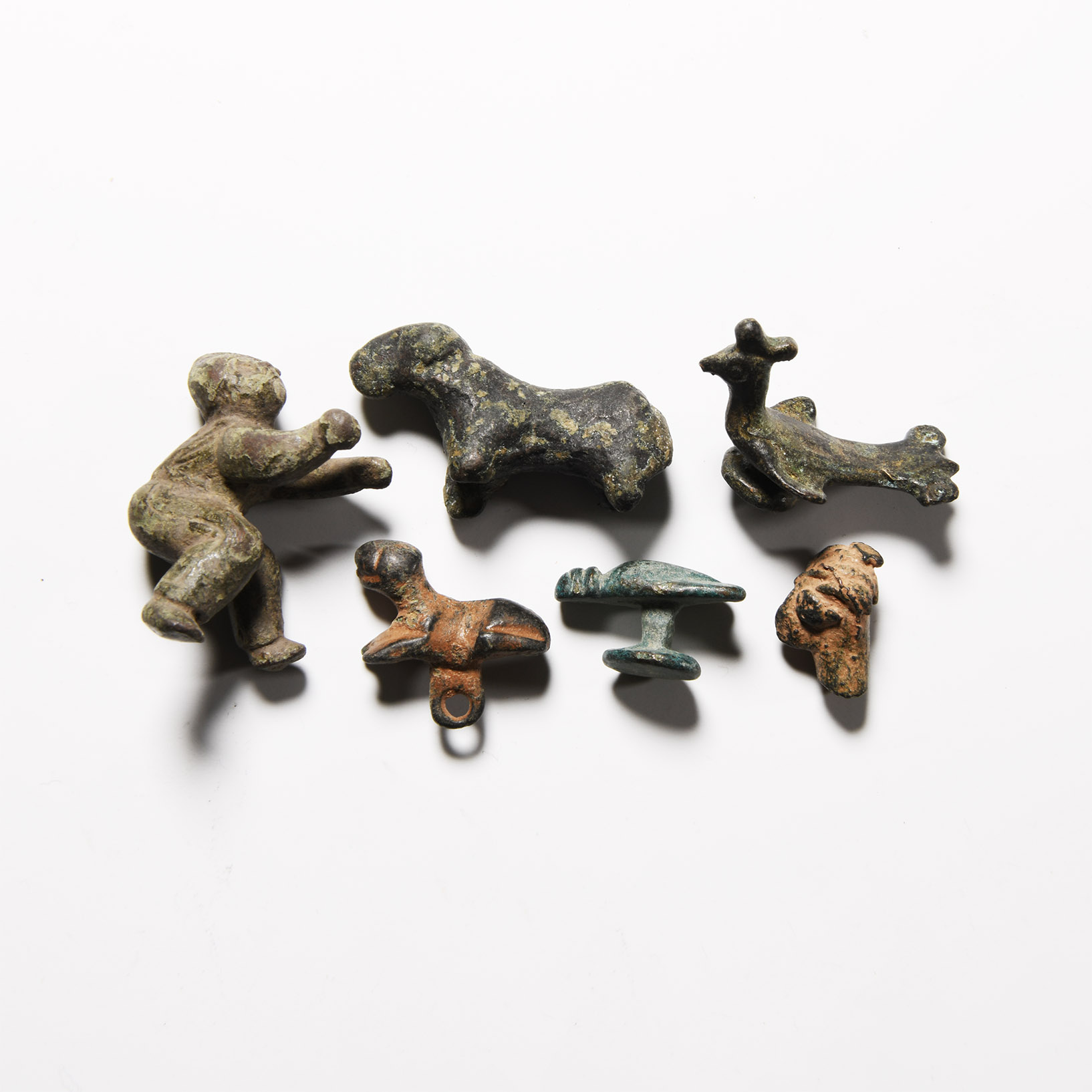
Roman and Later Bronze Artefact Group
3RD-4TH CENTURY A.D. AND LATER
3/4 - 1 1/2 in. (94 grams total, 18-40 mm).
Comprising various figures and mounts including: a sheep, a fly, a peacock, an anthropomorphic head, a mount with a lying feline and a crouching figure. [6, No Reserve]
ProvenanceAcquired on the UK art market.
Property of a Ruislip, UK, gentleman, by inheritance.
Cf. Durham, E., Metal Figurines in Roman Britain, University of Reading PhD thesis, 2010, item 287 (horse from Spalding, Lincolnshire).
FootnotesIn the art of late antiquity and early Christianity, during the Christian Middle Ages to the present, peacock held a prominent place, not only as a decorative motif, but also as a distinctive emblematic and symbolic sign. Its image was usually combined with a kantharos or a tree of life. Individually or in pairs, it was usually represented on places which were the ones closest to the holiest part of churches (altar’s parapet wall panels). Votive statuettes were brought in the church by the believers.
CONDITIONTimeLine Auctions follows a vetting process to ensure the authenticity and legality of all items, reinforcing our commitment to integrity and responsible trading. Each antiquity, antique, and coin lot undergoes thorough examination by a vetting committee of at least ten external specialists, professional trade association members, scientists, and archaeologists: Our Vetting Process
AUCTIONS:
TimeLine is a leading auction house specialising in antiquities, ancient art, collectables, natural history, coins, medals, and books. Our auctions offer museums, collectors, historians, and enthusiasts the opportunity to acquire unique and historically significant pieces.
-
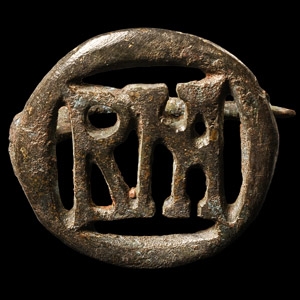
Roman Bronze ROMA Brooch
2nd-3rd century A.D.Sold for (Inc. bp): £117
With openwork monogram in Latin letters, ('R'+'M'+'A', with the 'O' represented by the circular plan of the brooch itself), a palindrome 'AMOR'; complete with pin. 13.86 grams, 35 mm
Acquired on the German art market around 2000s. From the collection of an EU gentleman living in the UK.
The brooch is composed of the stylised letters ‘RMA’. When viewed from the obverse RMA + the circle of the brooch form a monogram for ‘Roma’. Roma refers to both the city and its divine personification, the Dea Roma. But if RMA is read from right to left (or the brooch is viewed from the opposite side), the letters display a monogram for ‘AMOR’, the Latin name for Cupid, the god of love. The phrase pertains to Roma-Amor, a widely recognised palindrome espousing Roman wordplay in the ancient times. -
.jpg)
Roman Carnelian Grasshopper Amulet
Circa 1st century A.D.Sold for (Inc. bp): £910
Carved in the round with wings folded; tail absent. 12.9 grams, 49 mm
Very fine condition.
Acquired prior to 2000. Ex British private collection, London, UK. -
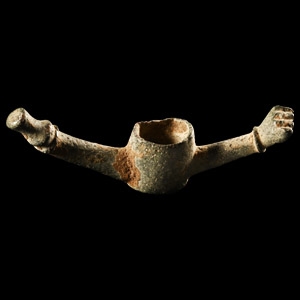
Roman Bronze Phallic and Fist Fitting
1st-4th century A.D.Estimate: £150 - 200 (+bp*)
Opening Bid: £75
The central circular socket flanked by a stylised phallus on one side and an extended arm with clenched fist on the other. 12.8 grams, 57 mm
From the collection of a Cambridge lady, 1990s.
