
Loading, please wait...
_900x900.jpg "Roman Amethyst Gemstone of the Goddess Minerva")
_200x200.jpg "Roman Amethyst Gemstone of the Goddess Minerva")
.jpg "Roman Amethyst Gemstone of the Goddess Minerva")
LOT 0003
Roman Amethyst Gemstone of the Goddess Minerva
1ST-2ND CENTURY A.D.
3/8 in. (0.48 grams, 11 mm).
Plano-convex in section with incuse bust of Minerva wearing a Corinthian-style crested helmet; supplied with a museum-quality impression.
ProvenancePrivate English collection, formed between the late 1970s and early 1990s.
Private collection, London, UK.
TimeLine Auctions follows a vetting process to ensure the authenticity and legality of all items, reinforcing our commitment to integrity and responsible trading. Each antiquity, antique, and coin lot undergoes thorough examination by a vetting committee of at least ten external specialists, professional trade association members, scientists, and archaeologists: Our Vetting Process
AUCTIONS:
TimeLine is a leading auction house specialising in antiquities, ancient art, collectables, natural history, coins, medals, and books. Our auctions offer museums, collectors, historians, and enthusiasts the opportunity to acquire unique and historically significant pieces.
LOT 0003
Roman Amethyst Gemstone of the Goddess Minerva
Estimate £1,200 - 1,700€1,390 - 1,970 (for guidance only)$1,620 - 2,300 (for guidance only)
-
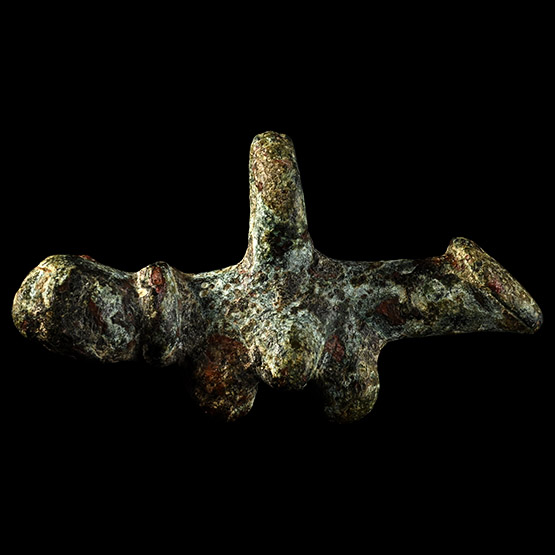
Roman Bronze Phallic Pendant
1st-3rd century A.D.Estimate: £300 - 400 (+bp*)
Opening Bid: £150
Modelled in the round pendant with male genitals flanked by a phallus and a hand in the fica gesture. 19.4 grams, 44 mm
UK private collection before 2000. Acquired on the UK art market. Private collection, London, UK. -
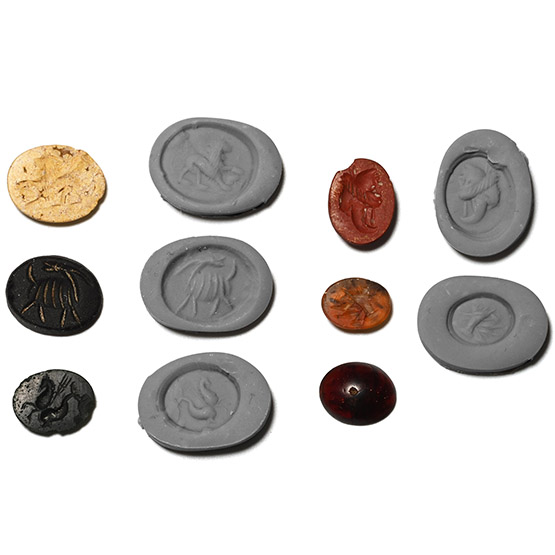
Roman Gemstone Collection
1st-3rd century A.D.Estimate: £380 - 480 (+bp*)
Opening Bid: £210
Including profile bust, advancing lion, two fish and other types; each supplied with a museum-quality impression. 2.9 grams total, 9-13 mm
From the collection of a gentleman, acquired on the London art market in the 1990s.
One of the rings, representing a seahorse with a trident swimming beside a dolphin, could be connected with the Legio X Fretensis, whose symbol was Neptune and the dolphin, adopted after the battle of Actium. -
.jpg)
Roman Nicolo Gemstone of a Grazing Horse in Gold Ring
1st-2nd century A.D.Estimate: £2,000 - 3,000 (+bp*)
Opening Bid: £1,000
Ellipsoid with chamfered edge, incuse grazing horse image on a baseline; set into a later gold ring; supplied with a museum-quality impression. 7.72 grams, 23.21 mm overall, 18.46 x 18.02 mm internal diameter (approximate size British Q, USA 8, Europe 17.49, Japan 16)
Private collection, Europe. Acquired on the English art market. This lot has been checked against the Interpol Database of stolen works of art and is accompanied by search certificate number no.13165-248341.
