
Loading, please wait...
LOT 0820
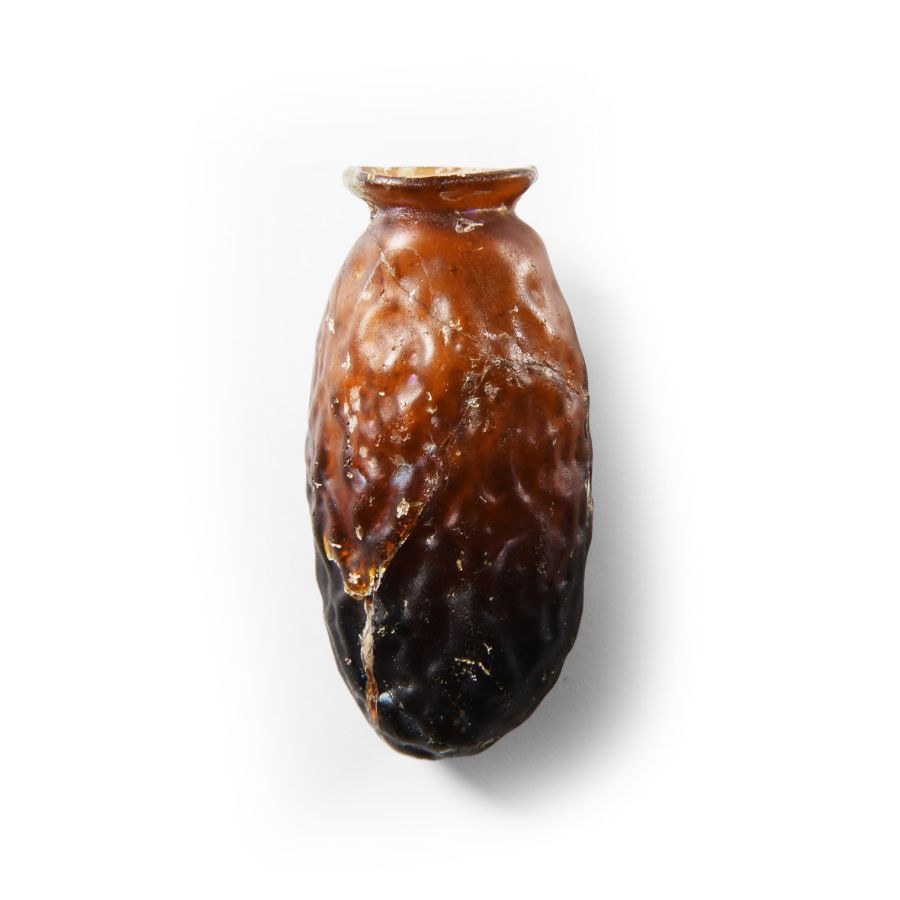
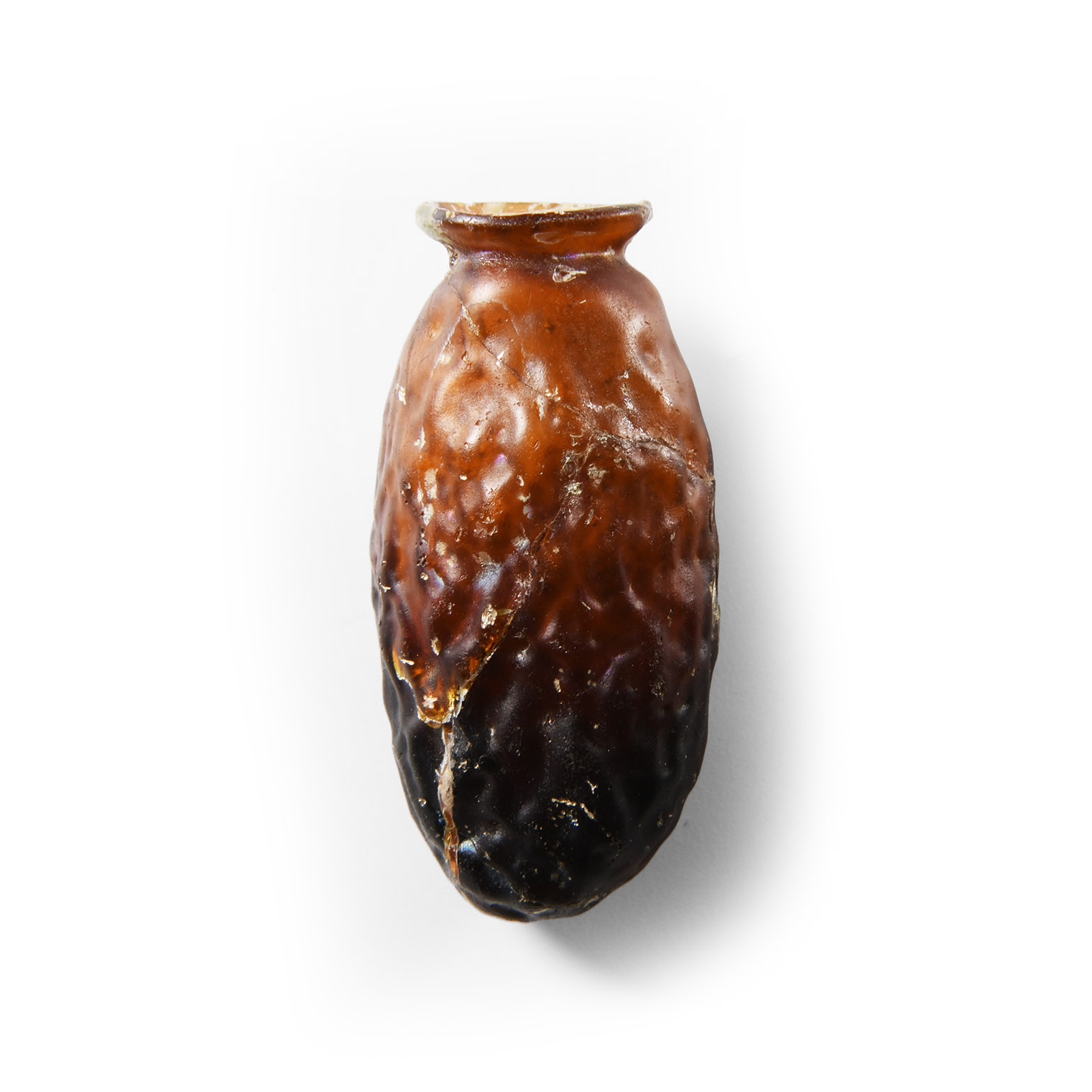
Roman Amber Glass Date Vessel
2ND-3RD CENTURY A.D.
2 1/2 in. (30.3 grams, 64 mm high).
Mould-blown with elliptical body, short neck and thick everted rim in amber-tinted glass, the body with modelled wrinkles to resemble a date. [No Reserve]
ProvenanceAcquired 1970s-1996.
Property of a North American collector.
London collection, 2016.
See Whitehouse, D., Roman Glass in the Corning Museum of Glass, vol.2, New York, 2001, item 631, for type.
CONDITIONTimeLine Auctions follows a vetting process to ensure the authenticity and legality of all items, reinforcing our commitment to integrity and responsible trading. Each antiquity, antique, and coin lot undergoes thorough examination by a vetting committee of at least ten external specialists, professional trade association members, scientists, and archaeologists: Our Vetting Process
AUCTIONS:
TimeLine is a leading auction house specialising in antiquities, ancient art, collectables, natural history, coins, medals, and books. Our auctions offer museums, collectors, historians, and enthusiasts the opportunity to acquire unique and historically significant pieces.
-
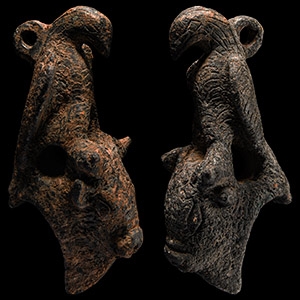
Roman Bronze Jupiter Dolichenus Eagle Pair
2nd-3rd century A.D.Sold for (Inc. bp): £910
The imperial birds modelled in the round, each standing on the head of a horned bull, wings partially spread; semi-naturalistic detailing to the head and feathers; suspension loop behind the neck. 487 grams total, 89-92 mm
Acquired in Europe before 1992.
The cult of Jupiter Dolichenus was a variant of worship of Zeus from Asia Minor whose mystery cult was widespread in the Roman Empire from the early 2nd to mid-3rd centuries A.D., especially in the military. The god is usually represented mounting a bull, with the double axe (labrys or bipennis) in his right raised hand, and dressed in the military attire of a Roman general. -
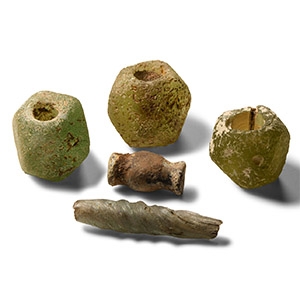
Roman Large Glass Necklace Bead Group
Circa 1st-4th century A.D.Sold for (Inc. bp): £26
Comprising five opaque glass beads, including three large facetted beads, a decoratively twisted tubular bead and a 'bow-tie' shaped clay bead with bulbous mid-section; some with traces of iridescence to the surface. 60 grams total, 24-44 mm
UK gallery, early 2000s. -
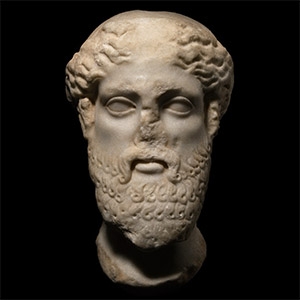
Roman Marble Head of Dionysus
Circa 2nd century A.D.Estimate: £30,000 - 40,000 (+bp*)
Opening Bid: £15,000
A Roman copy of a Greek original, wearing a crown of leaves and corymbs, hair falling in straight lines underneath the diadem; full beard composed of four rows of thick tufts with drilled holes; slightly open mouth with a fleshy lower lip; low cheekbones and hollow cheeks; large almond-shaped eyes with lachrymal duct; mounted on a custom-made display stand. 15.8 kg total, 48 cm high including stand
Ex private French collection, early 1960s. Acquired by the current owner in 2011. Accompanied by an academic report by Dr Marina Mattei and Dr Laura Maria Vigna. Accompanied by a copy of a French cultural passport no.129940. This lot has been checked against the Interpol Database of stolen works of art and is accompanied by search certificate number no.11791-206395
The head finds comparable parallels with a series of herms representing philosophers, lyricists and the god Hermes, deriving from Greek originals of the 5th century B.C. The reworking of these typologies in a cultured environment is due to the diffusion of sculptures linked to the idea of speculative otium and withdrawal into the bucolic world of which Dionysus was guardian and protector. The typology of the representation associates him with the concept of continuous rebirth and fertility of nature, typical of Dionysus Lenaeus.
