
Loading, please wait...
_900x900.jpg "Roman Agate Cameo with Devouring Hound")
_200x200.jpg "Roman Agate Cameo with Devouring Hound")
.jpg "Roman Agate Cameo with Devouring Hound")
LOT 0089
Roman Agate Cameo with Devouring Hound
CIRCA 1ST-2ND CENTURY A.D.
5/8 in. (0.81 grams, 15 mm).
Black-and-white cameo featuring a raised image of a hunting dog devouring a hare with its long ears pulled against the neck, detailed ribs and claws on the back paw. [No Reserve]
ProvenanceFrom the private collection of a European gentleman (1942-2024), formed since the 1970s.
LiteratureCf. for parallel (cameo with sleeping dog) the British Museum, London, no.1890,0901.9, from Pompeii.
CONDITIONTimeLine Auctions follows a vetting process to ensure the authenticity and legality of all items, reinforcing our commitment to integrity and responsible trading. Each antiquity, antique, and coin lot undergoes thorough examination by a vetting committee of at least ten external specialists, professional trade association members, scientists, and archaeologists: Our Vetting Process
AUCTIONS:
TimeLine is a leading auction house specialising in antiquities, ancient art, collectables, natural history, coins, medals, and books. Our auctions offer museums, collectors, historians, and enthusiasts the opportunity to acquire unique and historically significant pieces.
-
.jpg)
Roman Bronze Mount with Phallus
2nd-3rd century A.D.Sold for (Inc. bp): £182
With discoid base, angled stem and ridged finial. 26.9 grams, 37 mm
Ex German art market, 2000s. Acquired from an EU collector living in London. From the collection of a Surrey, UK, gentleman. -
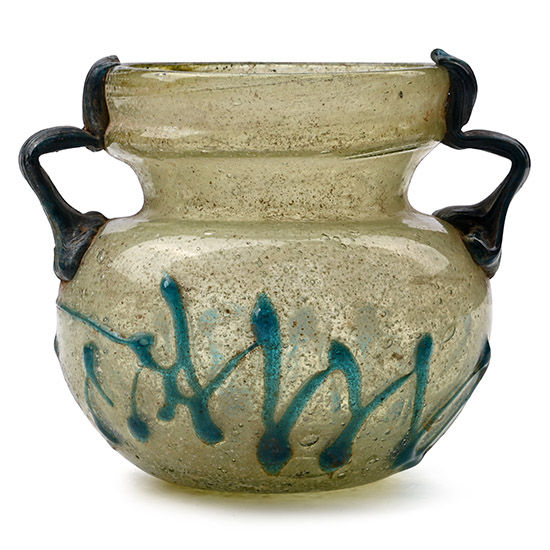
Roman Green Glass Jar with Blue Handles and Zig-Zag Trail
Circa 4th-5th century A.D.Sold for (Inc. bp): £1,170
Bulbous body with funicular neck and ribbed mouth, applied blue handles and trail decoration on the body. 98.9 grams, 95 mm wide
Acquired from Shirley Warren Antique Glass, Surrey, UK, in 1993 with reference no.4155/4083. From the collection of a Bedfordshire, UK, lady. Accompanied by an original Shirley Warren invoice no.2388 dated 18 September 1993.
This is a common form of jar with trailed ornaments, and numerous examples have been found in the Syro-Palestinian Region (Beit Fajjar, Jerusalem, Grave A at Ain Nabrud, etc). -
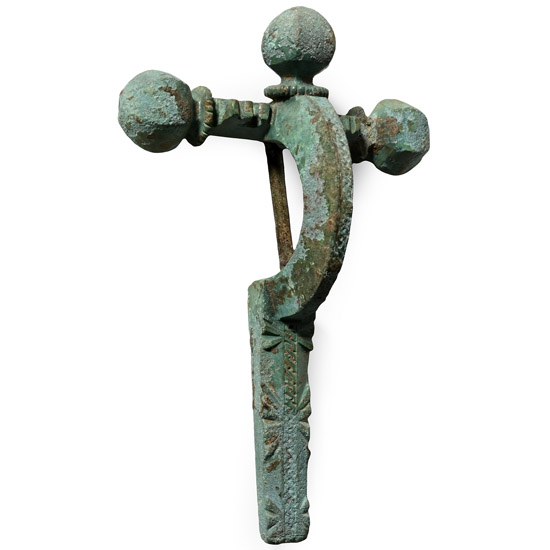
Roman Bronze Crossbow Brooch
4th century A.D.Sold for (Inc. bp): £78
With facetted onion-knop finials above notched collars, a vertical band of punched detailing to the bow extending along the foot, chamfered lateral faces to the foot with radiating detailing, and a hinged pin to the reverse. 47.9 grams, 79 mm
Ex German art market, 2000s. Acquired from an EU collector living in London. From the collection of a Surrey, UK, gentleman.
