
Loading, please wait...
_900x900.jpg "Roman Agate Cameo of Augustus")
_200x200.jpg "Roman Agate Cameo of Augustus")
.jpg "Roman Agate Cameo of Augustus")
LOT 0155
Roman Agate Cameo of Augustus
1ST CENTURY A.D.
3 5/8 in. (99 grams total, 92 mm including stand, pendant: 50 mm).
Ellipsoid cameo with profile portrait bust in antique gold pendant frame with surrounding cabochons: emerald, sapphire, ruby - and clusters of pearls; marked to reverse '750', in a rectangle 'Bd G' (believed to be an upstate New York jeweller's stamp) and an indeterminate third mark; supplied with a custom-made display stand.
ProvenanceAmerican collection, early 20th century, New York.
with Robert Haber Gallery, New York, 1990.
Ex Jean Clostre, Geneva, Switzerland.
Accompanied by a scholarly report by Dr Ittai Gradel.
This lot has been checked against the Interpol Database of stolen works of art and is accompanied by search certificate number no.12223-222312.
This lot has been cleared against the Art Loss Register database, and is accompanied by an illustrated lot declaration signed by the Head of the Antiquities Department, Dr Raffaele D'Amato.
Cf. Vollenweider, M. L., and Avisseau Broustet, M., Camées et intailles. Les Portraits Romains du Cabinet des médailles,
1995, no.52; and Megow, W. R., Kameen von Augustus bis Alexander Severus, 1987, no.A19.
Dr Ittai Gradel says: 'The cameo, of exquisite technical quality, has a close parallel in the Cabinet des médailles, Paris .. The TimeLine auction cameo is not, however, an exact copy .. though details are so close to the larger Paris cameo that the same gem carver, or at least workshop, probably produced both.'
CONDITIONTimeLine Auctions follows a vetting process to ensure the authenticity and legality of all items, reinforcing our commitment to integrity and responsible trading. Each antiquity, antique, and coin lot undergoes thorough examination by a vetting committee of at least ten external specialists, professional trade association members, scientists, and archaeologists: Our Vetting Process
AUCTIONS:
TimeLine is a leading auction house specialising in antiquities, ancient art, collectables, natural history, coins, medals, and books. Our auctions offer museums, collectors, historians, and enthusiasts the opportunity to acquire unique and historically significant pieces.
LOT 0155
Roman Agate Cameo of Augustus
Estimate £25,000 - 35,000€29,000 - 40,600 (for guidance only)$33,750 - 47,250 (for guidance only)
-
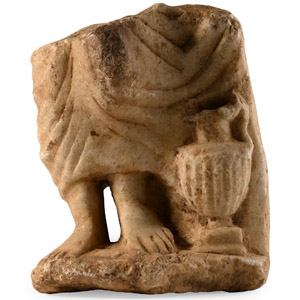
Roman Marble Sculpture Fragment
1st-2nd century A.D.Sold for (Inc. bp): £520
Carved in the half-round, pair of feet emerging from below a draped robe or toga, ewer to right on a square base. 708 grams, 11.6 cm
From the estate of a Yorkshire, UK, gentleman collector, acquired 1970s-1980s. This lot is accompanied by an illustrated lot declaration signed by the Head of the Antiquities Department, Dr Raffaele D'Amato. -
.jpg)
Roman Silver-Gilt Brooch with Diana
1st-2nd century A.D.Estimate: £1,000 - 1,400 (+bp*)
Opening Bid: £500
Modelled in the half-round figure of Diana reaching behind her shoulder to draw an arrow, her left hand reaching towards a hound; catch and spring-plate to the reverse. 14.09 grams, 40 mm
Acquired in the late 1980s-early 1990s. Private collection, London, UK. This lot is accompanied by an illustrated lot declaration signed by the Head of the Antiquities Department, Dr Raffaele D'Amato. -
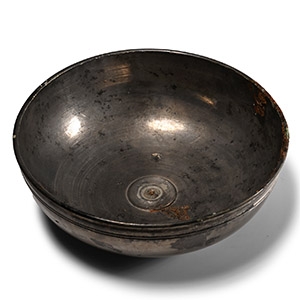
Roman Tinned Bronze Bowl
1st-3rd century A.D.Estimate: £1,500 - 2,000 (‡+bp*)
Opening Bid: £750
Hemispherical in profile with low foot, incised circumferential lines to rim; high-tin surface with silvery appearance. 177 grams, 10.3 cm
Acquired in the mid 1980s-1990s. Private collection, Switzerland, thence by descent. Private collection, since the late 1990s. This lot has been checked against the Interpol Database of stolen works of art and is accompanied by search certificate number no.12234-222176. This lot has been cleared against the Art Loss Register database, and is accompanied by an illustrated lot declaration signed by the Head of the Antiquities Department, Dr Raffaele D'Amato.
