
Loading, please wait...
_900x900.jpg "Renaissance Stained Glass Panel of Saint Leodegar Accompanied by the Arms of Dukedom of Alemannien")
_200x200.jpg "Renaissance Stained Glass Panel of Saint Leodegar Accompanied by the Arms of Dukedom of Alemannien")
.jpg "Renaissance Stained Glass Panel of Saint Leodegar Accompanied by the Arms of Dukedom of Alemannien")
LOT 2188
Renaissance Stained Glass Panel of Saint Leodegar Accompanied by the Arms of Dukedom of Alemannien
SWITZERLAND, LUCERNE, CIRCA 1520-1540 A.D.
38 1/8 in. (6 kg total, 97 cm high).
Rectangular window glass in lead cames with painted image of St. Leodegar standing in a wooded landscape wearing his episcopal mitre and robes, heater shield at bottom; wooden frame; damaged, the glass elements conserved and available for restoration. [No Reserve]
ProvenanceCollection of Lord Sudeley, Toddington Manor, Gloucestershire.
with Schweizer Glasmalereien Vorwiegend des XVI & XVII Jahrhunderts, Munich, Hugo Helbing, 4 October 1911, no.7.
UK Trade, 2018.
This lot has been checked against the Interpol Database of stolen works of art and is accompanied by a search certificate number no.12567-230649.
This lot is accompanied by an illustrated lot declaration signed by the Head of the Antiquities Department, Dr Raffaele D’Amato.
Leodegar of Poitiers (c. 615 – October 2, 679 AD) was a Burgundian noblemen and Bishop of Autun, son of Saint Sigrada and brother of Saint Warinus. He was an opponent of Ebroin, the Frankish Mayor of the Palace of Neustria, who arranged for him to be blinded and have his tongue cut out. He was later made a martyr and canonised.
Lord Sudeley's collection at Toddington Manor, Gloucestershire, was a treasure trove of Gothic Revival architecture, art, and history, reflecting his deep involvement in the manor's design with over 580 architectural drawings. His collection boasted exquisite 17th-century tapestries, heraldic stained glass, and historical artefacts that chronicled the family's lineage, including links to significant English historical events. Financial difficulties led to the dispersal of these items through auctions, yet the legacy of Toddington Manor endures as a testament to one of Britain's cultural and architectural gems.
TimeLine Auctions follows a vetting process to ensure the authenticity and legality of all items, reinforcing our commitment to integrity and responsible trading. Each antiquity, antique, and coin lot undergoes thorough examination by a vetting committee of at least ten external specialists, professional trade association members, scientists, and archaeologists: Our Vetting Process
AUCTIONS:
TimeLine is a leading auction house specialising in antiquities, ancient art, collectables, natural history, coins, medals, and books. Our auctions offer museums, collectors, historians, and enthusiasts the opportunity to acquire unique and historically significant pieces.
LOT 2188
Renaissance Stained Glass Panel of Saint Leodegar Accompanied by the Arms of Dukedom of Alemannien
Sold for (Inc. bp): £2,600
-
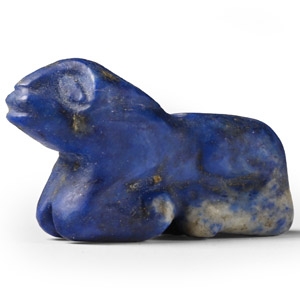
Bactrian Style Sodalite Sheep Amulet
20th century A.D.Sold for (Inc. bp): £39
Modelled in the round laying down with the legs tucked beneath the body, and long ears resting along the neck; pierced vertically through the back. 11.4 grams, 34 mm
Ex London, UK, collection, 1990s. -
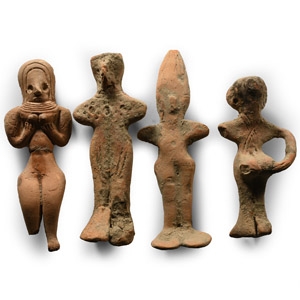
Western Asiatic Style Terracotta Figure Group
20th century A.D.Sold for (Inc. bp): £46
Including a crouching female with hands supporting her breasts, and other types. 177 grams total, 10-12.7 cm
Acquired 1980-2015. Ex Abelita family collection. This lot is accompanied by an illustrated lot declaration signed by the Head of the Antiquities Department, Dr Raffaele D’Amato. -
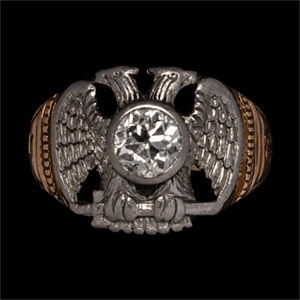
Scottish Masonic 32nd Degree Gold and Platinum Ring with 1 Carat Diamond
20th century A.D.Sold for (Inc. bp): £1,950
Comprising a wide D-shaped 14 carat yellow gold hoop expanding at the shoulders, pelletted band above a triangle to each shoulder, one with '32' and the other with Hebrew letter 'yod'; openwork platinum bezel formed as a double-headed eagle gripping a perch and with its wings spread, the body set with a one carat brilliant cut diamond (small chip); stamped to the inner face '14 KT PLAT'. 14.67 grams, 25.80 mm overall, 20.21 mm internal diameter (approximate size British R 1/2, USA 8 3/4, Europe 19.38, Japan 18)
Acquired on the UK art market. Ex Property of a County Durham collector. This lot has been checked against the Interpol Database of stolen works of art and is accompanied by search certificate no.12490-230251. This lot has been cleared against the Art Loss Register database, and is accompanied by an illustrated lot declaration signed by the Head of the Antiquities Department, Dr Raffaele D’Amato.
There is no officially mandated design for 32nd degree Scottish Rite rings beyond the double-headed eagle, hence they can vary greatly in appearance. Common symbols include the number 32, triangles, the Hebrew letter yod (as in this example), and the square and compasses. Since the 32nd degree ring is a reflection of its owner's Masonic journey, the rings can sometimes also contain symbols from other Masonic orders.
