
Loading, please wait...
_900x900.jpg "Renaissance Silver Interlinking Necklace")
_200x200.jpg "Renaissance Silver Interlinking Necklace")
.jpg "Renaissance Silver Interlinking Necklace")
LOT 0416
Renaissance Silver Interlinking Necklace
GERMANY, 16TH CENTURY A.D.
19 1/4 in. (110 grams, 49 cm).
Comprising interlinking flat loops with pierced spacers decorated with Renaissance motifs, winged telamon and ‘jewels’; sturdy hook-and-eye closure.
ProvenancePrivate collection, Europe.
Acquired on the English art market.
This lot has been checked against the Interpol Database of stolen works of art and is accompanied by search certificate number no.13154-248389.
Such chains were known as a 'Sivlonot' in German Jewish tradition dating from the 16th century, in a custom whereby silver or gold chains were sent as a gift by the bridegroom to his future bride. They were worn under the bridal canopy and throughout the following week, then often brought out again for holidays and ceremonial occasions.
CONDITIONTimeLine Auctions follows a vetting process to ensure the authenticity and legality of all items, reinforcing our commitment to integrity and responsible trading. Each antiquity, antique, and coin lot undergoes thorough examination by a vetting committee of at least ten external specialists, professional trade association members, scientists, and archaeologists: Our Vetting Process
AUCTIONS:
TimeLine is a leading auction house specialising in antiquities, ancient art, collectables, natural history, coins, medals, and books. Our auctions offer museums, collectors, historians, and enthusiasts the opportunity to acquire unique and historically significant pieces.
-
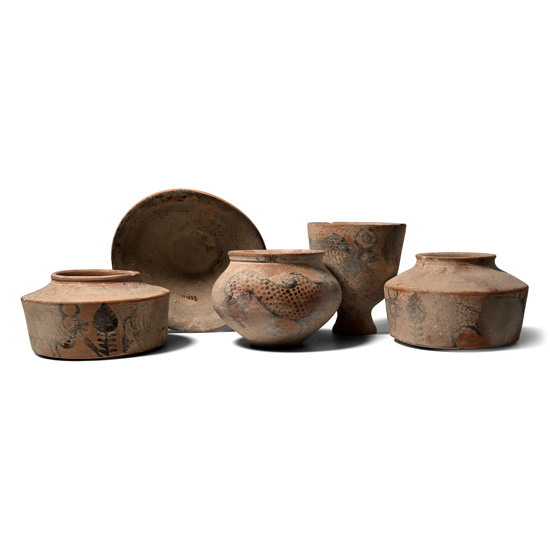
Indus Valley Style Terracotta Vessel Group
20th century A.D.Sold for (Inc. bp): £26
Mixed group of jars and a cup with painted details. 983 grams, 80-125 mm wide
Very fine condition.
From the private collection of John Meredith, acquired since the 1990s; thence by descent. -
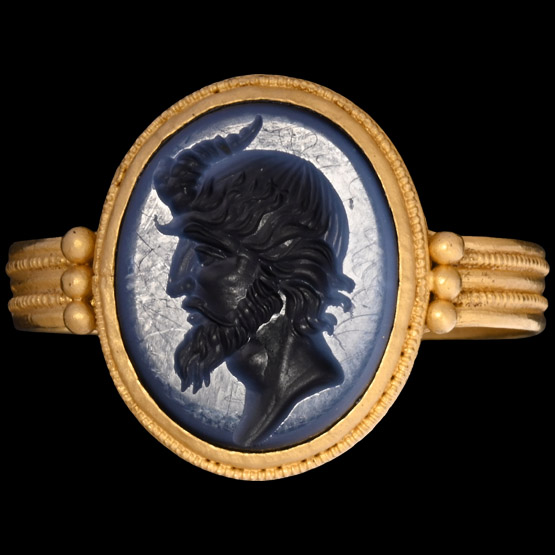
Renaissance Nicolo Gemstone with Bust of the Greek God Pan in Gold Ring
17th century A.D. or laterEstimate: £3,000 - 4,000 (+bp*)
Opening Bid: £1,500
Ellipsoid nicolo plaque with intaglio profile bust of Pan with thick hair and beard, goat's horns on the brow; in a later sympathetic gold ring; supplied with a museum-quality impression. 5.40 grams, 23.72 mm overall, 21.99 x 17.07 mm internal diameter (approximate size British P 1/2, USA 7 3/4, Europe 16.86, Japan 16)
Private collection, England. This lot has been checked against the Interpol Database of stolen works of art and is accompanied by search certificate number no.13153-249514. -
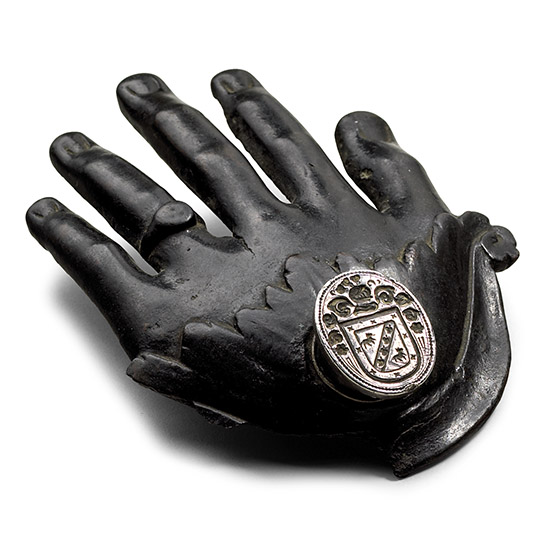
Italian Bronze Hand-Shaped Desk Seal
17th century A.D.Estimate: £2,000 - 3,000 (+bp*)
Opening Bid: £1,000
Formed as a left hand with flange rim to the cuff and wrist, ring to the third finger; stud to the reverse with geralfic seal, heater shield with helmet and lambrequin, underside with stud and profile bust. 453 grams, 13.5 cm
Acquired on the UK art market. Private collection, England. This lot has been checked against the Interpol Database of stolen works of art and is accompanied by search certificate number no.13087-249670.
In the 17th century, Italian noble seals were crucial heraldic instruments, depicting family crests, often surmounted by crowns (counts, marquises, princes) or helmets, and enriched with family specific symbols (e.g., vines for the Panevinos), portraits on horseback, or elements linked to ecclesiastical offices (papal keys) to authenticate documents, reflecting the prestige and authority of noble houses and civic patricians.
