
Loading, please wait...
_900x900.jpg "Renaissance Gold Ring with Toadstone")
_200x200.jpg "Renaissance Gold Ring with Toadstone")
_900x900.jpg "Renaissance Gold Ring with Toadstone")
_200x200.jpg "Renaissance Gold Ring with Toadstone")
.jpg "Renaissance Gold Ring with Toadstone")
.jpg "Renaissance Gold Ring with Toadstone")
LOT 0358
Renaissance Gold Ring with Toadstone
WESTERN EUROPE, 16TH CENTURY A.D.
1 1/4 in. (13.01 grams, 32.42 mm overall, 23.12 x 19.25 mm internal diameter (approximate size British V 1/2, USA 10 3/4, Europe 24.4, Japan 23)).
Featuring a round-section large hoop expanding towards the shoulders, a large circular bezel with a Greek key motif encircling the outer rim and set with a brown 'toadstone'.
ProvenanceAcquired on the European art market.
This lot has been checked against the Interpol Database of stolen works of art and is accompanied by search certificate number no.13398-257996.
Cf. the Victoria and Albert Museum, London, accession numbers: M.250-1962 & 389-1864, for similar examples; The British Museum, London, museum no. AF.1024, for similar; The Ashmolean Museum, accession nos.WA1897.CDEF.F817 and WA1897.CDEF.F589, for similar.
FootnotesWilliam Shakespeare’s As You Like It, circa 1599: 'Sweet are the uses of adversity, Which, like the toad, ugly and venomous, Wears yet a precious jewel in his head.' Toadstones are mythical stones that were thought to be found inside the head of a toad. They were believed to sweat, change colour or even heat up in the presence of poison. It was thought that a toadstone placed on bites from snakes, insects, spiders and shrews would extract poison from the wound. They were thought to bring good luck and ward off evil, whether in the present life or in the afterlife. The Book of Secrets from the 13th century recommends swallowing the stone to 'cleanse the bowels of filth and excrements'. The stone could then be retrieved and used again. They were often set as amulets and talismans, a practice that continued in Europe until the 18th century. Toadstones are actually the button-like fossilised teeth of Lepidotes, an extinct genus of fish common in the Jurassic and Cretaceous Periods, 200 to 100 million years ago.
CONDITIONTimeLine Auctions follows a vetting process to ensure the authenticity and legality of all items, reinforcing our commitment to integrity and responsible trading. Each antiquity, antique, and coin lot undergoes thorough examination by a vetting committee of at least ten external specialists, professional trade association members, scientists, and archaeologists: Our Vetting Process
AUCTIONS:
TimeLine is a leading auction house specialising in antiquities, ancient art, collectables, natural history, coins, medals, and books. Our auctions offer museums, collectors, historians, and enthusiasts the opportunity to acquire unique and historically significant pieces.
LOT 0358
Renaissance Gold Ring with Toadstone
Estimate £8,000 - 10,000€9,280 - 11,600 (for guidance only)$10,800 - 13,500 (for guidance only)
-
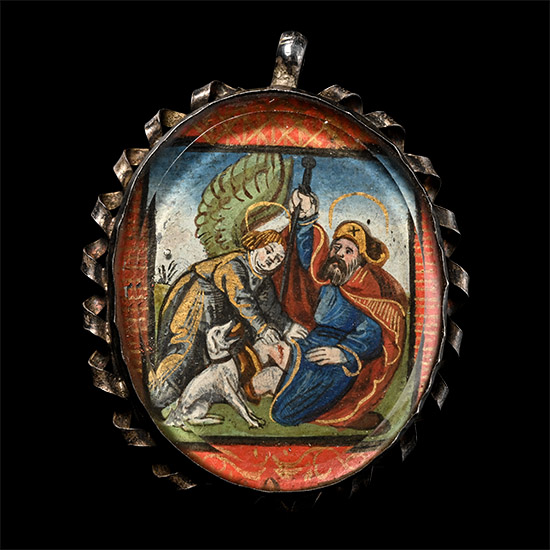
Silver Illuminated Miniature Pendant
France, 16th century A.D.Sold for (Inc. bp): £1,950
The glazed silver pendant containing illuminated miniatures on each side, one side depicting Saint Roch and the other Saint Matthew; Saint Roch shown seated on the ground while an angel is attending his bubonic plague sore on his thigh, and a white dog at his feet; Saint Matthew on the other side depicted writing the Gospel with a young attendant holding a book beside him; the frame with a fixed bale to the top and the sides adorned with a twisted silver wire decoration. 36.2 grams, 58 mm
Acquired on the European art market.
Saint Roch (c. 1348–1379) is a Catholic saint, revered as the patron of plague victims, dogs, and the sick. Born in Montpellier, France, he devoted his life to caring for those suffering from the plague. According to legend, he contracted the disease himself but was miraculously healed with the help of a dog that brought him food and licked his wounds. He is often depicted with a pilgrim’s staff, a dog by his side, and a wound on his leg. His feast day is celebrated on August 16. Saint Matthew was one of the twelve apostles of Jesus and the traditional author of the Gospel of Matthew. Before following Jesus, he was a tax collector, known as Levi. He is considered the patron saint of accountants, bankers, and tax collectors. His gospel emphasises Jesus as the Messiah and the fulfilment of Old Testament prophecies. According to tradition, he preached in various regions, including Ethiopia and Persia, before being martyred. His feast day is celebrated on September 21. -
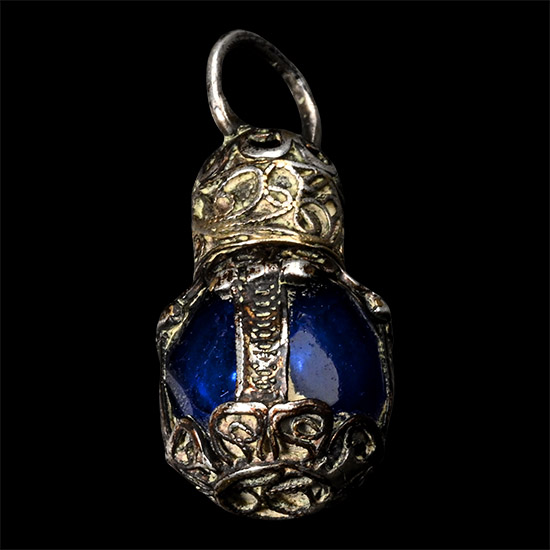
Miniature Blue Glass Scent Bottle with Silver Filigree Mounts
England, 17th century A.D.Estimate: £400 - 600 (+bp*)
Opening Bid: £200
Of facetted deep blue glass, enclosed within an elegant silver filigree cage mount retaining traces of its original gilding; the domed screw-cap similarly decorated with scrolling filigree ornament and fitted with a suspension loop, indicating that it was intended to be worn on a chain or ribbon, with an original clear glass stopper. 4.62 grams, 28 mm
Acquired on the European art market.
Delicate in scale yet refined in execution, the bottle is a characteristic example of late 17th-century English personal luxury wares. -
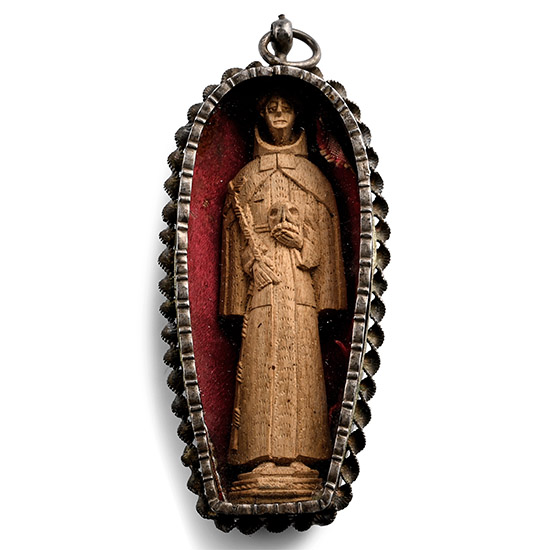
Wooden Sculpture of Saint Francis of Assisi in Silver Pendant
Spanish Colonies, 17th-18th century A.D.Sold for (Inc. bp): £390
A carved wooden figure of Saint Francis of Assisi holding a skull in his left hand and a cross in his right hand, set on a red fabric inside a silver tongue-shaped case with applied twisted wire decoration to the outer rim; attachment loop with ring to the top. 48.1 grams, 11 cm
Private collection, Europe. Acquired on the French art market.
