
Loading, please wait...
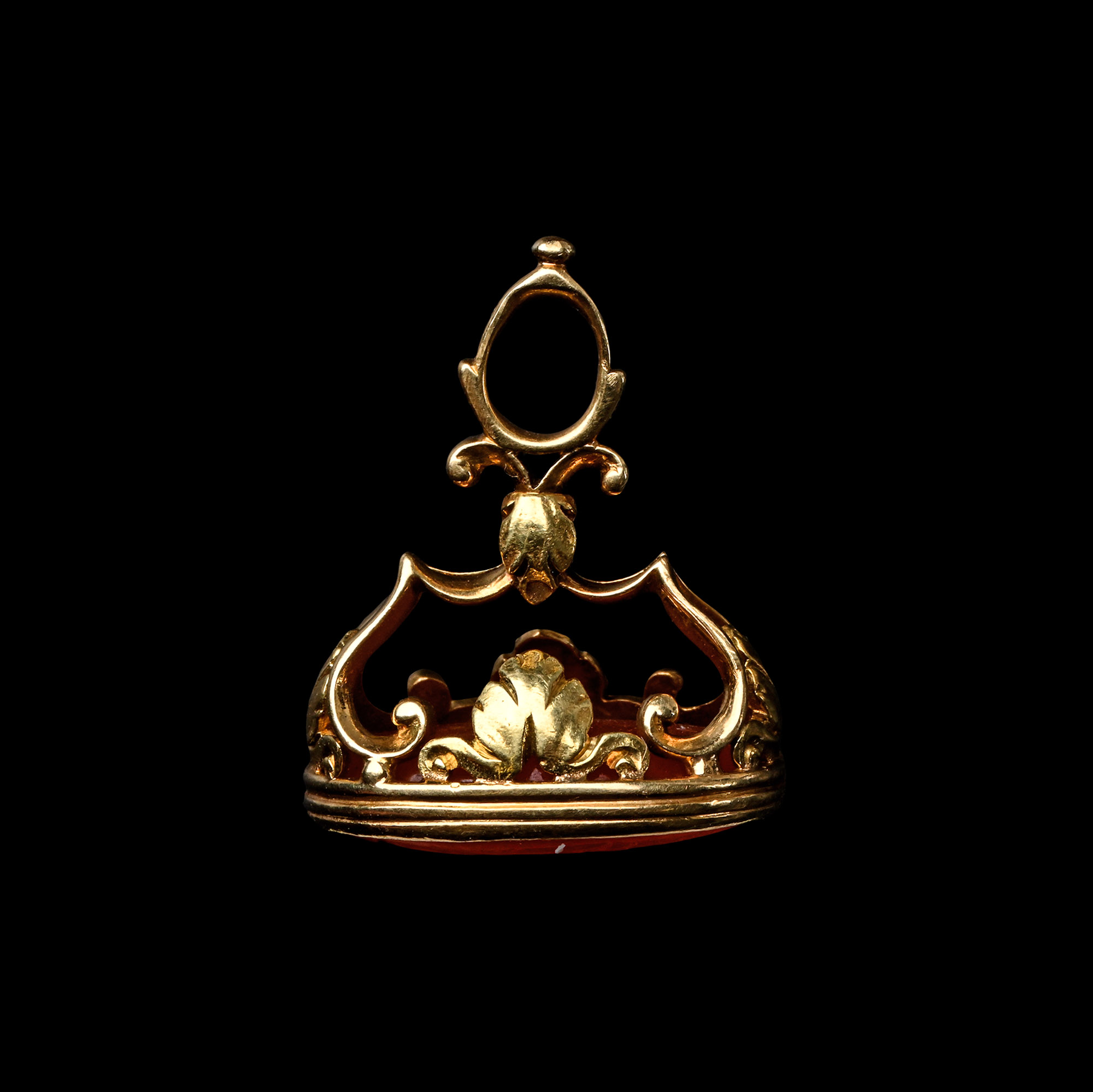
_900x900.jpg "Renaissance Gold Fob Seal with Carnelian Gemstone of a Herm and Figures")
_200x200.jpg "Renaissance Gold Fob Seal with Carnelian Gemstone of a Herm and Figures")


.jpg "Renaissance Gold Fob Seal with Carnelian Gemstone of a Herm and Figures")
LOT 0373
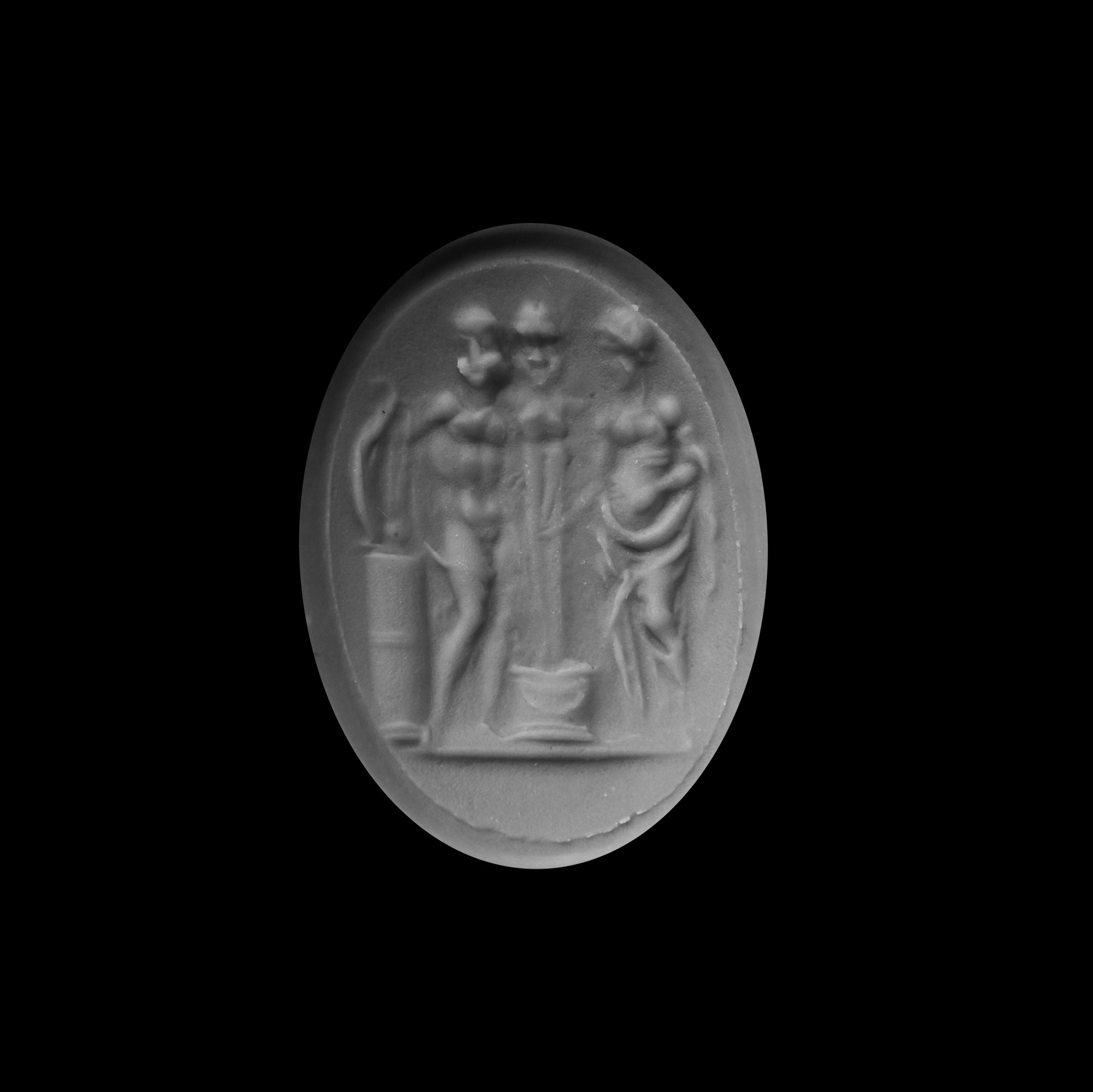
Renaissance Gold Fob Seal with Carnelian Gemstone of a Herm and Figures
16TH-19TH CENTURY A.D.
1 in. (6.60 grams, 25 mm).
An oval intaglio finely engraved with a classical scene, at the centre a herm upon a plinth, flanked by two figures: the woman on the left wearing a gown with loose drapery falling across her arms, while the figure to the right is shown nude, the body scarcely veiled by a fine transparent cloth; at the far right a sacrificial altar surmounted by a lyre, introducing a musical or poetic dimension to the scene and emphasising its votive character; mounted in an ornate 18th-century French gold fob mount, pierced with scrolling foliate ornament and stamped with duty marks; supplied with a museum-quality impression.
ProvenanceAcquired on the European art market.
FootnotesThe gem, cut in the 16th century, reflects the Renaissance revival of antique glyptic art, where Roman prototypes were carefully studied and reinterpreted with elegance and precision. The finely executed incision and harmonious arrangement of clothed and unclothed figures highlight the engraver’s technical mastery and antiquarian erudition.
CONDITIONTimeLine Auctions follows a vetting process to ensure the authenticity and legality of all items, reinforcing our commitment to integrity and responsible trading. Each antiquity, antique, and coin lot undergoes thorough examination by a vetting committee of at least ten external specialists, professional trade association members, scientists, and archaeologists: Our Vetting Process
AUCTIONS:
TimeLine is a leading auction house specialising in antiquities, ancient art, collectables, natural history, coins, medals, and books. Our auctions offer museums, collectors, historians, and enthusiasts the opportunity to acquire unique and historically significant pieces.
LOT 0373
Renaissance Gold Fob Seal with Carnelian Gemstone of a Herm and Figures
Estimate £1,000 - 1,400€1,160 - 1,620 (for guidance only)$1,350 - 1,890 (for guidance only)
-
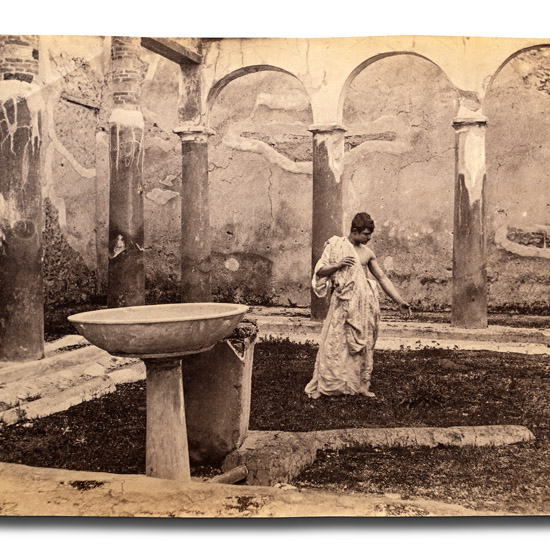
Wilhelm Von Gloeden, Albumen print - Two 'Taormina' Photographers' Stamps Verso
1856-1931 A.D.Sold for (Inc. bp): £1,170
Original albumen print of a toga-clad figure among architectural ruins; 'Giovane con toga nel cortile della Casa degli Archi' (IX 7,20) Pompei by Wilhelm von Gloeden; stamped to reverse W.von Gloeden Taormina, Sicilia (deposé)' and 'W.von Gloeden Tarmina (Sicilia) / Proprieta Artistica'. 5.2 grams, 15.6 x 11.7 cm
Acquired on the UK art market. Property of a Harwich, UK, collector.
Baron Wilhelm von Gloeden was known for photographic images of Italian youths posed as classical figures, often nude in a classical landscape or setting. At the outbreak of World War I he left Italy; Mussolini's fascists destroyed many of his images and glass negatives as obscene. -
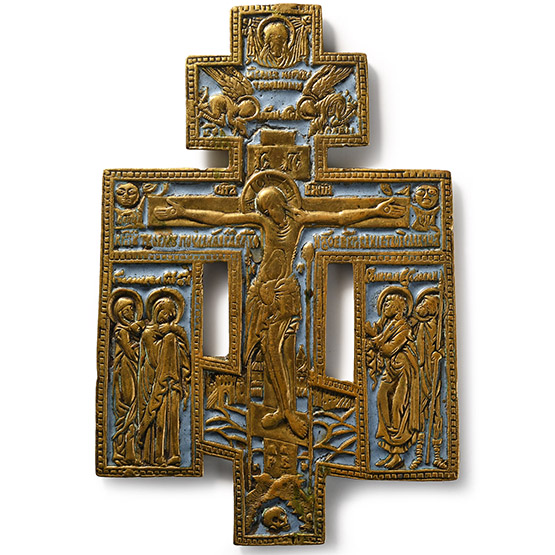
Russian Orthodox Enamelled Bronze Travel Icon with Christ Flanked by Mary, Maria, and Saint John
19th century A.D.Sold for (Inc. bp): £312
Representing the Saviour on the cross, the titulum inscribed with the letters 'ΙC ΧΡ' (Jesus Christ); Cyrillic inscriptions over the sun (Солнце) and the moon (Луна), flanking Jesus and above the heads of the figures: Mary of Magdala (Мария Магдала), the Mother of God ('ΜΡ ϴΥ'), Saint John the Theologian (Св Иоанн) and Saint Longinus (Св Лонгин); on the background the symbols of the Passion (sponge on reed, spear and a skull set on stones marking the site as Golgotha, twisted cords or wire, skan) and the city of Jerusalem; on the upper part of the cross the Archangels Michael and Gabriel with cloth-covered hands, the Mandylion above them. 270 grams, 16.6 cm
Acquired from Chris Martin-Zakheim, Iconastas, 5 Piccadilly Arcade, London SW1. From the private collection of a West London, UK, gentleman, formed since the early 2000s.
Orthodox travel icons were used by the faithful to carry a sacred representation with them during their journeys, offering protection and a constant spiritual connection. The icon features meticulous craftsmanship with intricate details of the Passion and Death of the Saviour, according to the Byzantine iconography. -
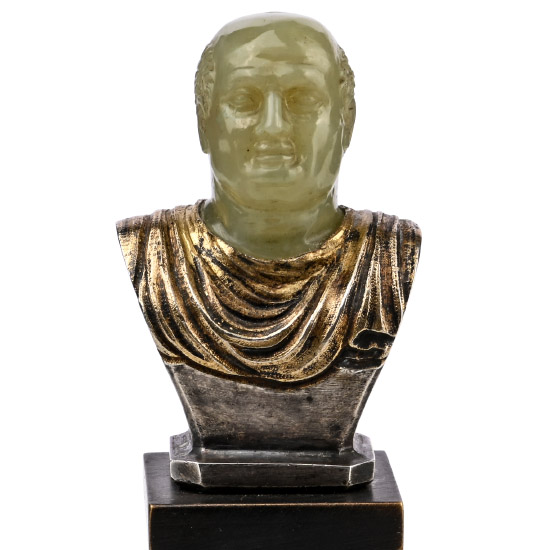
Chalcedony and Silver-Gilt Bust of the Emperor Vespasian
Italy, 17th-18th century A.D.Estimate: £1,500 - 2,000 (+bp*)
Opening Bid: £750
The head, carved from pale green chalcedony, polished to a smooth lustre and with a drilled aperture at the crown, the hair in tight curls around the nape and crown; the silver-gilt torso dressed in a draped toga carefully chased with deep folds and traces of gilding across the high points; mounted on a later patinated bronze column stand in the neoclassical manner. 208 grams total, 10.9 cm high including stand
Acquired on the European art market.
This small-scale portrait evokes the Roman tradition of imperial portraiture and the early modern fascination with the ancient world. From the seventeenth century onwards, artists and collectors revived classical subjects through hardstone and gilt-metal compositions, often intended for display in Kunstkammer or Grand Tour contexts. The combination of a reused ancient or earlier element with a later mount was a practice typical of the Renaissance and Baroque periods, reflecting the period’s reverence for antiquity and its imaginative recontextualisation of ancient forms.
