
Loading, please wait...
LOT 2133
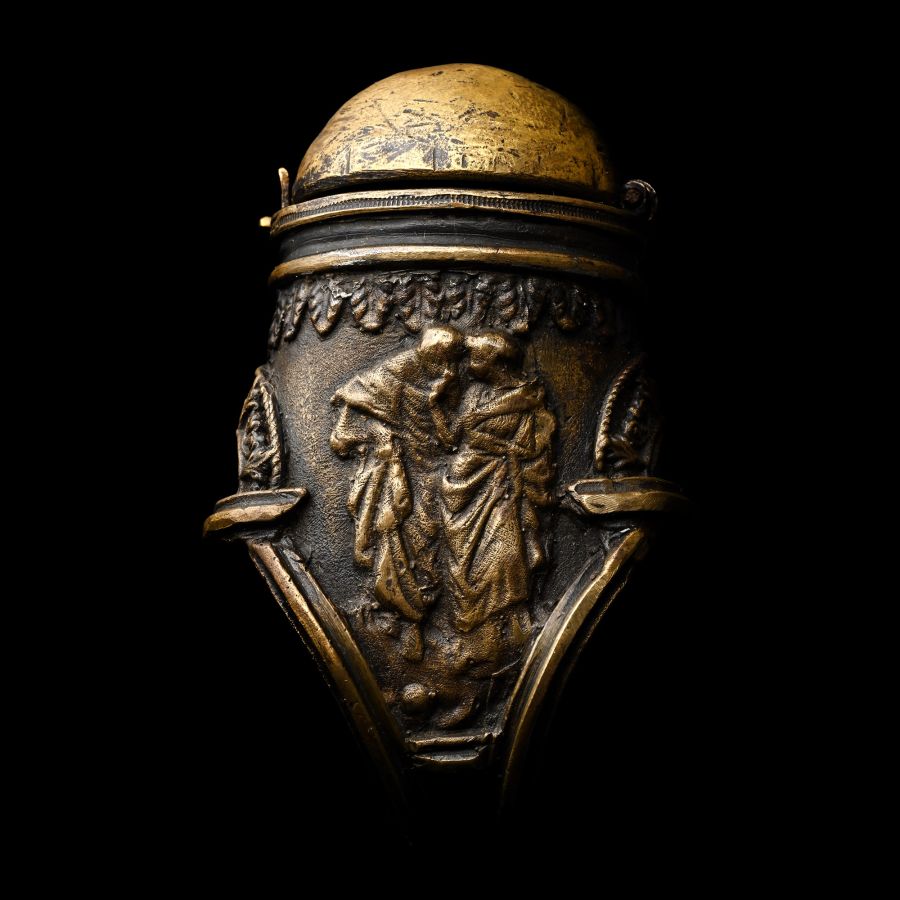
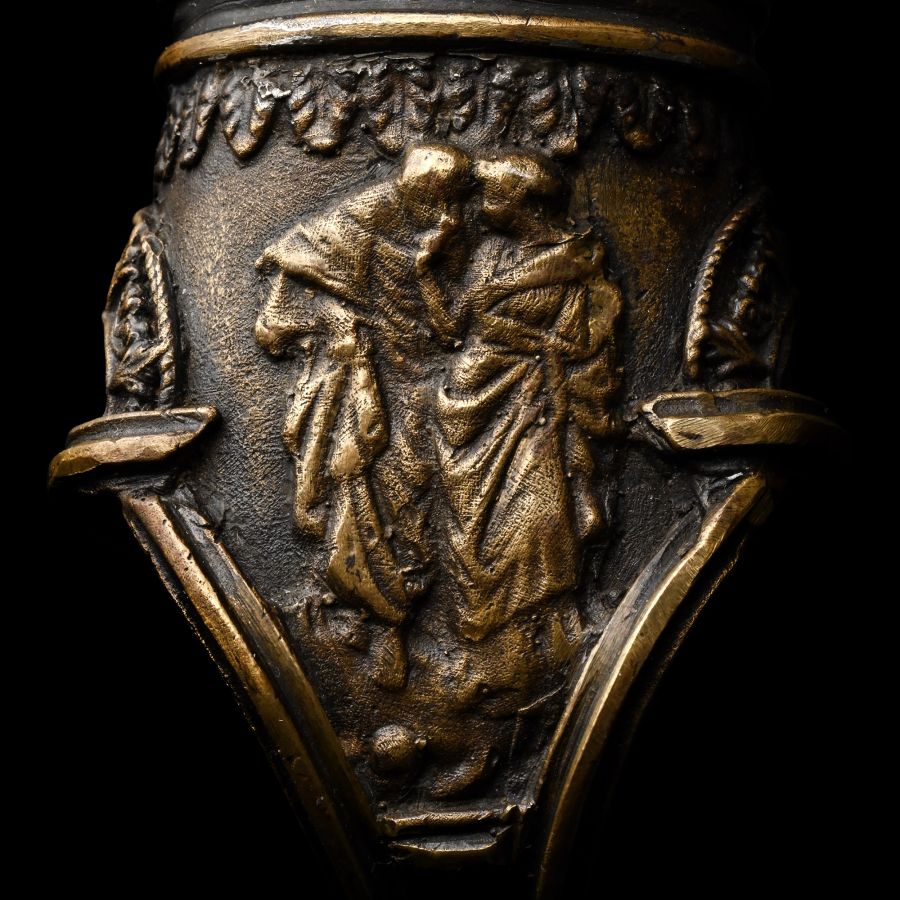
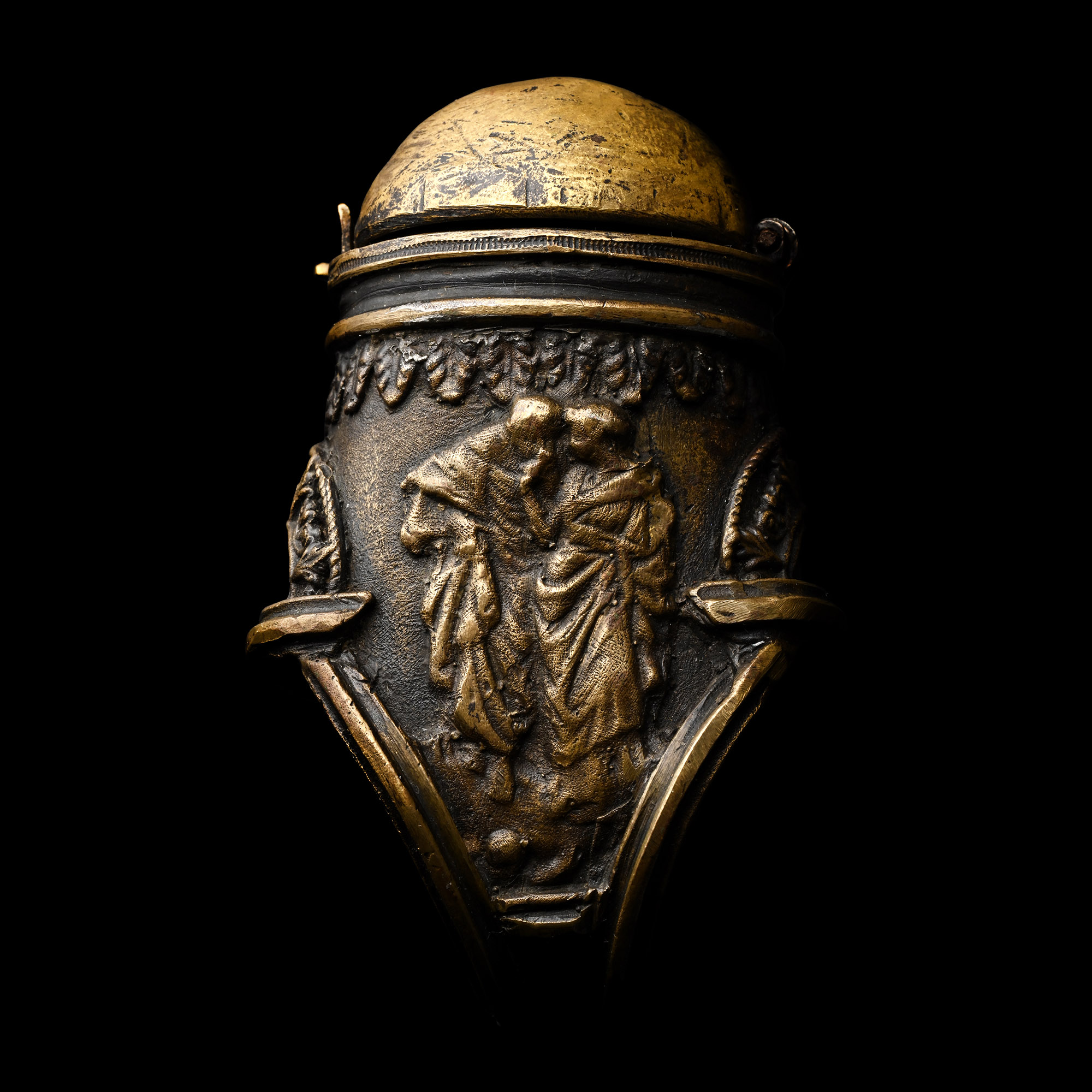
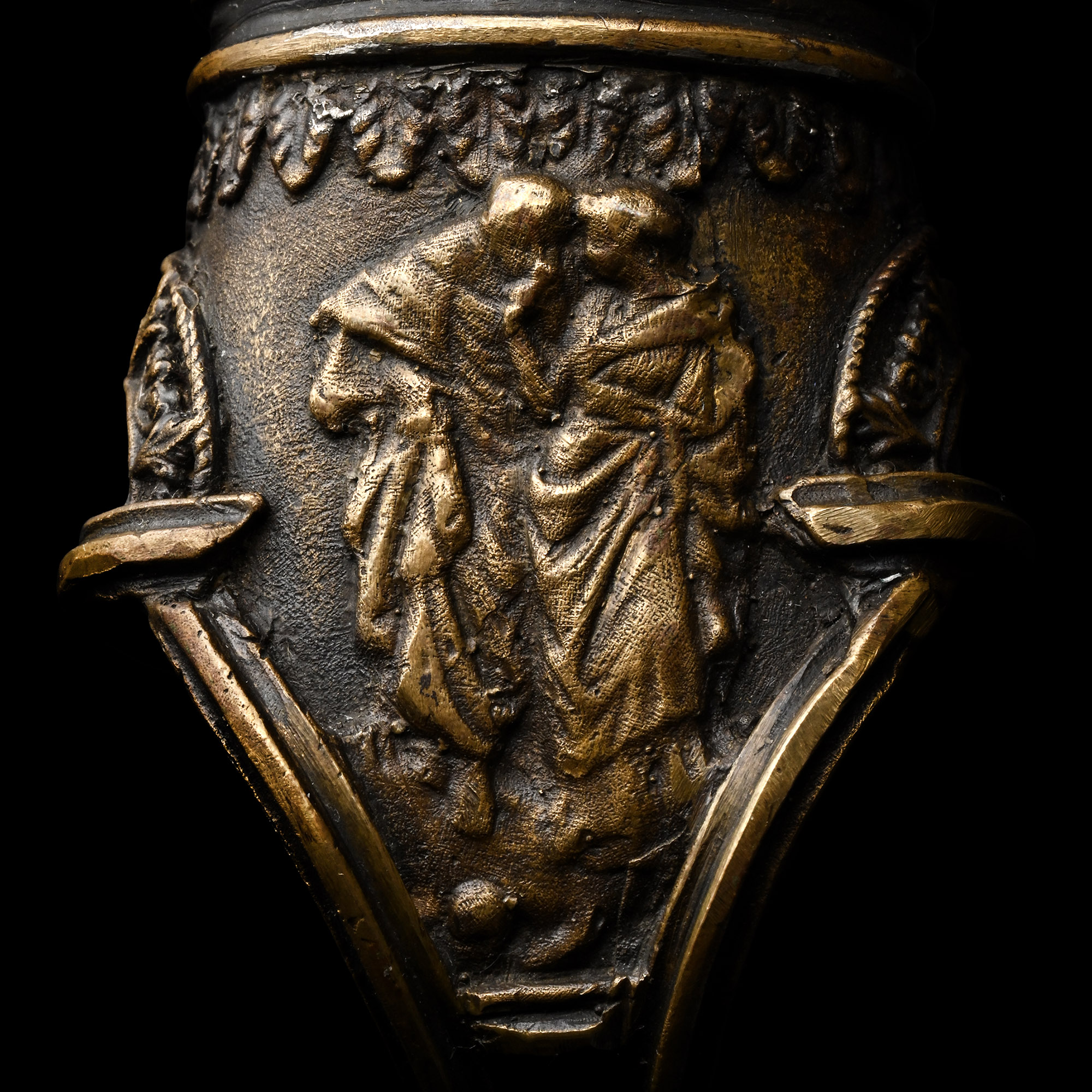
Renaissance Bronze Glove Ring with an Inkwell
ITALY, 17TH-18TH CENTURY A.D.
2 1/2 in. (115 grams, 64.40 mm overall, 22.38 mm internal diameter (approximate size British Y 1/2, USA 12 1/4, Europe 28.2, Japan 27)).
Flat-section hoop with raised rim to each edge, tubular shank with frieze of robed figures between decorated arches and with pendant fronds above; domed lid with hinge and catch, stepped rim and chamber.
ProvenancePrivate collection, UK.
CONDITIONTimeLine Auctions follows a vetting process to ensure the authenticity and legality of all items, reinforcing our commitment to integrity and responsible trading. Each antiquity, antique, and coin lot undergoes thorough examination by a vetting committee of at least ten external specialists, professional trade association members, scientists, and archaeologists: Our Vetting Process
AUCTIONS:
TimeLine is a leading auction house specialising in antiquities, ancient art, collectables, natural history, coins, medals, and books. Our auctions offer museums, collectors, historians, and enthusiasts the opportunity to acquire unique and historically significant pieces.
-
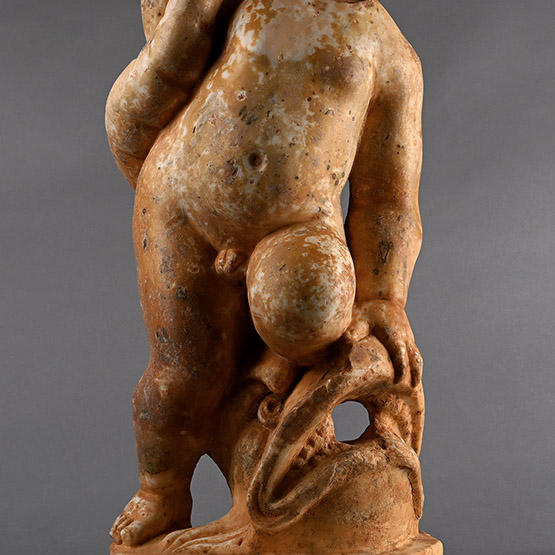
Marble Fountain Sculpture of a Putto Wrestling a Fish
Baroque, 17th century A.D.Sold for (Inc. bp): £598
Standing on an angular base resting his left knee on the open jaws of a fish, his left arm holding the jaws open, the body and tail held upright be the raised right hand (partly absent); with heavy sulphured patina. 20.75 kg, 48 cm
Acquired prior to 1970. From the estate of a Swiss gentleman, Ticino. Private collection, Zurich, Switzerland. This lot has been checked against the Interpol Database of stolen works of art and is accompanied by a search certificate number no.12790-240308.
In ancient Roman art and architecture, fountains were often decorated with sculptures of young boys or putti holding fish. These sculptures were known as 'putti with fish' or 'boy with fish' and were a popular motif in the decoration of fountains. The young boy or putto was shown holding a fish or a shell, which would spout water into the fountain basin below. The fish was a particularly popular motif because it symbolised abundance, fertility, and prosperity, which were all important values in ancient Roman society. Overall, the putti with fish sculptures are a notable example of the art and architecture of ancient Rome and have continued to be an enduring symbol of beauty, abundance, and prosperity throughout the centuries. Archaeological excavations in Pompeii have revealed many examples of sculptures of putti with fish. The putti with fish sculptures from Pompeii were usually made of bronze, marble, or terracotta. They were often placed in the centre of the fountain, surrounded by other decorative elements such as flowers, plants, and other sculptures. Many of these putti with fish sculptures are now on display in the National Archaeological Museum of Naples. The museum also houses a famous mosaic of a putto with a fish, which was discovered in the House of the Faun in Pompeii. The putti with fish sculptures from Pompeii and those in the Naples Museum provide valuable insights into the art and culture of ancient Rome. They demonstrate the importance of beauty and abundance in ancient Roman society and offer a glimpse into the everyday life of the people who lived in Pompeii over two thousand years ago. In the 17th and 18th centuries these sculptures were imitated and used to decorate the fountains of royal palaces and palaces. -
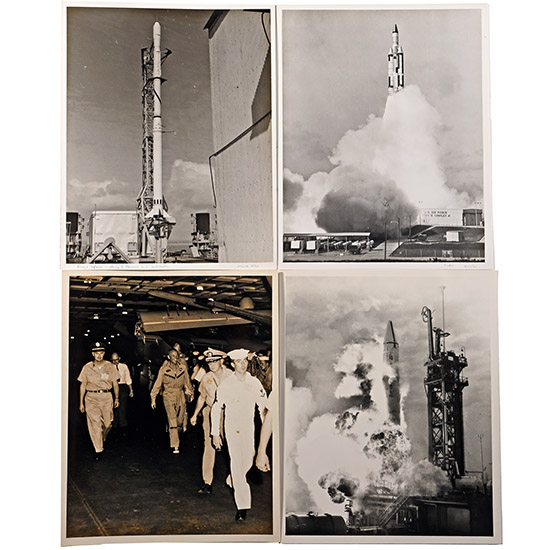
Original NASA Press Photograph Group
1962-1970 A.D.Sold for (Inc. bp): £59
Comprising monochrome gloss prints of NASA launches: an astronaut walking through a crowd of air force and navy personnel, endorsed 'NASA For Release February 22, 1962. NASA Photo no. 62-MA6-121. Cape Canaveral, FLA Aboard USS Randolph Astronaut John H. Glenn walks down the aircraft carrier's hangar deck following world orbital flight.'; rocket on launchpad in flames, endorsed 'Nasa Photo Unclassified 3-2-65 Nasa/Centaur. Cape Kennedy, FLA : 8:25 A.M. EST. March 2. 1966. The fifth experimental Atlas Centaur launch vehicle lifted off the pad, and the main stage prematurely cut off, causing the vehicle to fall back on the pad and explode.'; rocket leaving launchpad, endorsed 'U.S.Air Force Photo / Air Force Eastern T[est] Range / Photographic lLboratory Operated by [Y}CA. / P-66-75271 8/25/66 C[.]YA, Titan... Lift off of Titan ...Unclassified'; rocket on launchpad, endorsed 'NASA For Release: December 12, 1970 / Photo No. 70-H-1641 70-HC-1160 ... Kenya, Africa -- Italy to launch U.S. satellite - The first American satellite to be launched by another country will be placed in Earth orbit by a team of Italian space engineers operating from a mobile launch platform located in the Indian Ocean. The launch will take place off the coast of Kenya in East Africa, no earlier than December 12. The spacecraft is the Small Astronomy Satellite-A (SAS-A) 42 in the National Aeronautics and Space Administration's Explorer series. It is the first satellite equipped with sensitive experiments to detect high-energy X-ray sources in space, and is also known as the X-ray Explorer. Successful operation of the astronomy satellite will allow scientists to take the next giant step in astronomy -- the cataloguing of powerful X-ray sources both within and outside our galaxy, the Milky Way. During the first day of operation of its scientific instruments, the satellite is expected to collect more data than has been obtained with sounding rockets in the eight years since the science of X-ray astronomy was born.' 71 grams total, 25.3 x 20.4 - 25.3 x 20.3 cm
Acquired on the UK art market. Property of a Harwich, UK, collector. -
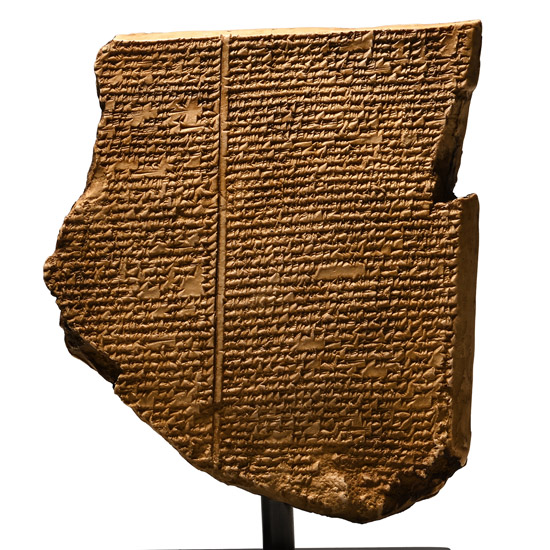
Museum Quality Replica of the Gilgamesh Tablet XI in the British Museum
21st century A.D.Sold for (Inc. bp): £260
Resin cast reproduction of the 'Gilgamesh tablet XI' with dense cuneiform text in two unequal columns on each broad face, separated by a vertical longitudinal gutter; mounted on a custom-made stand. 1.01 kg total, 20.4 cm including stand
From the collection of David Donlan (1947-2025), a dedicated and lifelong collector with a passion for the ancient world and the natural sciences, forming his collection from 1960s onwards, using many reputable dealers across the United Kingdom, including the well-regarded Coincraft and The Parthenon Gallery.
