
Loading, please wait...


LOT 0360
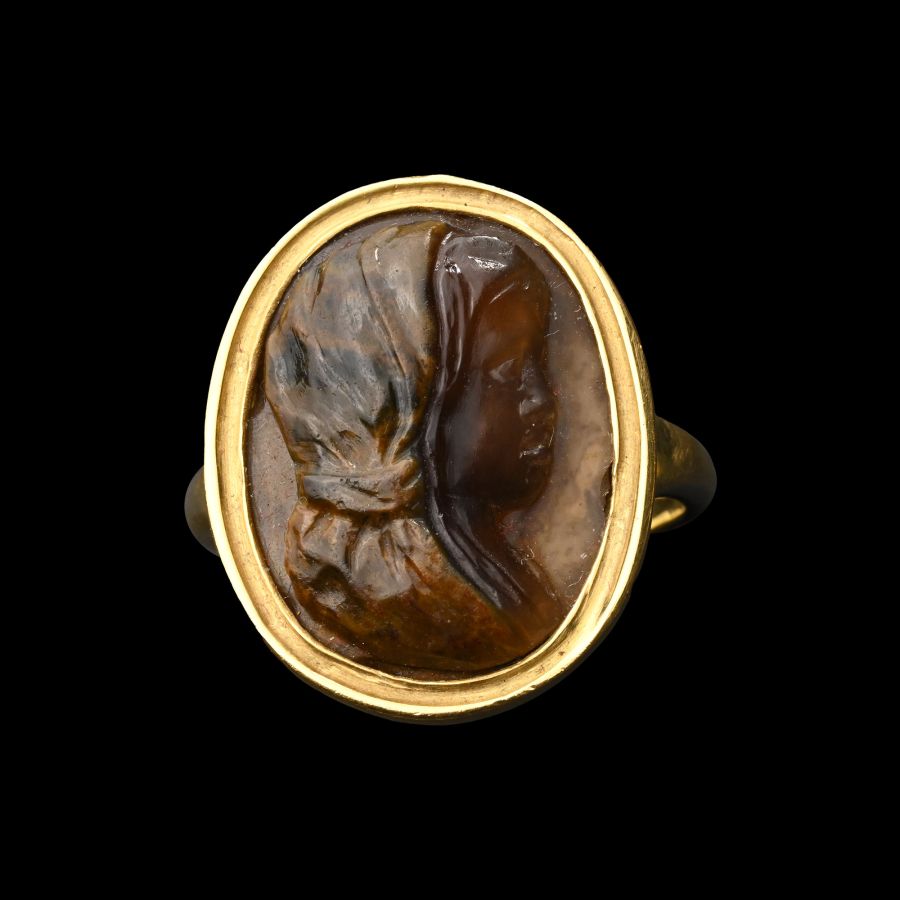
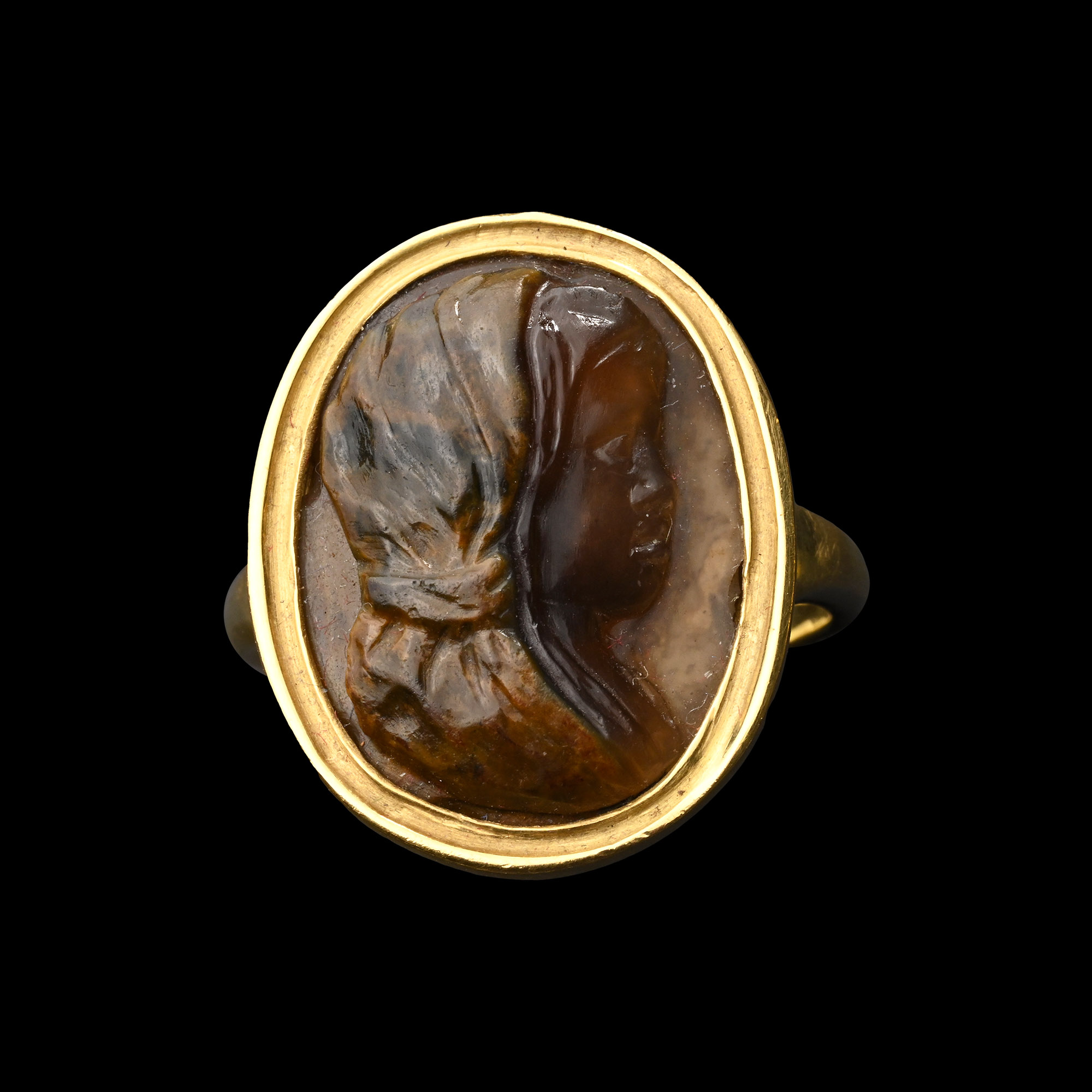
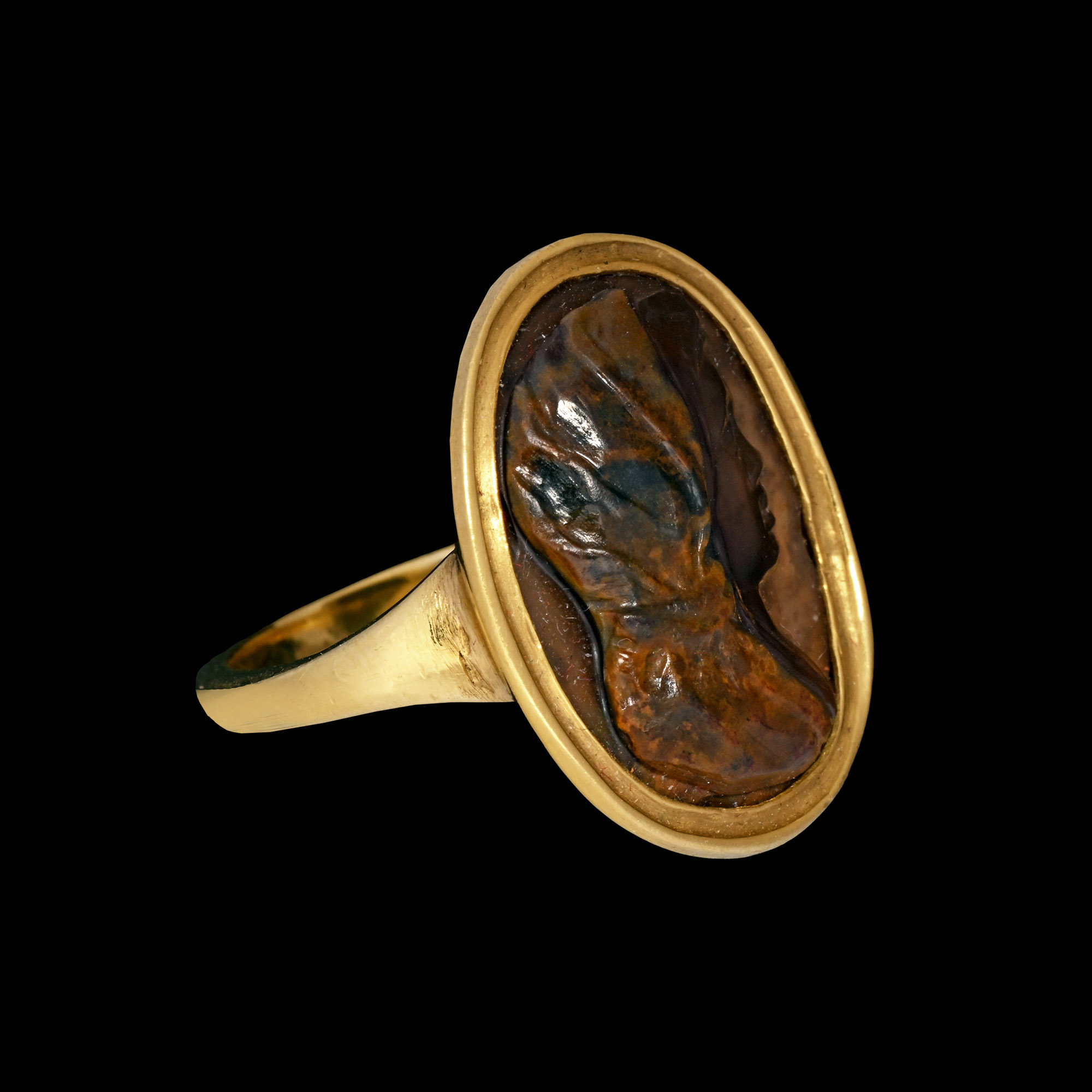
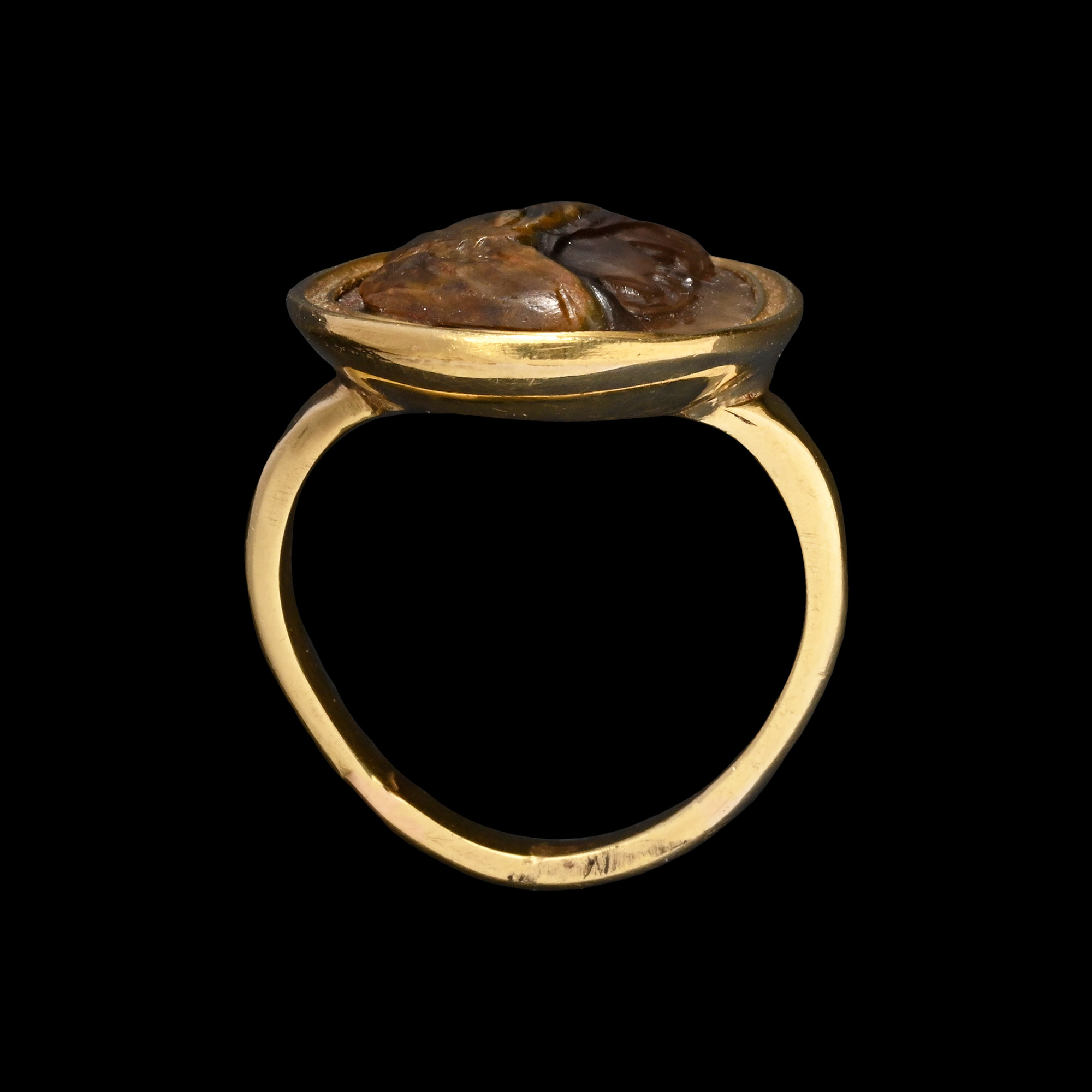
Renaissance Agate Cameo of a Woman in Gold Ring
ITALY, 16TH-17TH CENTURY A.D.
1 in. (10.26 grams, 24.74 mm overall, 18.91 mm internal diameter (approximate size British N, USA 6 1/2, Europe 13.72, Japan 13)).
Brown oval cameo depicting a profile bust of a veiled young woman with large eyes and a small button nose, set in a ring with a closed-back setting.
ProvenanceAcquired on the European art market.
This lot has been checked against the Interpol Database of stolen works of art and is accompanied by search certificate number no.13399-257955.
TimeLine Auctions follows a vetting process to ensure the authenticity and legality of all items, reinforcing our commitment to integrity and responsible trading. Each antiquity, antique, and coin lot undergoes thorough examination by a vetting committee of at least ten external specialists, professional trade association members, scientists, and archaeologists: Our Vetting Process
AUCTIONS:
TimeLine is a leading auction house specialising in antiquities, ancient art, collectables, natural history, coins, medals, and books. Our auctions offer museums, collectors, historians, and enthusiasts the opportunity to acquire unique and historically significant pieces.
LOT 0360
Renaissance Agate Cameo of a Woman in Gold Ring
Estimate £2,000 - 3,000€2,320 - 3,480 (for guidance only)$2,700 - 4,050 (for guidance only)
-
Enamelled Gold Cross Pendant with Instruments of Passion
Germany, 17th century A.D.Estimate: £2,000 - 3,000 (+bp*)
Current Winning Bid: £1,300
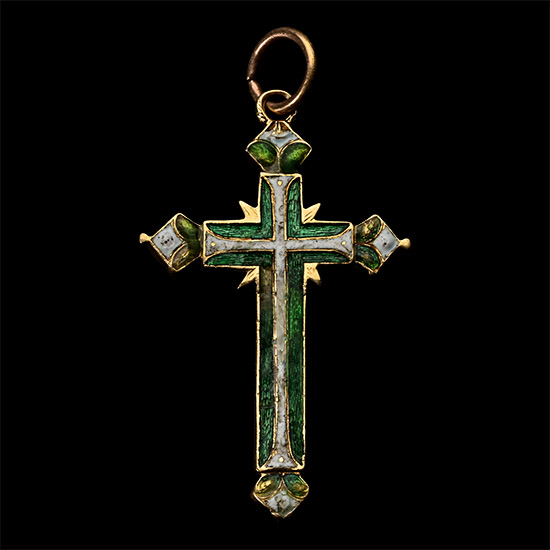
A finely executed devotional pendant in the form of a Latin cross, worked in high-carat gold and elaborately decorated on both sides; the obverse set with twelve table-cut almandine garnets, each enclosed within raised rub-over collets and inset with finely painted polychrome enamel scene depicting symbols of the Arma Christi, the Instruments of the Passion, including the scourge, hammer and pincers, the column of flagellation, rooster, dice, crown of thorns, and other emblematic motifs; the upper terminal with black enamel and bearing a gilt inscription 'INRI', an abbreviation of 'Iesus Nazarenus Rex Iudaeorum' for 'Jesus of Nazareth, King of the Jews'; the reverse with guilloché enamel in translucent green and opaque white, forming a cross with stylised foliate terminals; the pendant retaining its original integral suspension loop; some restoration on the enamel. 4.06 grams, 43 mm
Acquired on the European art market. This lot has been checked against the Interpol Database of stolen works of art and is accompanied by search certificate number no.13403-257997.
This pendant typifies early 17th-century German devotional jewellery, in which vivid enamelwork and miniature Passion iconography converge in portable, contemplative forms of piety. -
Tudor Gold 'BE . TRVE . IN . HART' Posy Ring
Circa 16th century A.D.Sold for (Inc. bp): £2,470
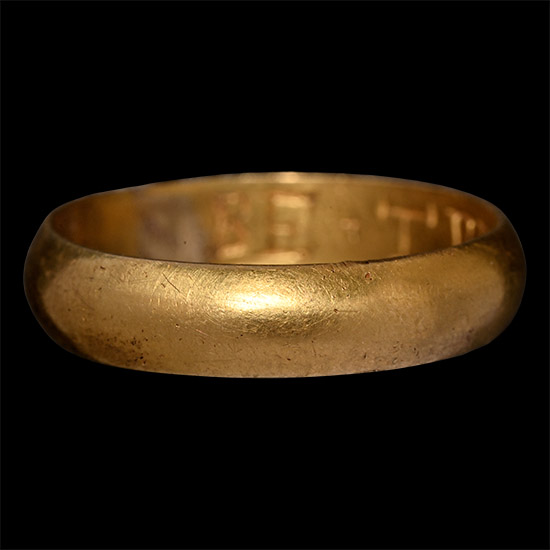
Featuring a smooth exterior and D-shaped in cross-section, a flat internal face with an inscription in upper case Roman letters, reading 'BE . TRVE . IN . HART' for 'Be true in heart' with the stops formed as small crosses and the N reversed. 4.25 grams, 20.66 mm overall, 18.06 mm internal diameter (approximate size British P, USA 7 1/2, Europe 16.23, Japan 15)
Found whilst searching with a metal detector near Edgmond, Telford & Wrekin, UK, by George Elymn, on 27 October 2024. Recorded with the British Museum's Portable Antiquities Scheme (PAS) with reference no.HESH-B237EA; handed in as Treasure under the Treasure Act, and subsequently disclaimed and returned to the finder. Accompanied by a copy of the Report for H M Coroner on finding of Potential Treasure, with reference no.2025T1645. Accompanied by a copy of a letter from the British Museum explaining that the Crown's interest in this find has been disclaimed.
The 'posy' name is derived from the 'poesy' (motto) engraved around the hoop. In medieval examples, the posy is usually found around the hoop exterior, although on later examples, inscriptions were more usually engraved on the interior. Rings with amatory inscriptions can be found from the 14th century AD onwards, when they served as love gifts, betrothal and wedding rings. Posy rings were also given to friends or used to mark significant occasions. Posies were composed by the giver, kept in stock by goldsmiths, or could be selected from published compendiums or commonplace books such as 'The Mysteries of Love or the Arts of Wooing' (1658 AD), or 'Love's Garland or Posies for Rings, Hand-kerchers and Gloves and such pretty tokens that Lovers send their Loves' (1674 AD). Rings were one genre of personal item amongst many to be adorned with posies at this time. -
Post Medieval Bronze Coins and Trade Weight Group
17th-20th century A.D.Sold for (Inc. bp): £20
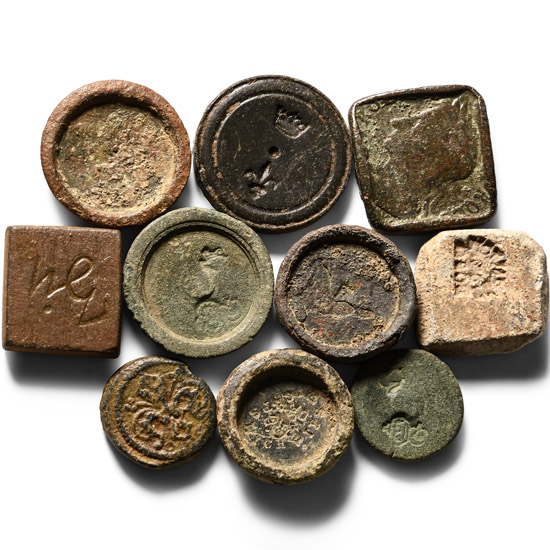
Comprising ten round and rectangular weights, including one with a crown over fleur-de-lys, one with fleur-de-lys, a square weight with profile bust, a square lead weight, and others. 59.6 grams total, 14-19 mm
Found Suffolk, UK.
