
Loading, please wait...

LOT 1248
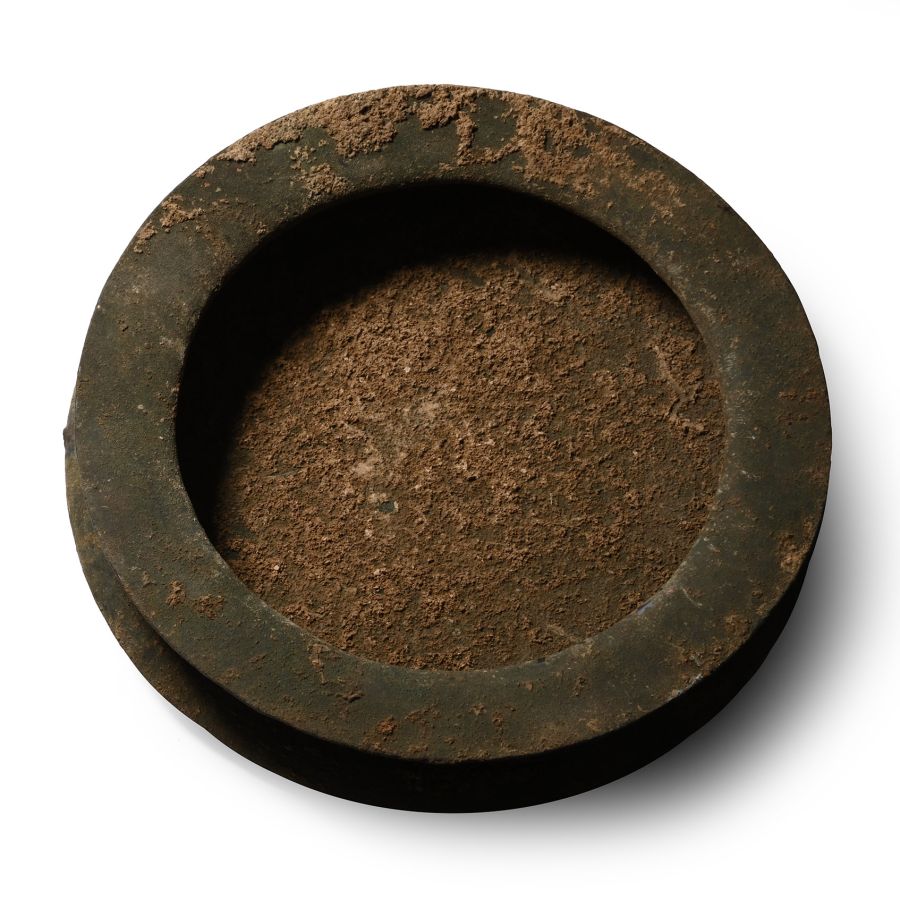
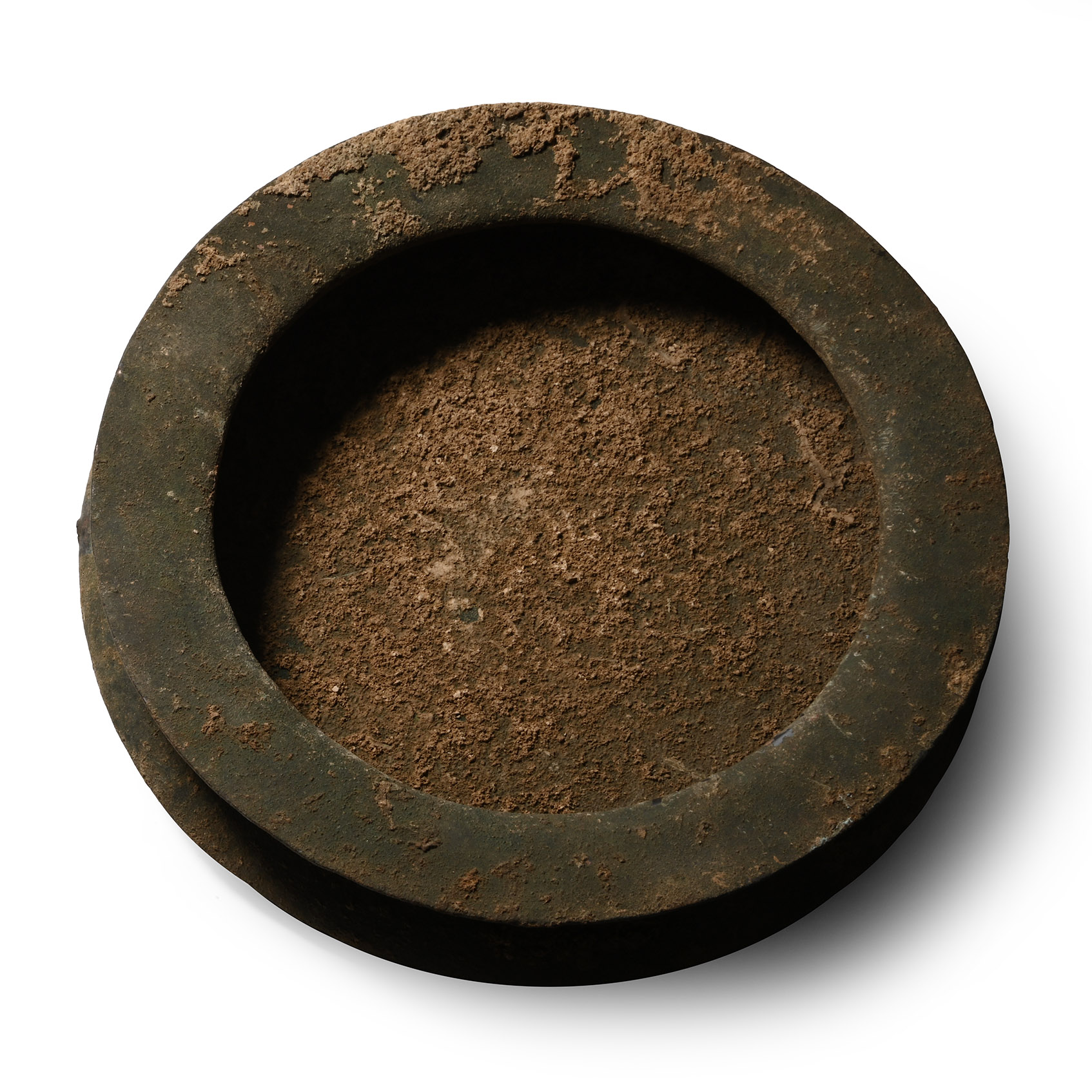
Qaznavid Bronze Dish
CIRCA 12TH-13TH CENTURY A.D.
7 3/4 in. (712 grams, 19.5 cm).
Comprising a shallow body with sharply sloping walls and wide, everted rim.
ProvenanceAcquired 1980-2015.
Ex Abelita family collection.
TimeLine Auctions follows a vetting process to ensure the authenticity and legality of all items, reinforcing our commitment to integrity and responsible trading. Each antiquity, antique, and coin lot undergoes thorough examination by a vetting committee of at least ten external specialists, professional trade association members, scientists, and archaeologists: Our Vetting Process
AUCTIONS:
TimeLine is a leading auction house specialising in antiquities, ancient art, collectables, natural history, coins, medals, and books. Our auctions offer museums, collectors, historians, and enthusiasts the opportunity to acquire unique and historically significant pieces.
-
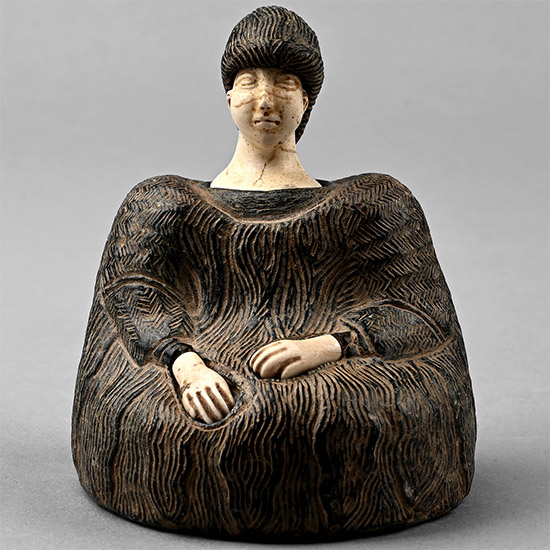
Bactrian Stone Female 'Princess' Idol
Bactria-Margiana, late 3rd-2nd millennium B.C.Sold for (Inc. bp): £11,700
Carved as a seated human figure, body with rows of overlapping tufts of fur, set with a bald head carved from cream stone with semi-naturalistic detailing to the face; a separate wig with wavy hair, and separately modelled hands. 540 grams total, 95 mm high
Palace Galleries, New York, early 2000s. Acquired by the current owner from the above. Private collection of a North American lady. This lot has been checked against the Interpol Database of stolen works of art and is accompanied by search certificate number no.13372-256950.
This wonderful composite stone sculpture of a seated female figure with finely carved features is typical of the area of Bactria-Margiana, from the late 3rd to early 2nd millennium B.C. Among the few three-dimensional images assigned to this period in Central Asia are a group of stone female figures seated or squatting on a platform and wearing a pattern-decorated robe, perhaps imitating sheep's fleece. -
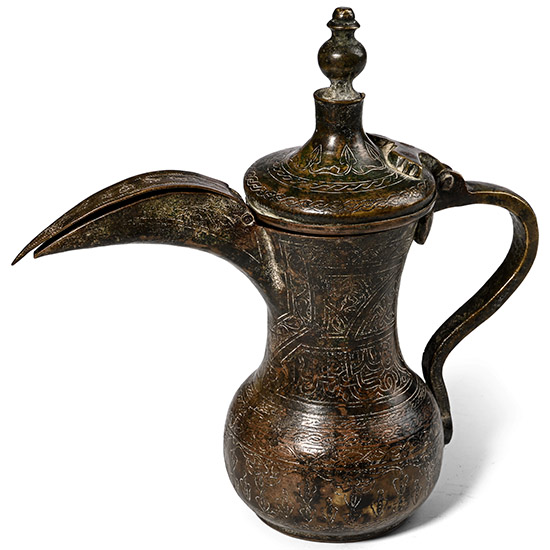
Syrian or Turkish Copper Ewer with Calligraphic Inscription
17th-18th century A.D.Sold for (Inc. bp): £338
Comprising a bulbous body with basal ring, tubular body with flared upper end, deeply curved spout with hinged cover, strap handle attached at the shoulder, hinged lid with knop handle; stamped and incised bands of guilloche, ropework, tendrils and other motifs. 621 grams, 21 cm
with Roseberys, 22 October 2020, no.204. Private collection, London, UK. -
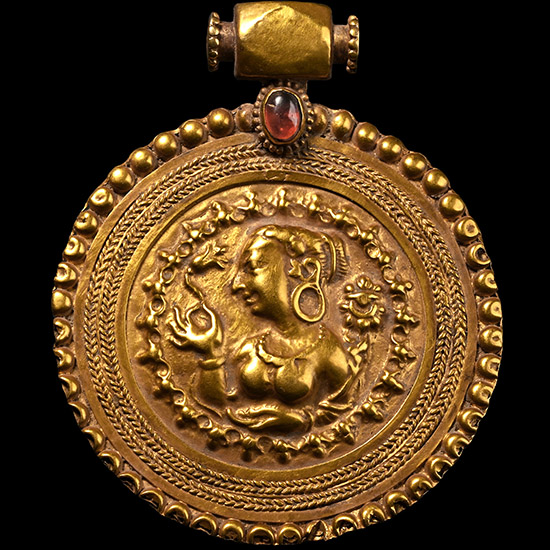
Large Kushan Gold Pendant with Bust of a Goddess
Circa 4th century A.D.Sold for (Inc. bp): £15,600
A late Kushan or Hephthalites Dynasty discoid pendant with a female deity, possibly Nana, at the centre holding a lotus flower in her right hand, hair elaborately dressed and wearing large earrings, necklace and bracelets; enclosed by a border of stylised bull heads and a double-plaited border, the outer edge with raised bosses; later applied polygonal suspension loop with granulated collars and an oval garnet cabochon. 22.11 grams, 71 mm
Acquired by a Swiss family in the mid-1980s to late 1990s, thence by descent. Private collection, Switzerland, since the late 1990s. Accompanied by an academic report by Dr Raffaele D’Amato. This lot has been checked against the Interpol Database of stolen works of art and is accompanied by search certificate number no.13021-246776.
Nana (Kushan Greek: Νανα, Ναναια, Ναναϸαο, Sogdian Nni) was a Bactrian female deity, a variation of the pan-Asian Nana, a fusion of the Sumero-Babylonian Inanna-Ishtar with a local deity, in her Kushan form with the local (Zoroastrian) Harakhvati Aredvi Sura Anahita. Such syncretism was common among Kušan deities. She was an important patron deity in the Kushan Empire and the most important deity worshipped by Emperor Kaniška (c. 127-150 A.D.).
