
Loading, please wait...


LOT 1954
Published Iron 'Peerman' Splint Holder
AUSTRIA, 18TH CENTURY A.D.
27 in. (1.7 kg, 68.7 cm).
The sprung nip on a tall stem wrought with three S-scrolls for holding spare splints, on a tripod base.
ProvenanceEx Nic McElhatton, former chairman of Christie's South Kensington.
Property of a Berkshire, UK, collector.
Accompanied by a copy of McElhatton's cataloguing page.
Accompanied by copies of the relevant book pages where published.
Ashley, Robert, The Rushlight and Related Holders - A Regional View, Ashley Publications, 2001, illustrated on p.286, no.249.
CONDITIONTimeLine Auctions follows a vetting process to ensure the authenticity and legality of all items, reinforcing our commitment to integrity and responsible trading. Each antiquity, antique, and coin lot undergoes thorough examination by a vetting committee of at least ten external specialists, professional trade association members, scientists, and archaeologists: Our Vetting Process
AUCTIONS:
TimeLine is a leading auction house specialising in antiquities, ancient art, collectables, natural history, coins, medals, and books. Our auctions offer museums, collectors, historians, and enthusiasts the opportunity to acquire unique and historically significant pieces.
LOT 1954
Published Iron 'Peerman' Splint Holder
Estimate £500 - 700€580 - 810 (for guidance only)$680 - 950 (for guidance only)
-
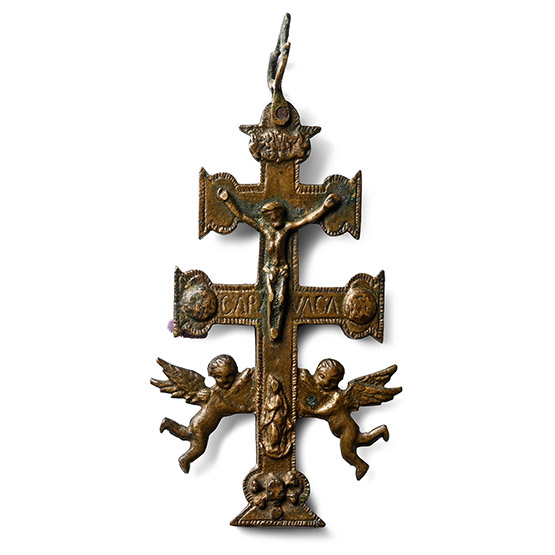
Caravaca de la Cruz Bronze Cross Pendant
17th-18th century A.D.Sold for (Inc. bp): £221
Bifacial double cross with two angels at the base carrying the cross, applied figures of Corpus Christi and Virgin Mary to one side with an inscription 'CAR VACA'; separately made reverse panel with openwork panels and foliate decoration; made as a reliquary. 101 grams, 13.7 cm
Acquired on the UK art market, early 2000s.
The Caravaca Cross, also known as the Cross of Caravaca, originated in the Spanish town of Caravaca de la Cruz and according to tradition, first appeared in the 13th century during the Christian reconquest of Spain. According to a legend, during the rule of the Muslim king Abu Zeid in 1231, a miraculous event occurred. A Christian priest lacking a cross celebrated Mass and was not able to continue as the cross is an essential element for the Eucharist. Miraculously, two angels bearing the Caravaca Cross appeared thus enabling the Mass to proceed. This event is considered the foundational miracle of the Caravaca Cross. -

Post Medieval Black Stone Ram's Head Amulet
20th century A.D.Estimate: £200 - 300 (+bp*)
Opening Bid: £150
Carved in the round with two openings for suspension hole to rear. 13.39 grams, 32 mm
Private collection, England. -
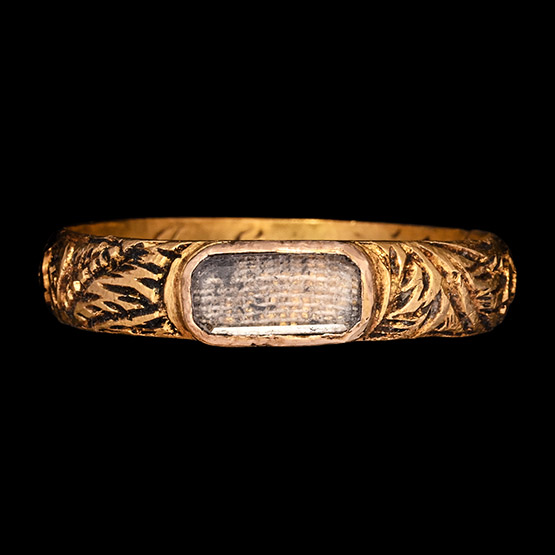
Stuart Period Gold Mourning Ring with Rock Crystal Gemstone
England, 18th century A.D.Sold for (Inc. bp): £2,860
Decorated with black enamelled foliate engraving; bezel set with a table cut rock crystal compartment containing some hair of the deceased; inner face engraved ‘Capt(ain). G Squrritt ob 1 Jan 1724’ and the maker's mark ‘GE’. 3.33 grams, 20.04 mm overall, 17.17 mm internal diameter (approximate size British M, USA 6, Europe 12.46, Japan 12)
Private collection, Europe. Acquired on the English art market. This lot has been checked against the Interpol Database of stolen works of art and is accompanied by search certificate number no.13055-248357.
Mourning rings were made to commemorate the death of an individual. Similar examples are held in the British Museum's collection, including AF.1547; AF.1551; AF.1550; AF.1552; AF.1549. While the majority of mourning rings tend to refer to the deceased by initials and death only, this ring mentions the deceased's family name in full, which is usually the case for people of note/influence.
