
Loading, please wait...
LOT 0055
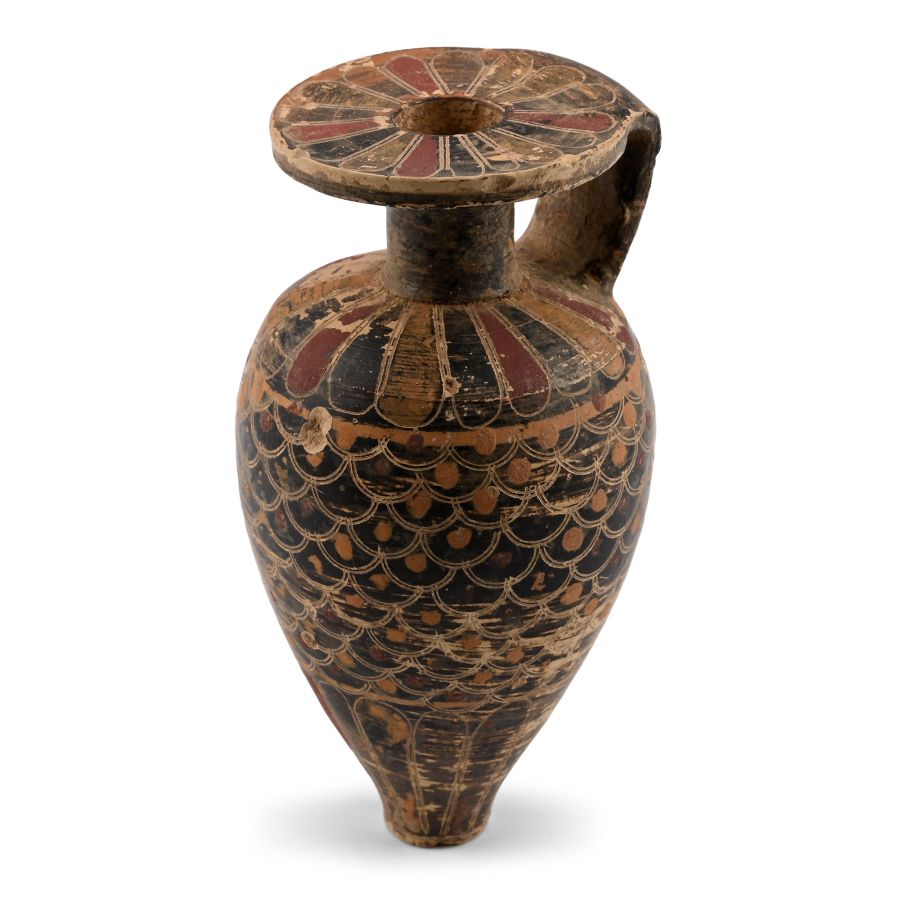
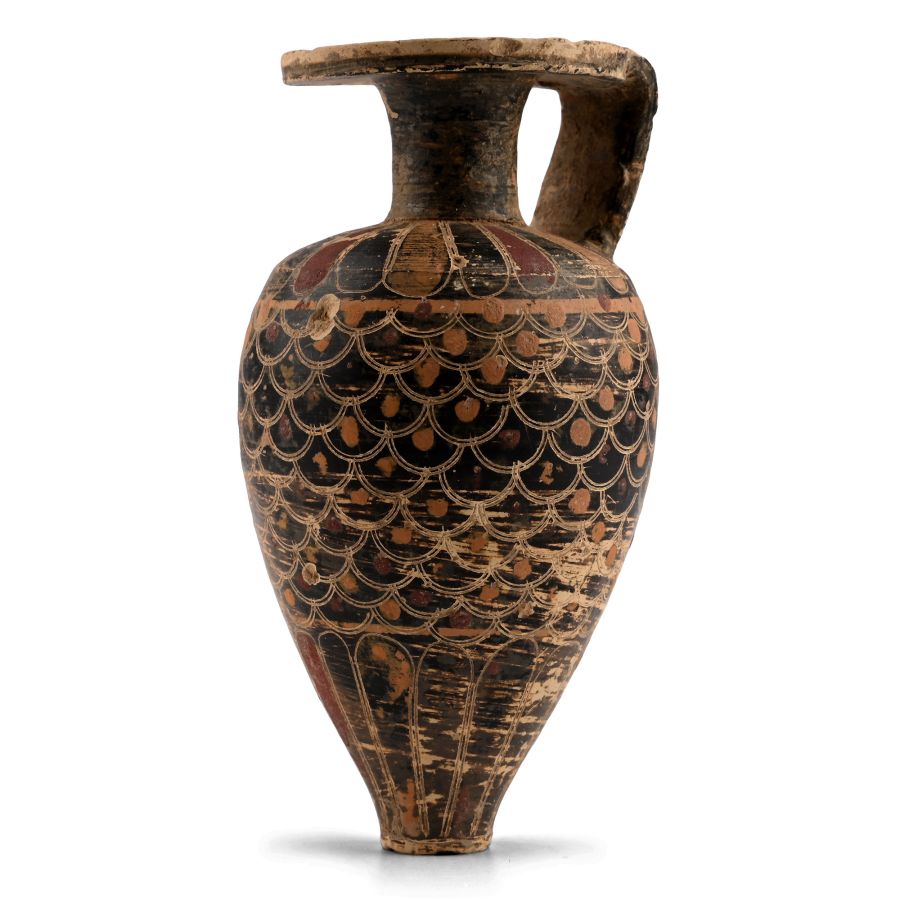
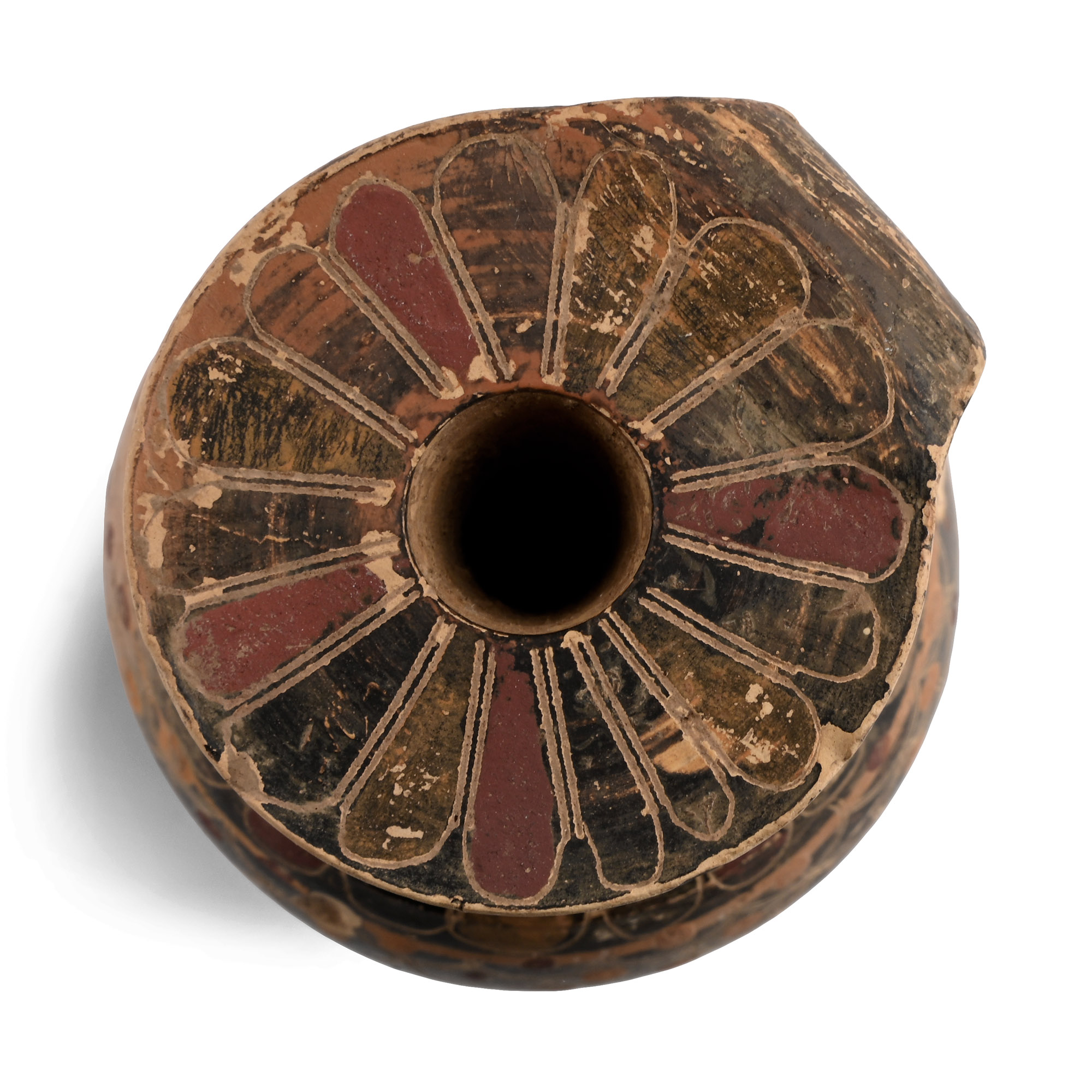
Proto-Corinthian Painted Terracotta Aryballos
7TH CENTURY B.C.
4 1/8 in. (79 grams, 10.5 cm).
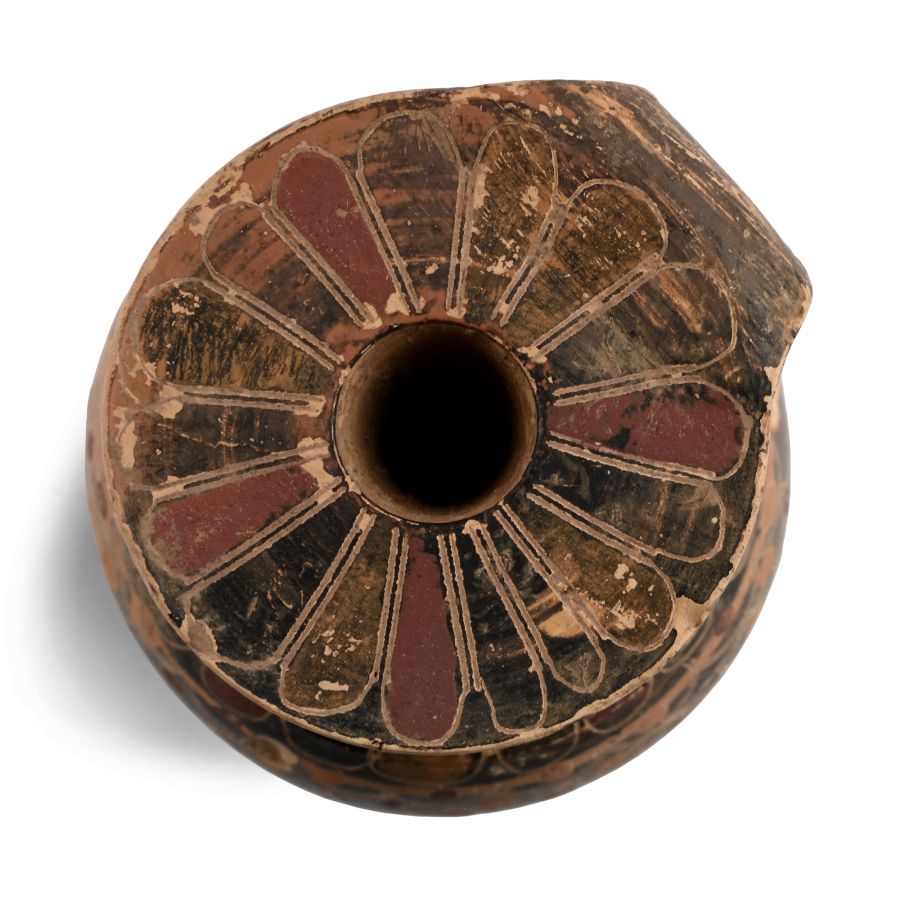
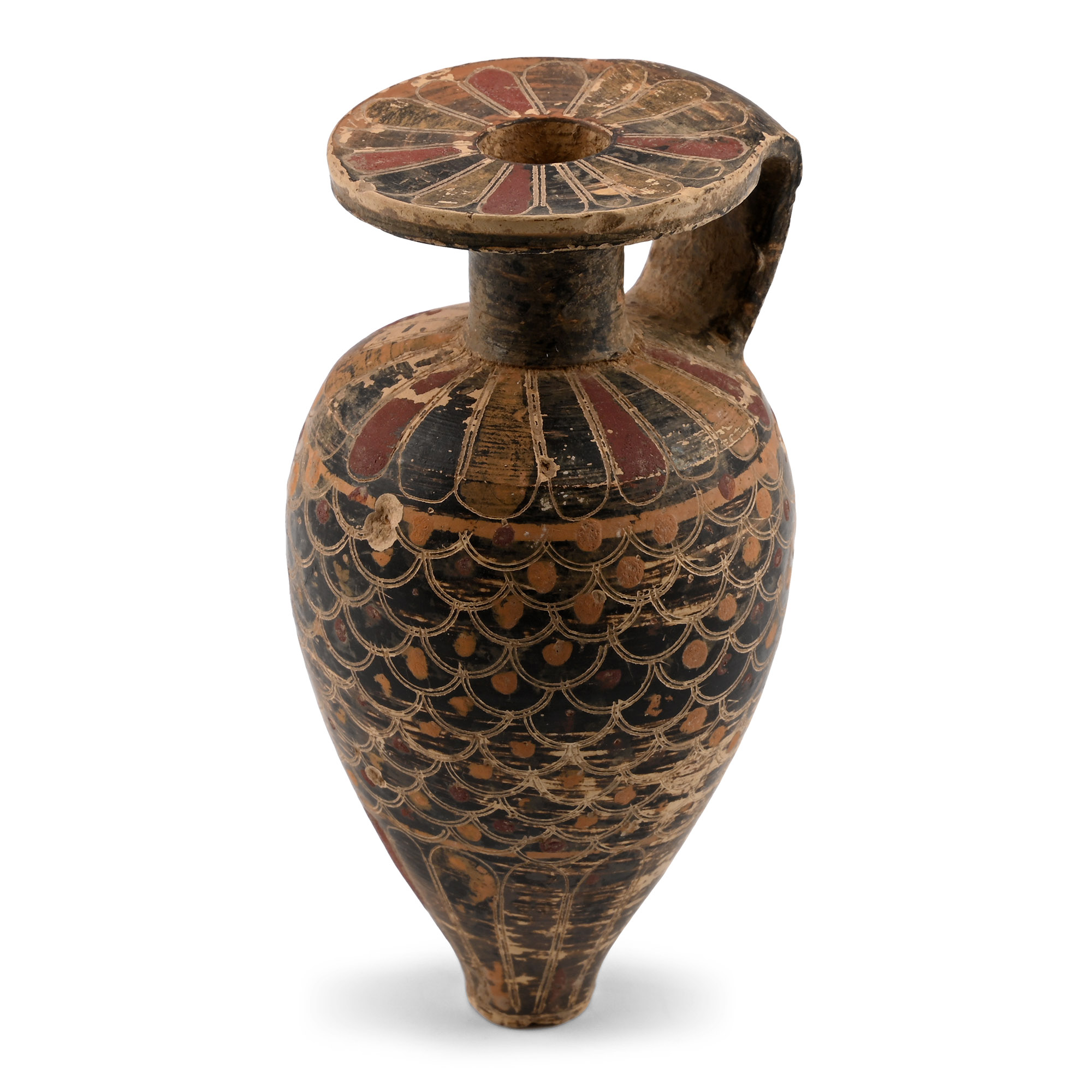
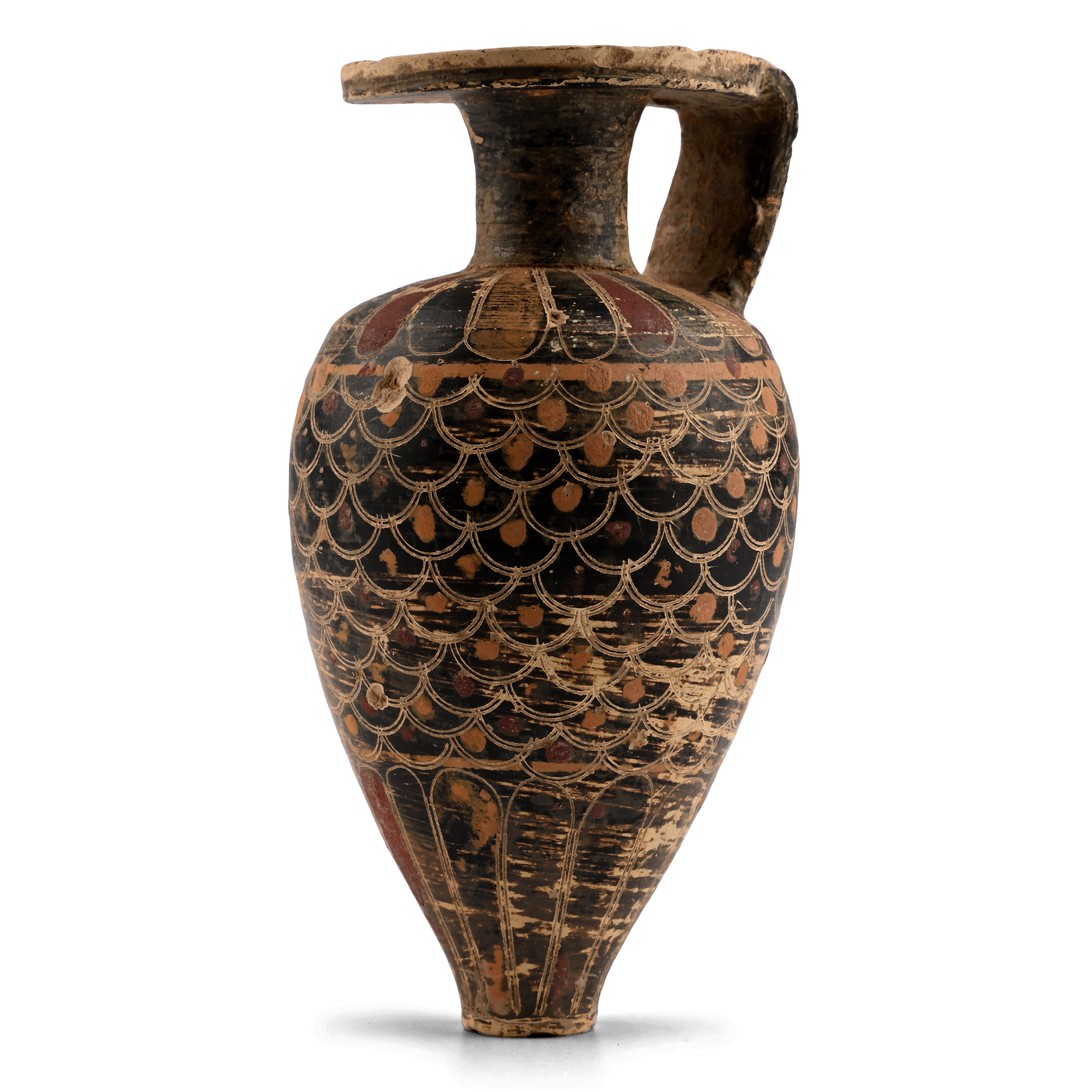
Comprising a piriform body and a tubular neck with a wide rim, a strap handle to the rear, the rim with painted polychrome petals, the pattern repeating beneath the neck and on the base of the vessel; the body decorated with fishscale decoration.
ProvenanceSwiss private collection, assembled in the 1960s and 1970s.
Acquired by the present owner in 2004.
Accompanied by an academic report by Dr Raffaele D’Amato.
This lot has been checked against the Interpol Database of stolen works of art and is accompanied by search certificate number no.30017-246794.
Cf. for similar aryballoi, the Metropolitan Museum of Art, New York, accession nos.37.128.1 and 07.286.38; cf. also Anderson, J.K., ‘The Corinthian Pottery’ in Annual of the British School at Athens, Vol.53/54 (1958/1959), pp.138-151, no.84 pl.24; Saka A. and Aktaş R., ‘A group of archaic pottery from Çandarli at the Izmir Archaeological Museum in Gürtekin Demir R.G., Cevizoğlu, H., Polat Y. & Polat G. (eds), Archaic and Classical Western Anatolia: New Perspectives in Ceramic Studies, Proceedings of the second Keramos international conference at Ege University, Izmir, 3–5 June, 2015, Leuven – Paris – Bristol, 2018 cat.12-13 p.272; a lower portion of a similar Proto-Corinthian piriform aryballos was found in Sardis, see Sardis Museum inventory no.P61.252, and Schaeffer, J., Monograph 10: The Corinthian, Attic, and Lakonian Pottery from Sardis, Harvard, 1997, cat.no.48; for a comprehensive list of other examples in public and private collections see the fundamental work of Neeft, C.W., Protocorinthian Subgeometric Aryballoi (Allard Pierson Series, vol. 7), Amsterdam, 1987, pp. 282f., list 274, CX, CXI, CXIII, CXIV: NC 478A type1; on the scale patterns in general, ibid. pp.275-289.
FootnotesThe aryballoi were used to hold perfumed oil, an essential item for the wealthy middle classes of the time. Similar piriform vases are fairly common in Corinthian contexts. There is utmost precision in both the potting and the execution of the incised scale pattern of the present example. The fish-scale decoration was realised with the incision technique, by executing the scales neatly with their ends meeting.
CONDITIONTimeLine Auctions follows a vetting process to ensure the authenticity and legality of all items, reinforcing our commitment to integrity and responsible trading. Each antiquity, antique, and coin lot undergoes thorough examination by a vetting committee of at least ten external specialists, professional trade association members, scientists, and archaeologists: Our Vetting Process
AUCTIONS:
TimeLine is a leading auction house specialising in antiquities, ancient art, collectables, natural history, coins, medals, and books. Our auctions offer museums, collectors, historians, and enthusiasts the opportunity to acquire unique and historically significant pieces.
-
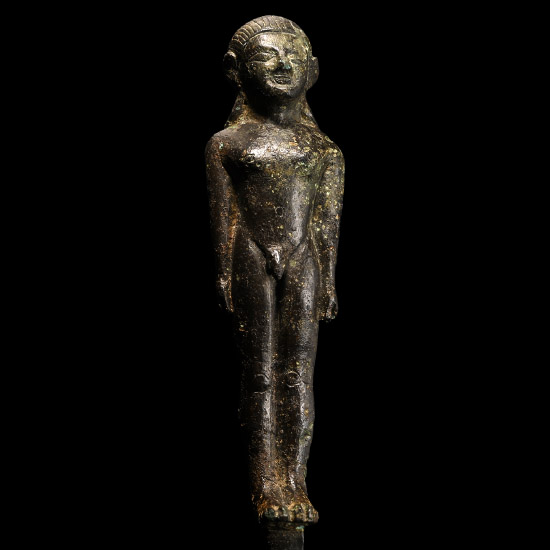
Etruscan Bronze Figure of a Kouros
Late 6th century B.C.Estimate: £2,000 - 3,000 (+bp*)
Current Winning Bid: £1,200
Depicting a youthful nude kouros standing frontally, with a long, slender body, broad shoulders, a narrow waist, and arms hanging close to the sides; the head, slightly oversized, characterised by an oval face, large almond-shaped eyes, an Archaic smile, and finely modelled ears, the hair arranged in beaded locks framing the forehead and falling onto the shoulders, reflecting the influence of contemporary Greek Archaic sculpture; standing on an integral rectangular base provided with a long tang for attachment. 118 grams, 11.2 cm
Acquired on the European art market between 1960s and 1980s. English private collection, property of a gentleman. Bertolami Fine Art, London, Auction 54, 9 November 2018, no.88. This lot has been checked against the Interpol Database of stolen works of art and is accompanied by search certificate number no.13320-258214.
The elegant proportions and linear modelling place the statuette within the widespread production of Etruscan votive bronzes of the Late Archaic period, probably intended as a sanctuary dedication. -
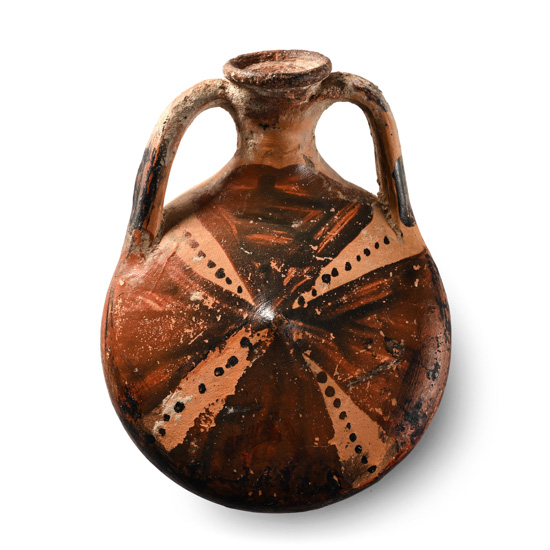
Mycenaean Painted Pottery Flask
14th-13th century B.C.Sold for (Inc. bp): £1,820
Comprising a circular body with a rounded base and two strap handles, a short neck with an everted rim; the body with a painted expanding cross motif with the arms separated by a band of pellets. 132 grams, 11.1 cm
Private collection, Switzerland, acquired in the 1994. Private family collection since the late 1990s. Accompanied by an academic report by Dr Raffaele D'Amato. This lot has been checked against the Interpol Database of stolen works of art and is accompanied by search certificate number no.13018-246795.
Mycenaean ceramics were influenced by Minoan shapes and decorative styles from the late Middle Helladic period. This close relationship – likely accompanied by the development of shared cultural practices and etiquette – creates the hypothesis that pilgrim flasks were introduced to Greece via Crete. Pilgrim flasks were produced in Mycenaean contexts from the Late Helladic IIA:1 period (1420-1390 B.C.). -
.jpg)
Parthian Carnelian Gemstone of a Goat-Headed Rhyton in Gold Ring
4th century B.C.-220 A.D.Estimate: £2,000 - 3,000 (+bp*)
Opening Bid: £1,000
Achaemenid or Parthian oval intaglio engraved with a style standing at the threshold between natural and stiff rigid linear style, depicting a goat-headed rhyton, the vessel terminating in the forepart of a wild goat with the front leg tucked under the body, the head rendered in profile with elegantly arched horns, pronounced muzzle, and carefully incised eye; the neck of the conical rhyton decorated with diagonal and cross-hatched incisions suggesting ribbing or chased metalwork; set in a modern gold ring with a small triangular area at the top left of the stone filled in with gold; supplied with a museum-quality impression. 8.51 grams, 24.02 mm overall, 21.18 mm internal diameter (approximate size British P, USA 7 1/2, Europe 16.23, Japan 15)
Acquired on the European art market. This lot has been checked against the Interpol Database of stolen works of art and is accompanied by search certificate number no.13356-257945.
The subject, a rhyton terminating in an animal protome, belongs to a well-established tradition in Eastern Greek and Achaemenid art of the late Archaic and Classical periods, in which zoomorphic libation vessels were used in ritual and ceremonial contexts. Goat-headed rhyta, though less commonly preserved in glyptic media, are attested in silver and ceramic examples, notably from Asia Minor and Thrace. The stylised horned animal, here likely a wild goat or ibex, is associated with vitality and mountain symbolism, while the rhyton itself signals elite drinking culture and votive use. The use of carnelian is typical of high-quality glyptic production in the 6th to 4th century BC, valued for its durability and ability to take a fine polish. The style and iconography suggest an Eastern Mediterranean origin, most probably Ionian or Anatolian.
