
Loading, please wait...
LOT 0217
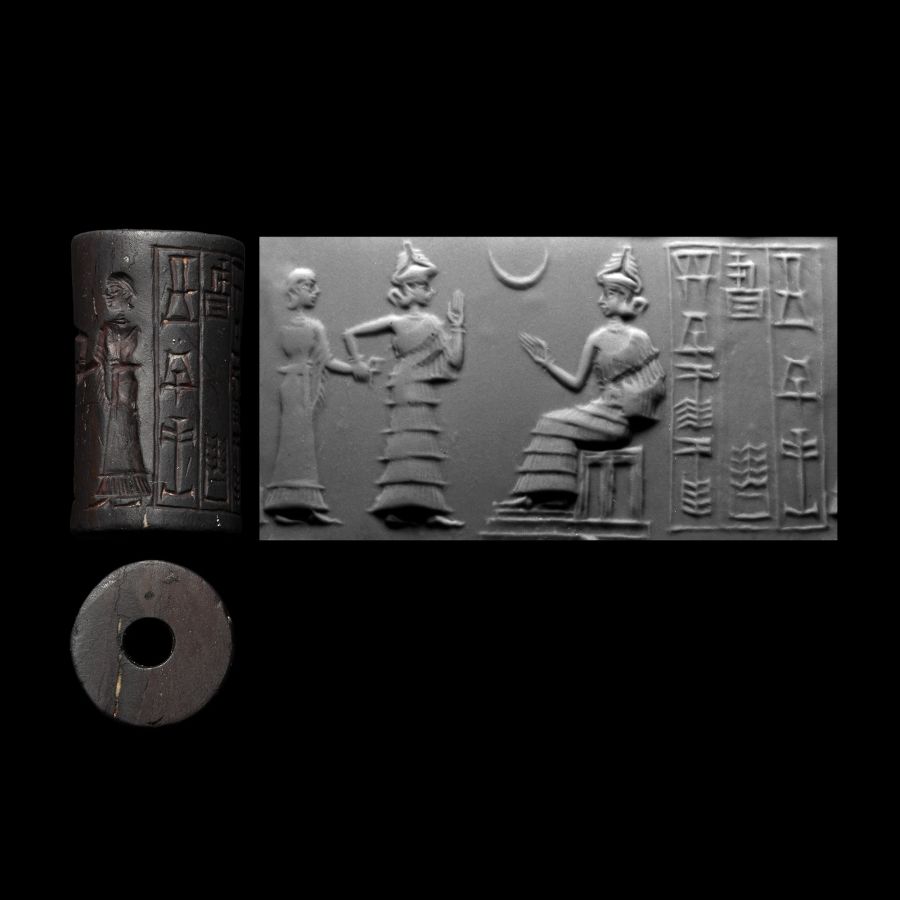
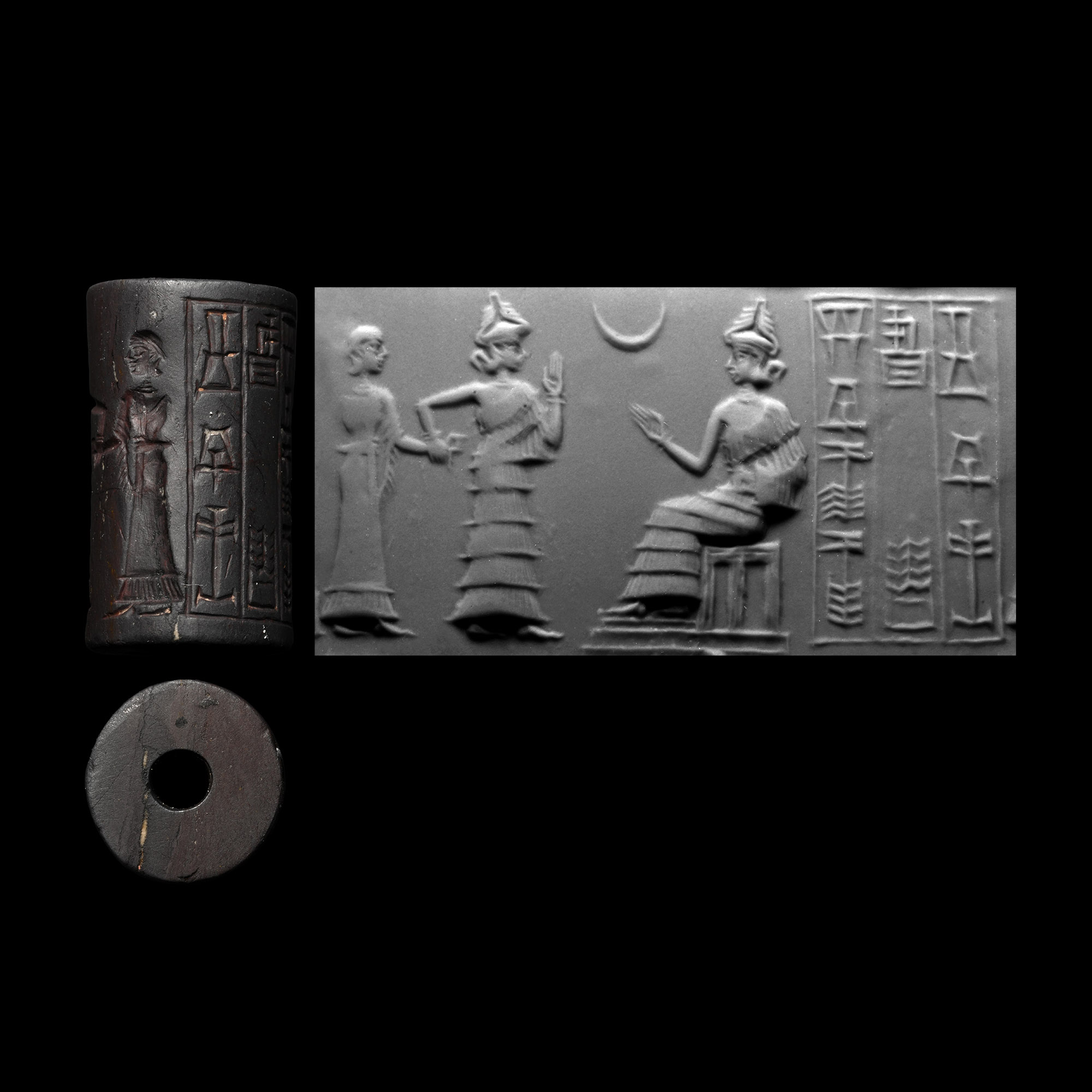
'Professor Erlenmeyer’s First Cylinder Seal' A Neo-Sumerian Haematite Seal of Abbamu, Scribe, Son of Bazige
MESOPOTAMIA, THIRD DYNASTY OF UR, CIRCA 2100-2000 B.C.
1 in. (18 grams, 27 mm).
Finely carved in haematite with a formal presentation scene: a goddess sitting enthroned upon a dais, clad in a flounced robe and a multiple-horned tiara, her arm extended in reception; before her a similarly attired interceding goddess approaching, leading a robed worshipper into the divine presence; lunar crescent in the field, with three-line inscription within a panel: 'Abbamu, scribe, son of Bazige'; supplied with a museum-quality impression.
ProvenanceFrom the private collection of Professor Dr. Hans (1900-1967) and Mrs Erlenmeyer, Switzerland.
The Erlenmeyer Foundation, Basel Switzerland, since 1981.
with Sotheby's, Western Asiatic Cylinder Seals and Antiquities from the Erlenmeyer Collection (Part 1), London, 9 July 1992, no.109.
Private collection, London, UK.
Accompanied by copies of the relevant Sotheby's catalogue pages.
This lot has been checked against the Interpol Database of stolen works of art and is accompanied by search certificate number no.13283-253486.
Prof Hans Erlenmeyer was a noted Swiss collector from 1943 to circa 1960; he and his wife established the Erlenmeyer Foundation.
This seal is of particular note as the first cylinder seal given to Professor and Mrs Erlenmeyer. Its imagery belongs to the religious and political language of the Third Dynasty of Ur, when order was restored after the collapse of the Akkadian dynasty. In the eyes of the ancient Mesopotamians, that earlier collapse could be understood as a sign of divine displeasure; under Ur III, renewed piety and correct devotion assumed central importance. The presentation scene seen here reflects that world precisely: the seal owner is led by a minor goddess, or Lamma, into the presence of his personal deity. Seals of this class are valued for their exacting workmanship and disciplined clarity of design. Though they lack the freer energy of the Akkadian age, they possess instead a ceremonial gravity and devotional precision that are wholly characteristic of Neo-Sumerian art.
TimeLine Auctions follows a vetting process to ensure the authenticity and legality of all items, reinforcing our commitment to integrity and responsible trading. Each antiquity, antique, and coin lot undergoes thorough examination by a vetting committee of at least ten external specialists, professional trade association members, scientists, and archaeologists: Our Vetting Process
AUCTIONS:
TimeLine is a leading auction house specialising in antiquities, ancient art, collectables, natural history, coins, medals, and books. Our auctions offer museums, collectors, historians, and enthusiasts the opportunity to acquire unique and historically significant pieces.
LOT 0217
'Professor Erlenmeyer’s First Cylinder Seal' A Neo-Sumerian Haematite Seal of Abbamu, Scribe, Son of Bazige
Sold for (Inc. bp): £8,450
-
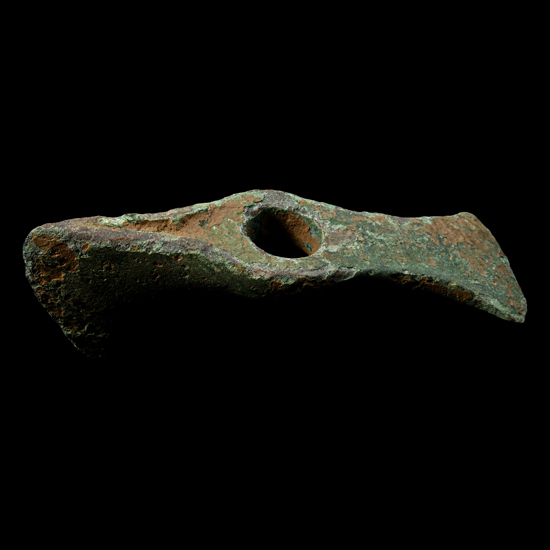
Luristan Bronze Socketted Adze-Axehead
2nd-1st millennium B.C.Sold for (Inc. bp): £117
Comprising a triangular-section blade with a curved cutting edge and a rectangular-section blade with a gently curving cutting edge flanking a round socket. 741 grams, 19 cm
Ex Abelita family collection, 1980s-2000s.
The adze-axe was a fundamental weapon of many Bronze Age cultures around the world. The form lends itself to dual purposes - for war and peace. As a tool, it was used for fabricating wood; as a weapon, its heavy mass and compact form make it a deadly striking and chopping weapon, even able to defeat light armour. -
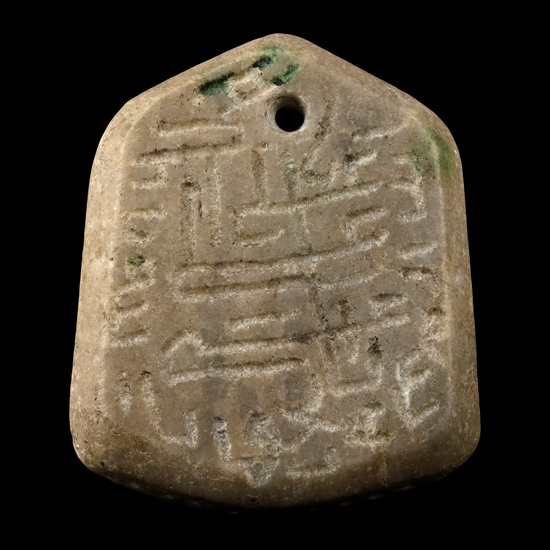
Western Asiatic Stone Talisman Pendant
Circa 9th-13th century A.D.Sold for (Inc. bp): £26
Hexagonal in plan with rounded sides ornamented with a row of roundels, holed at the top; inscribed legend to both faces. 51.9 grams, 51 mm
Formerly in an old French collection. Ex Marc Labarbe, Toulouse France. Property of a West Northamptonshire, UK, gentleman. -
.jpg)
Western Asiatic Black Terracotta Cuneiform Tablet
2nd millennium B.C.Estimate: £1,200 - 1,700 (‡+bp*)
Opening Bid: £600
Pillow-shaped with columnar ribbing to the broad faces, dense cuneiform text in the columns. 57.2 grams, 63 mm
Private collection of Mr K., Maryland, USA. Private collection, Switzerland, acquired in 2000. This lot has been checked against the Interpol Database of stolen works of art and is accompanied by a search certificate number no.12893-241757.
The 2nd millennium B.C. (about 2000–1000 B.C.) was an important period in the ancient Near East, when major civilisations such as the Babylonians, Assyrians, Hittites, and Egyptians grew in power and influence. It was a time of progress in trade, government, law, and writing, helping us understand how people lived and worked. Cuneiform tablets, which are small clay tablets written in one of the earliest writing systems, were widely used to record business, legal matters, letters, and stories. When these tablets are found outside their place of origin, it can show connections through trade, travel, or official communication, offering insight into both the ancient world and how such objects later moved through collections.
