
Loading, please wait...
LOT 0750
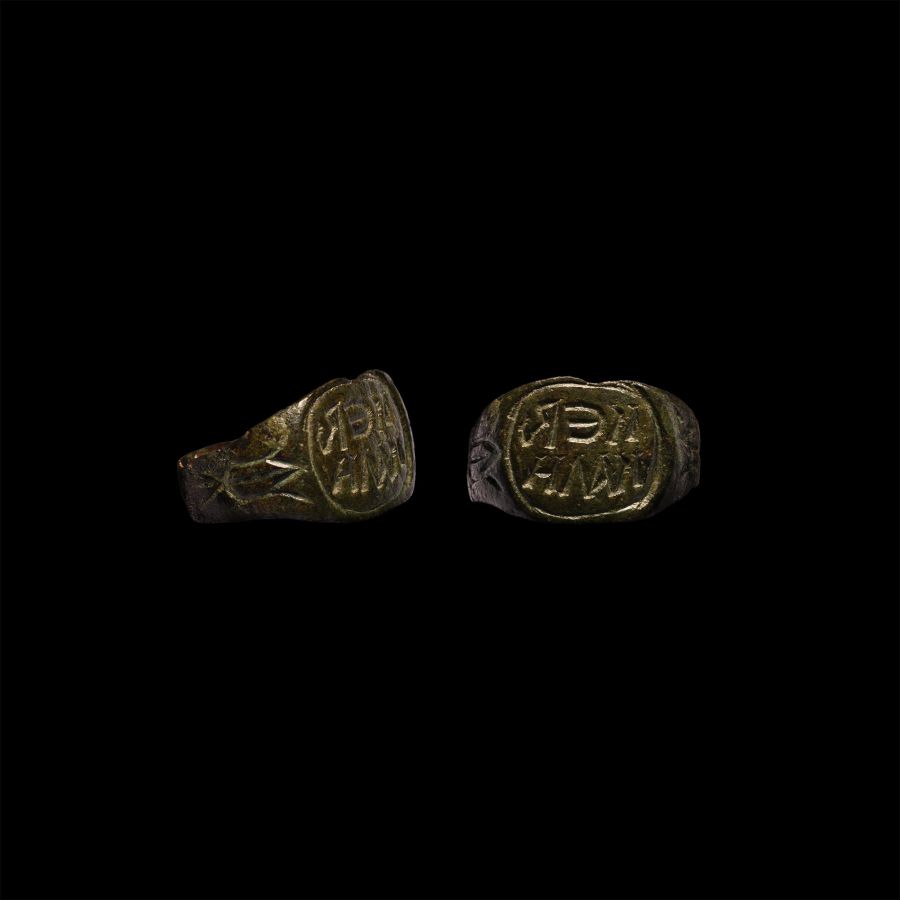
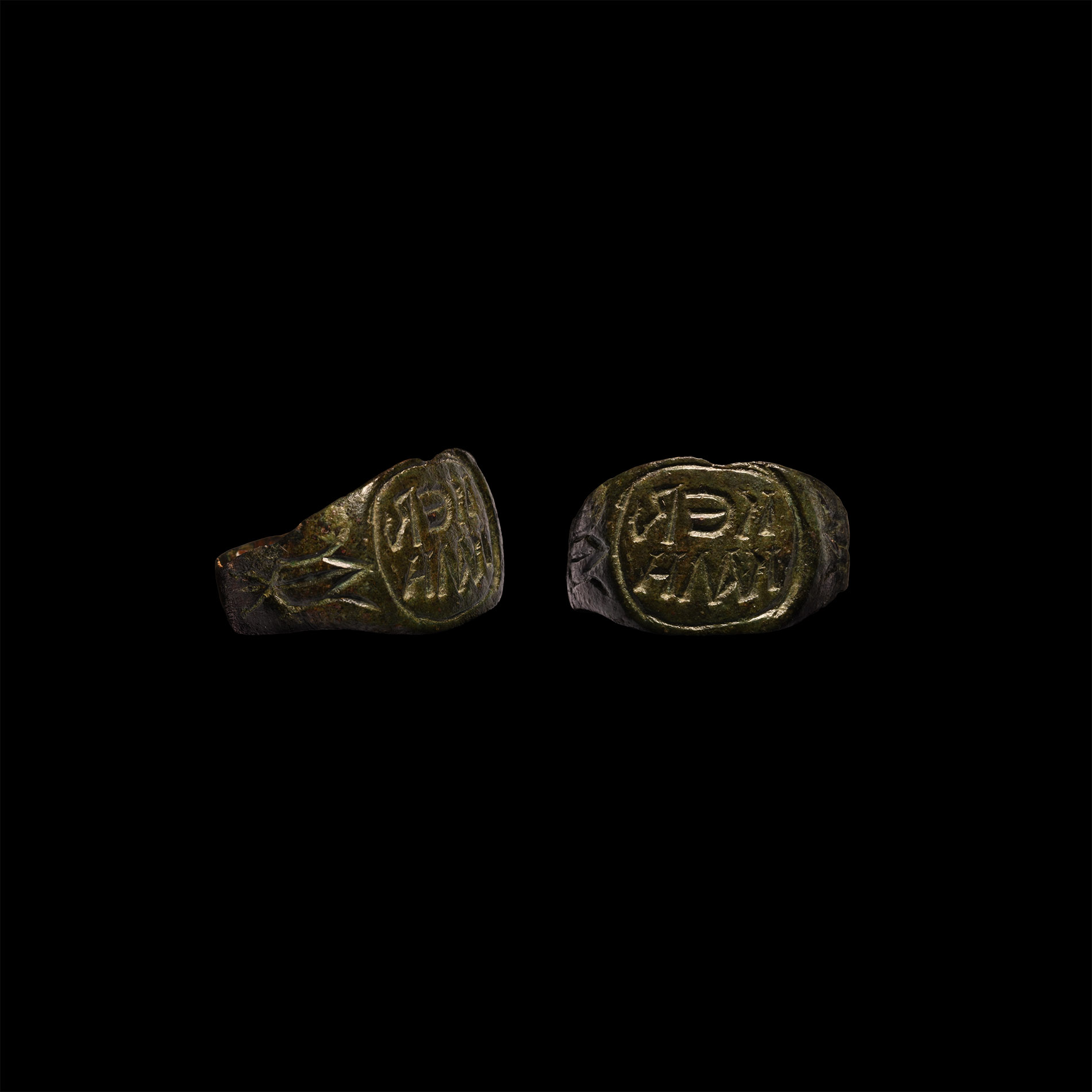
Post Roman Ring with Inscription
6TH-7TH CENTURY A.D.
1 in. (4.33 grams, 23.12 mm overall, 21.00 mm internal diameter (approximate size British U 1/2, USA 10 1/4, Europe 23.15, Japan 22)).
A bronze finger ring with raised ellipsoid bezel, the shoulders decorated with engraved foliage, on the bezel incised in Greek letters the inscription 'ΚΕΡΙ ΚАΛΗ' (written backwards).
ProvenanceAcquired in the late 1990s-2000.
Property of an East London gentleman.
Cf. Hadjadj, R., Bagues Merovingiennes - Gaul du Nord, Paris, 2007, item 454, for type.
FootnotesThe ring corresponds to the 1d type of Hadjadj's classification. The Greek inscription is probably a barbaric interpretation of 'ΚΗΡΙ ΚАΛΗ' (kind-hearted). The Merovingian typology of the ring suggests a late Roman product under the Roman-Barbarian kingdoms of Gaul or the Iberian Peninsula.
CONDITIONTimeLine Auctions follows a vetting process to ensure the authenticity and legality of all items, reinforcing our commitment to integrity and responsible trading. Each antiquity, antique, and coin lot undergoes thorough examination by a vetting committee of at least ten external specialists, professional trade association members, scientists, and archaeologists: Our Vetting Process
AUCTIONS:
TimeLine is a leading auction house specialising in antiquities, ancient art, collectables, natural history, coins, medals, and books. Our auctions offer museums, collectors, historians, and enthusiasts the opportunity to acquire unique and historically significant pieces.
-
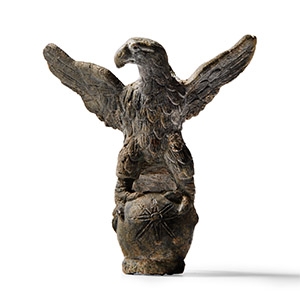
Roman Military Eagle Staff Terminal
2nd-3rd century A.D.Sold for (Inc. bp): £11,050
A free-standing bronze imperial or military eagle terminal from a staff or a sceptre, modelled in the round in a dynamic pose standing on a globe, wings spread, head turned to the right, semi-naturalistic anatomical and feather detailing; the globe bearing an incised eight-armed stylised Macedonian star; sub-triangular lug to back of the neck; collar to globe with hollow underside. 166 grams, 88 mm high
with Bonham's, London, Knightsbridge, UK, 16 May 2002, lot 301. Accompanied by a copy of the relevant Bonhams catalogue pages. Accompanied by an academic report by Dr Raffaele D'Amato. This lot has been checked against the Interpol Database of stolen works of art and is accompanied by search certificate number no.11582-198947
In the Roman world, the eagle was associated with the god Jupiter or Zeus, king of the Olympian gods, and was seen as ‘the symbol and agent of apotheosis after death’. An eagle was released from the top of an emperor’s funeral pyre to signal the journey of the soul towards heaven. A sacred attribute of Jupiter, this eagle terminal may have been attached to a sceptre of the statue of the god. Eagles were also the principal standard of the legions, and became the military symbol for excellence. -
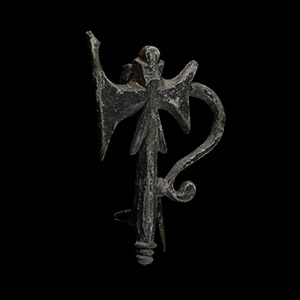
Roman Axe Plate Brooch
2nd-3rd century A.D.Sold for (Inc. bp): £117
A bronze plate brooch formed as an axe, scrolled tendrils to socket and butt, slender handle; hinged pin and catch to the reverse. 13.6 grams, 47 mm
Acquired before 2000. From the collection of a European gentleman living in the UK.
The fibula, made for a military cloak, belongs to the type 28 of Jobst classification. Similar fibulae were widespread in the central part of the Limes between Germania Superior and Raetia. -
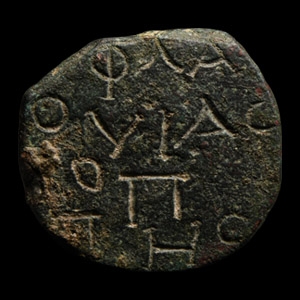
Late Roman Double-Sided Bulla with Inscription
4th-5th century A.D.Sold for (Inc. bp): £130
A bronze discoid bulla, cut from a larger bronze plaque in antiquity with fragments of Greek inscription; Side A: 'ΦΛΑ [..]/ΟΥΙΑC/ YΟΠΠΗC[..]'; Side B: '[..]N[..]ENΤΙΟΥ/EΠΙCΚOΠΟΥ'. 165 grams, 58 mm
Acquired 1969-1999. London collection of the late S.M., thence by descent.
The bulla probably belonged to a bishop, probably to a certain Vinkentios (N[..]ENΤΙΟΥ/EΠΙCΚOΠΟΥ = of Vincentius Bishop) and as well as a woman named Flavia from Joppa (ΦΛΑ [..]/ΟΥΙΑC/ YΟΠΠΗC), probably his servant. It could have been used as a weight or as a personal sign to fulfil various activities in the name of the owner.
