
Loading, please wait...
LOT 0278
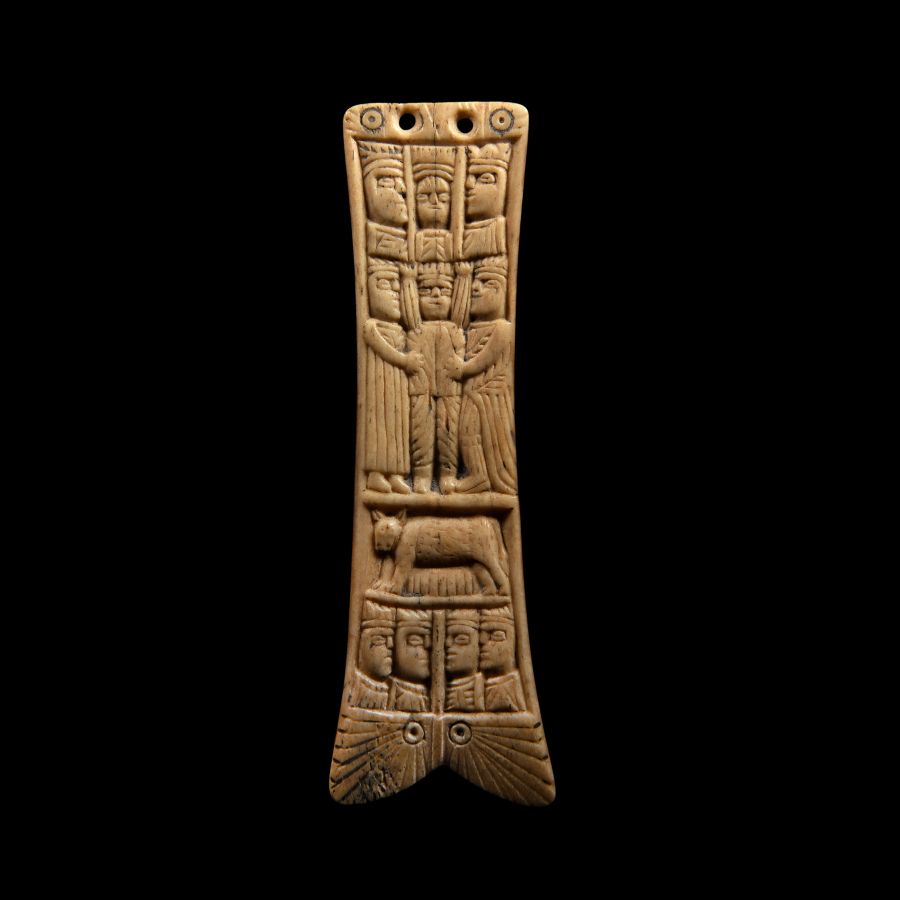
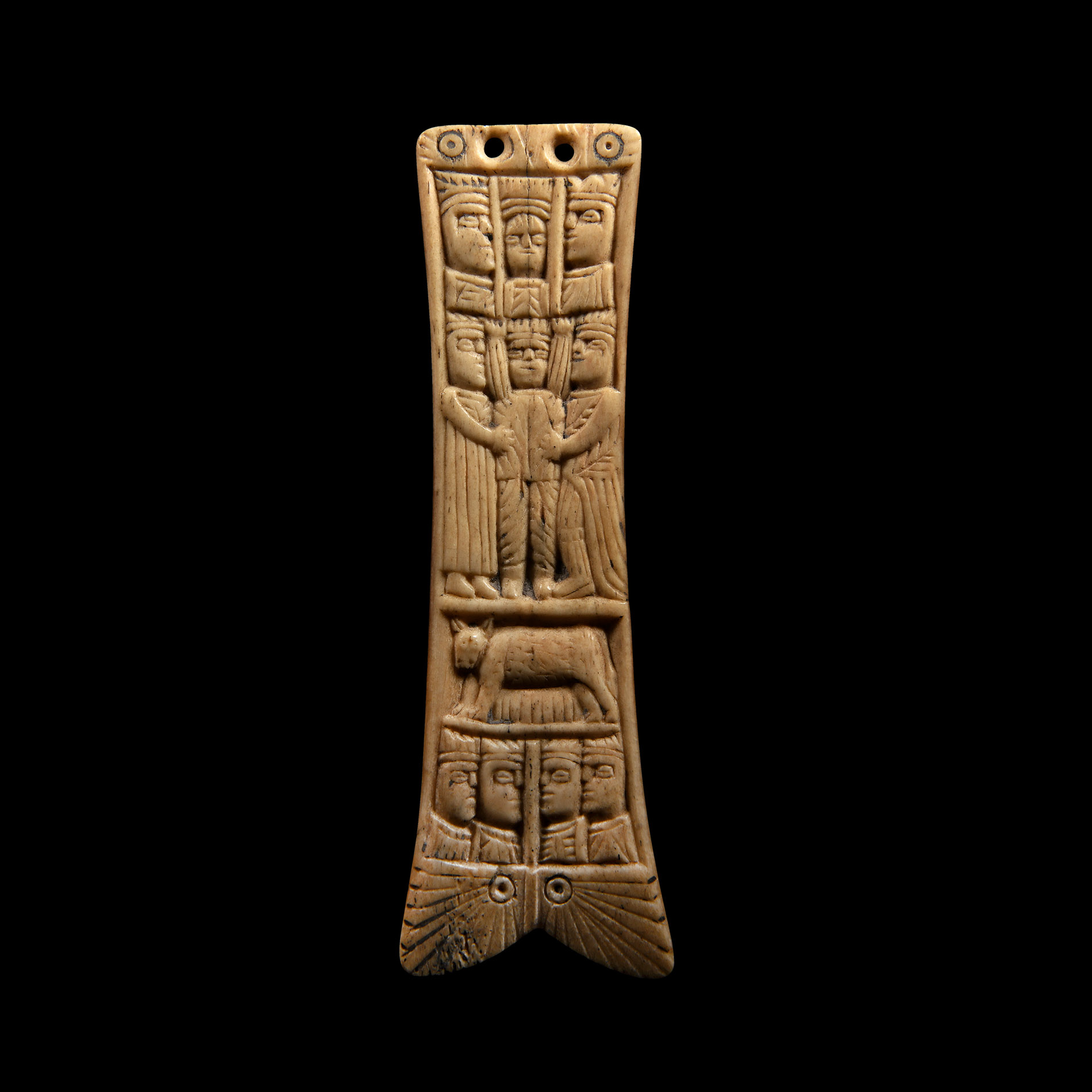
Post Roman Gallic Figural Amuletic Bone Carving
5TH-7TH CENTURY A.D. OR LATER
4 3/4 in. (23.4 grams, 12 cm).
A fishtail-shaped bone amulet or strap end displaying vertically arranged stylised figural panels: at the top, a central facing bust flanked by two further busts; a standing central figure with arms held skywards, a robed figure standing to each side holding his torso, one in a floor-length female garment and the other with one leg advancing showing trousers; an animal facing left below; panel with central vertical divide below, each populated with two busts, one pair facing left, the other facing right; ring-and-dot motifs with radiating lines below, possibly stylised sun motifs; two perforations to top edge for suspension; natural shrinkage crack, mostly evident to the reverse.
ProvenancePreviously in the Alison Barker collection, a retired London barrister.
From a Cambridge collection.
Property of a North London gentleman.
Cf. Dalton, O.M., Catalogue of Early Christian Antiquities and Objects from the Christian East in the Department of British and Medieval Antiquities and Ethnography of the British Museum, London, 1901, item 291, for type; for similar carving style see the belt of Saint Caesarius, in D'Amato, R., Post Roman Kingdoms, Dark Ages Gaul and Britain, AD 450-800, Oxford, 2022, p.12.
FootnotesThe standing animal may represent the lupa or she-wolf which nurtured Romulus and Remus in the mythical story of the founding of Rome. The Emperor Julian, later known as 'the Apostate', was responsible for turning his back on Christianity and promoting a return to traditional Roman values, which included veneration of 'Roma' and the founding legends.
CONDITIONTimeLine Auctions follows a vetting process to ensure the authenticity and legality of all items, reinforcing our commitment to integrity and responsible trading. Each antiquity, antique, and coin lot undergoes thorough examination by a vetting committee of at least ten external specialists, professional trade association members, scientists, and archaeologists: Our Vetting Process
AUCTIONS:
TimeLine is a leading auction house specialising in antiquities, ancient art, collectables, natural history, coins, medals, and books. Our auctions offer museums, collectors, historians, and enthusiasts the opportunity to acquire unique and historically significant pieces.
LOT 0278
Post Roman Gallic Figural Amuletic Bone Carving
Estimate £1,200 - 1,700€1,390 - 1,970 (for guidance only)$1,620 - 2,300 (for guidance only)
-
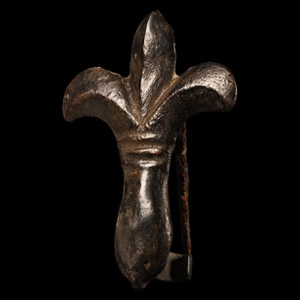
Merovingian Cicada Brooch
5th-6th century A.D.Sold for (Inc. bp): £143
A stylised cicada brooch with minimalistic detailing to the upper face; pin lug, pin and catchplate to reverse. 10 grams, 42 mm
Acquired before 2000. From the collection of a European gentleman living in the UK. -
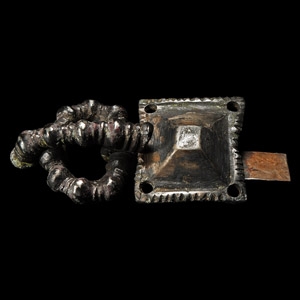
Large Germanic Silver Buckle
6th century A.D.Sold for (Inc. bp): £127
A heavy silver belt buckle, the bow and tongue decorated with raised nodules, rectangular plate with beaded edges, pierced through the corners, modern plate for attachment. 101 grams, 87 mm
Fine condition.
Acquired mid 1980s to early 1990s. Private family collection formed in London.
The construction of the buckle loop and tongue could suggest that this object originates from the Heruli culture, when compared to finds like those from the Ulów graves. Another possibility is that the buckle belongs to Alemannic or Frankish culture. The rectangular buckle plate seems to be an addition from a different buckle of Gothic type, but the assemblage could have been done already in antiquity. -
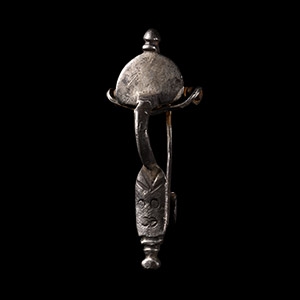
Eastern Germanic Silver Bow Brooch
Early 6th century A.D.Sold for (Inc. bp): £98
A silver bow brooch with semi-circular headplate, decorative knop to apex, slender arched bow, sub-rectangular footplate with knop finial and punched annulets; spring, pin and catchplate to reverse. 8.58 grams, 51 mm
Acquired before 2000. From the collection of a European gentleman living in the UK.
The triple-bossed fibula developed from the fibulae of the southern east-European Germanic tribes, during the migration in the 5th century. This type can be found in modern territories from Hungary to France and occasionally even in England, but in general it remains rare. The type usually carries button-shaped decorations at the end of the semi-circular bow plate.
