Loading, please wait...
Details
LOT 1455
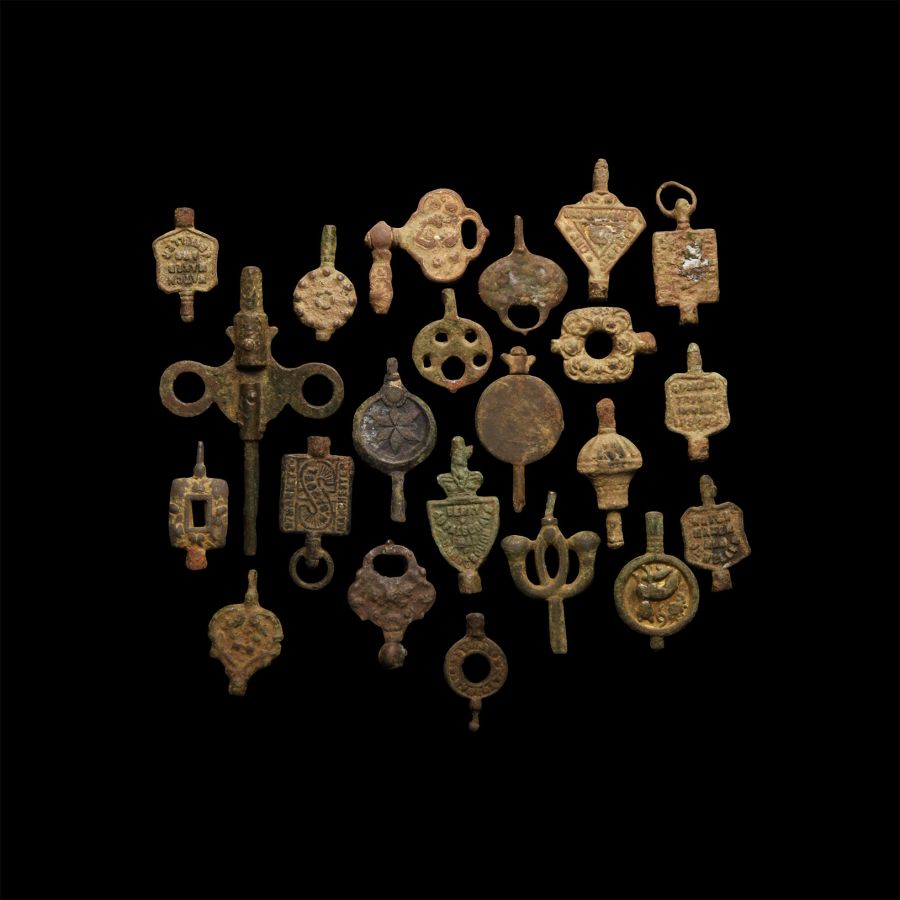
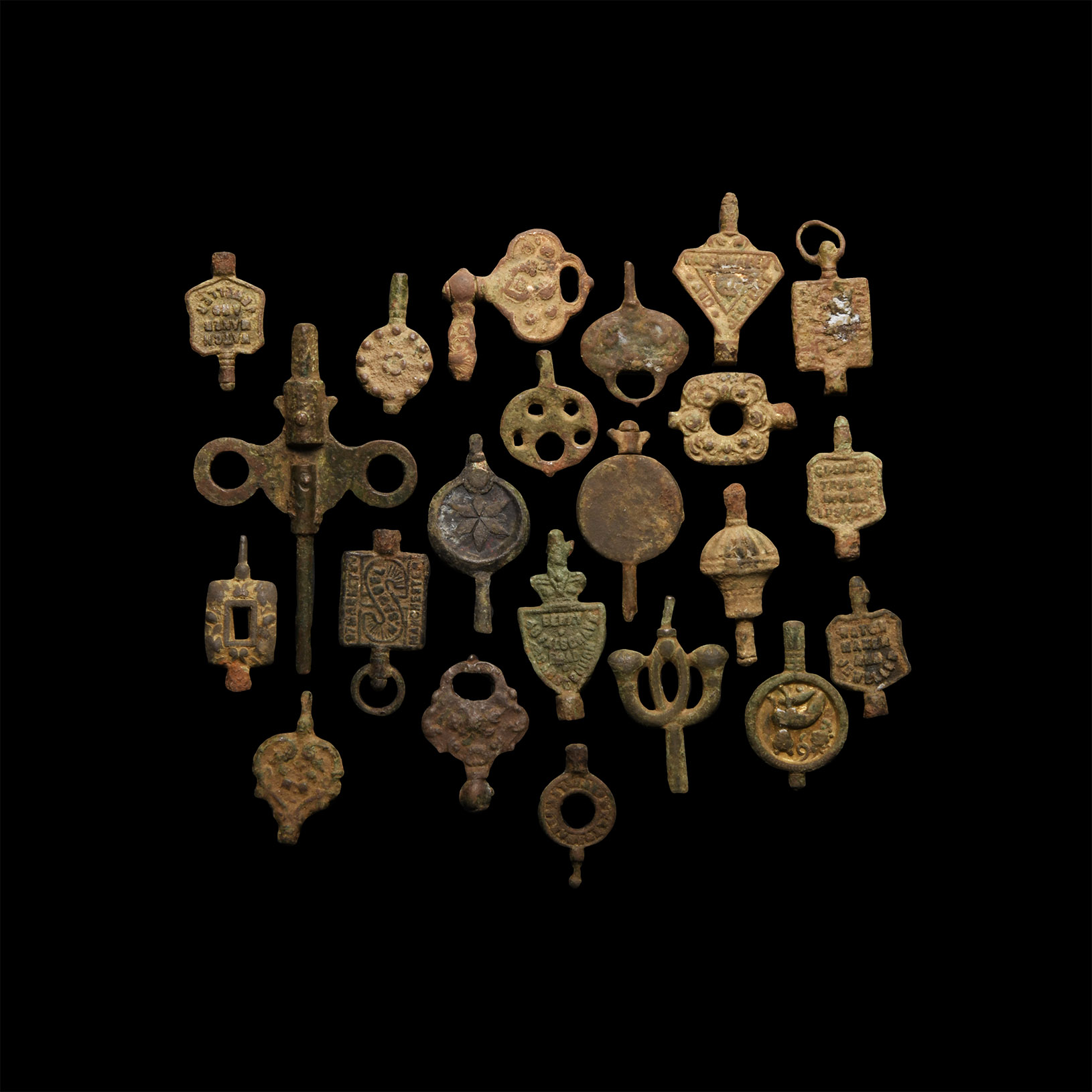
Post Medieval Watch Key Group
18TH-19TH CENTURY A.D.
3/4 - 2 1/8 in. (75.4 grams total, 20-55 mm).
A mixed group of mainly bronze watch keys, some with manufacturer's name. [22, No Reserve]
Provenance
Found Suffolk.
CONDITIONVETTING:
TimeLine Auctions follows a vetting process to ensure the authenticity and legality of all items, reinforcing our commitment to integrity and responsible trading. Each antiquity, antique, and coin lot undergoes thorough examination by a vetting committee of at least ten external specialists, professional trade association members, scientists, and archaeologists: Our Vetting Process
AUCTIONS:
TimeLine is a leading auction house specialising in antiquities, ancient art, collectables, natural history, coins, medals, and books. Our auctions offer museums, collectors, historians, and enthusiasts the opportunity to acquire unique and historically significant pieces.
RELATED LOTS
-
Stuart Period Gold, Rock Crystal and White Enamel Ring
17th century A.D.Sold for (Inc. bp): £4,420
A gold ring composed of a slender hoop embellished with tapering, white enamelled shoulders with black enamelled flourishes, fluted box collet setting, set with a pink foil back and table-cut rock crystal; accompanied by a vintage ring box. 1.89 grams, 21.50 mm overall, 16.63 mm internal diameter (approximate size British L 1/2, USA 6, Europe 11.87, Japan 11)
Valued by Bentley & Skinner, Piccadilly, London W1, 2016. Property of an East Sussex collector. Accompanied by a copy of the Bentley & Skinner insurance valuation. This lot has been checked against the Interpol Database of stolen works of art and is accompanied by search certificate no.11669-197584.
The V & A Museum explains that during the '...Renaissance, the ring developed from the simple forms of the medieval period into a miniature work of art, combining the skills of the chaser, engraver and enameller as well as the stone cutter. -
Early Georgian Gold Enamelled Memento Mori Skeleton Ring for 'S N'
Dated 1717 A.D.Sold for (Inc. bp): £4,420
A gold George I period memento mori ring decorated around the exterior with a stylised human skeleton against a black enamelled field, the body featuring an elongated neck, exaggerated numbers of ribs and disproportionately short legs, with a crescent at the base of the feet; interior engraved 'SN 17.17'. 3.15 grams, 20.76 mm overall, 18.77 mm internal diameter (approximate size British Q 1/2, USA 8 1/4, Europe 18.12, Japan 17)
Acquired in the late 1990s-2000. Property of an East London gentleman. -
Ethiopian Maskal of Kernebege Type Hand Cross with Inscription
17th-18th century A.D.Sold for (Inc. bp): £520
A bifacial wooden cross comprising intertwined elements with trefoil finials, resting on a tall stem decorated with wavy lines enclosed within a geometric frame, the stem resting on a tabula with an inscription on the front and vegetal decorative element on the back, rhomboidal termination with inscribed cross on both sides; mounted on a custom-made display stand. 600 grams, 43 cm high (50.7 cm high including stand)
Acquired from Owen Hargreaves, 2003. UK private collection.
The Ethiopian manual cross is usually divided in three parts: the cross at the top; the handle; and a square element, the tablet, at the base. It is not easy to define the origin of the cross-borne tablets. There are three suppositions as to what they signify: according to one, the tablet represents the earth with its four corners. According to the second one, the tablet represents Adam's grave on Calvary. The third one is that it represents the Tabot, the highest relic of Ethiopia, the Ark of the Covenant. The cross belongs to the Kernebege (Horns of Ram) group, where the tips of the cross are reminiscent of ram's horns or trefoils. Inscriptions are only very rarely found on wooden, manual crosses like this maskal. They usually give the name of the owner or donor.