
Loading, please wait...
LOT 1436
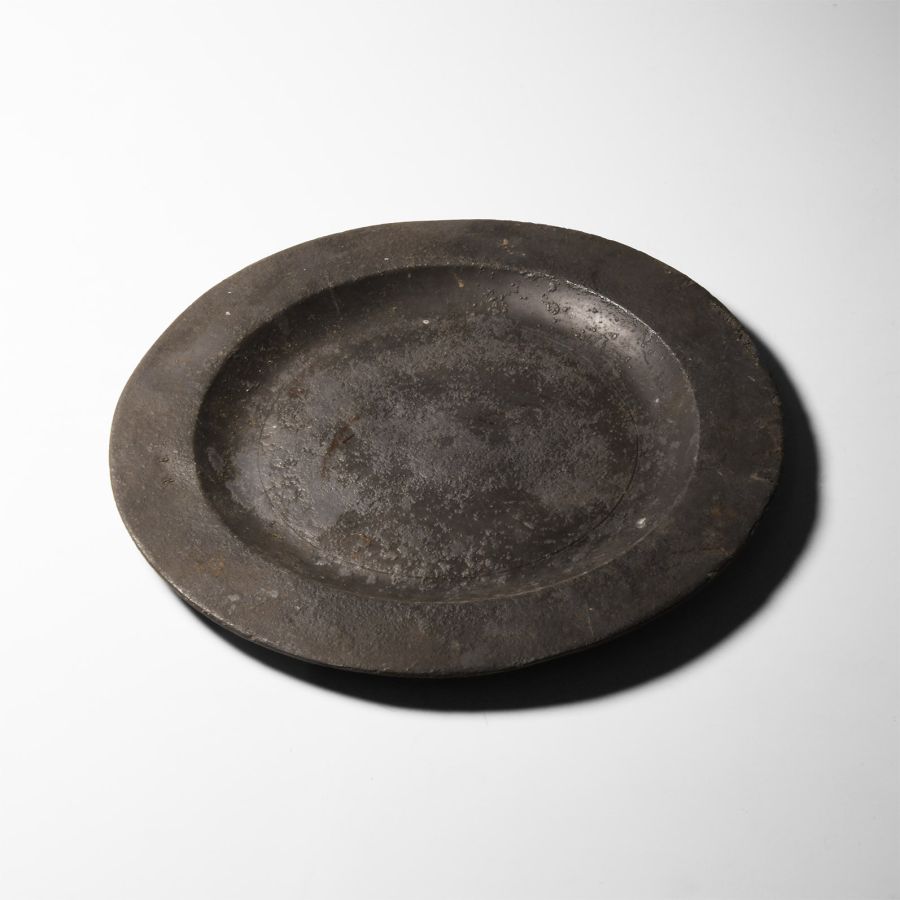
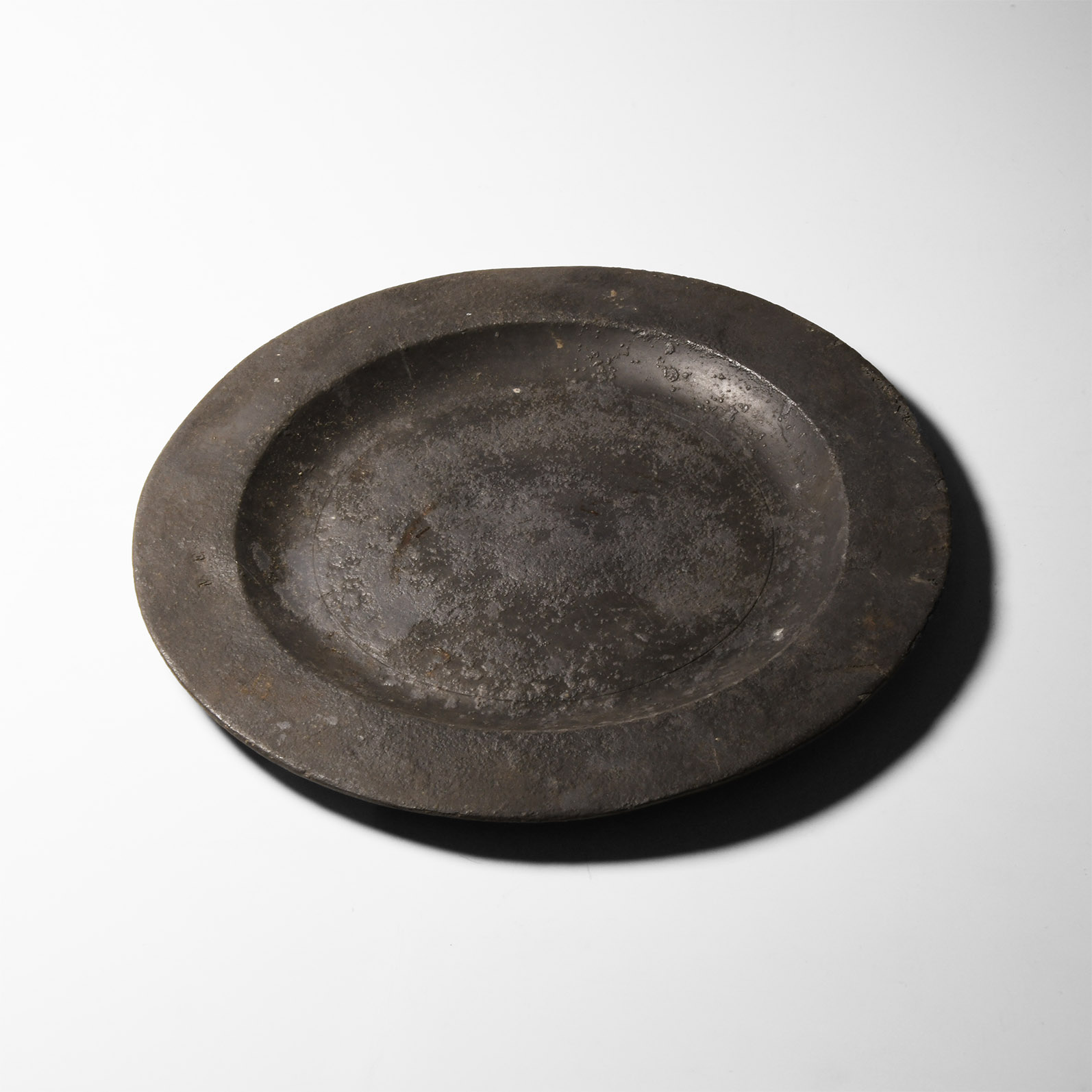
Post Medieval 'Thames' John Duncombe of London Pewter Plate
EARLY 18TH CENTURY A.D.
8 5/8 in. (334 grams, 22 cm wide).
A pewter plate bearing worn stamps to the reverse and a label reading 'John Duncombe London'; initials stamped to upper face of rim 'M[ ]E'. [No Reserve]
ProvenanceFound on the Thames foreshore, London, UK.
Acquired on the UK antiques market between 1974-1985.
Albert Ward collection, Essex, UK.
TimeLine Auctions follows a vetting process to ensure the authenticity and legality of all items, reinforcing our commitment to integrity and responsible trading. Each antiquity, antique, and coin lot undergoes thorough examination by a vetting committee of at least ten external specialists, professional trade association members, scientists, and archaeologists: Our Vetting Process
AUCTIONS:
TimeLine is a leading auction house specialising in antiquities, ancient art, collectables, natural history, coins, medals, and books. Our auctions offer museums, collectors, historians, and enthusiasts the opportunity to acquire unique and historically significant pieces.
LOT 1436
Post Medieval 'Thames' John Duncombe of London Pewter Plate
Sold for (Inc. bp): £26
-
.jpg)
Massive Painted Oak Framed Slate Altar Screen
19th century A.D.Sold for (Inc. bp): £169
A magnificent and superb quality Victorian Gothic revival painted altar or reredos panel, as exemplified by the works and designs of Augustus Pugin, on Welsh slate depicting a large golden cross with latticed arms and squared quatrefoil terminals showing the emblems and names of the four Evangelists, Matthew, Mark, Luke and John; the cross set over a circle enclosing a quatrefoil background with the main discus showing a white cross trefoil on a red expanding cross against a green background with the Christogram letters 'IHS' entwined for Jesus Christ; the design set against a dark blue field ornamented with 48 golden radiant six-pointed stars; complete with the original carved oak frame together with the carved oak projecting base plinth shelf with quatrefoil perforations and another Christogram 'IHS' within a blue oval to the central projection. 73 kg total, 134.5 cm base and 159 cm high
Fine condition.
Collection formed in the 2000s. Property of an East Anglia gentleman.
From the 4th century A.D., the vision of Ezekiel and John's Apocalypse, assigned the lion, the angel, the eagle and the ox a stable place in the iconography of the tetramorph to represent the evangelist Mark (lion) next to the calf (Luke), the angel (Matthew) and the eagle (John). They are, in Christian iconography and theology, the four winged cherubs singing the triumphal hymn, exclaiming, proclaiming, and saying: 'Holy, holy, holy, Lord Sabaoth'. The oldest representations date back to the 5th century A.D., and are found in the mosaics of the baptistry of Naples and in the apse of S. Prudenziana in Rome. The tetramorph was a favourite subject in 12th century ecclesiastic art and its use has continued to the present day. -
Post Medieval Gilt Silver Dated Decorated Chalice
15th-16th century A.D.Sold for (Inc. bp): £1,950
A gilt silver chalice with bowl decorated with repoussé arcading, fluting and entwined motifs, balustered stem with ovoid centre adorned with pseud-architectural and leaf detailing, fluting below splaying out onto a circular foot bearing an applied oval armorial cartouche; interior base with foliate roundel in raised relief; dated 1589 in Roman numerals incised on the base. 309 grams, 13.5 cm high
English private collection. -
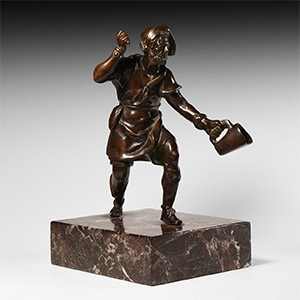
Bronze Bird Catcher Figure
18th-19th century A.D.Estimate: £1,000 - 1,400 (+bp*)
Opening Bid: £500
A bronze bird catcher figure clad in garments evoking the Middle Ages, modelled in the round stalking his prey with a cage in one hand and a cudgel or baton held in the other, ready to strike, a number of birds suspended from his belt, together with other pouches; mounted on a veined granite base. 6.15 kg total, 27 cm high including stand
English private collection.
