
Loading, please wait...
LOT 1507
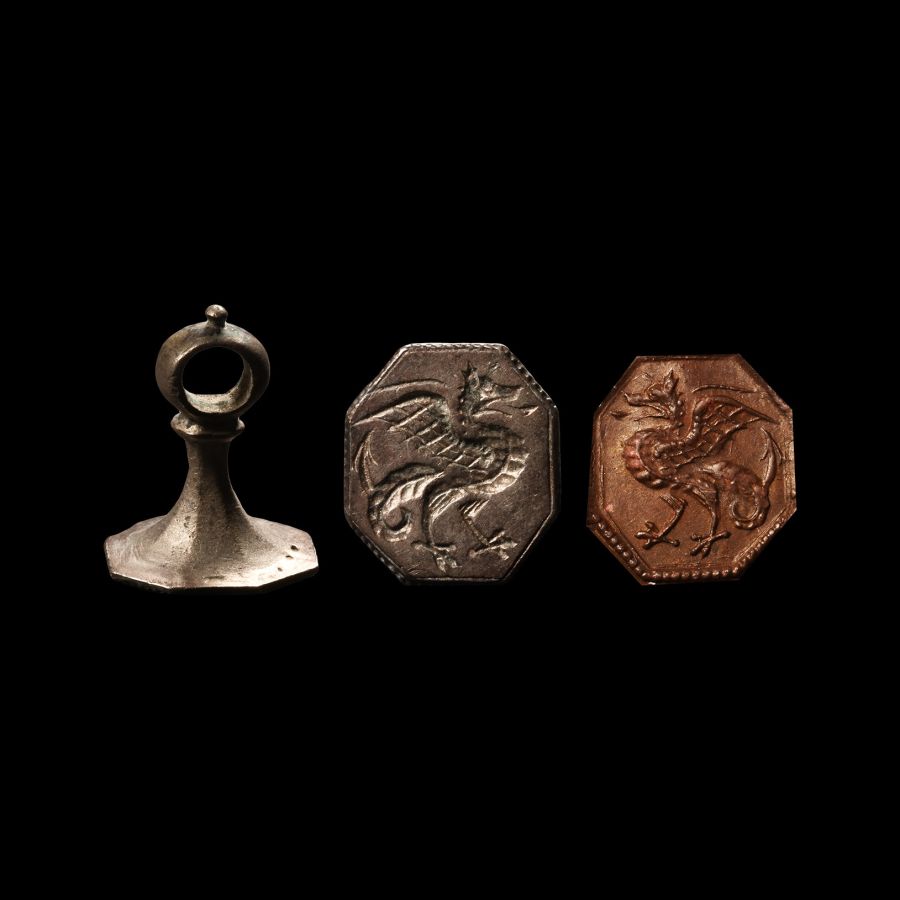
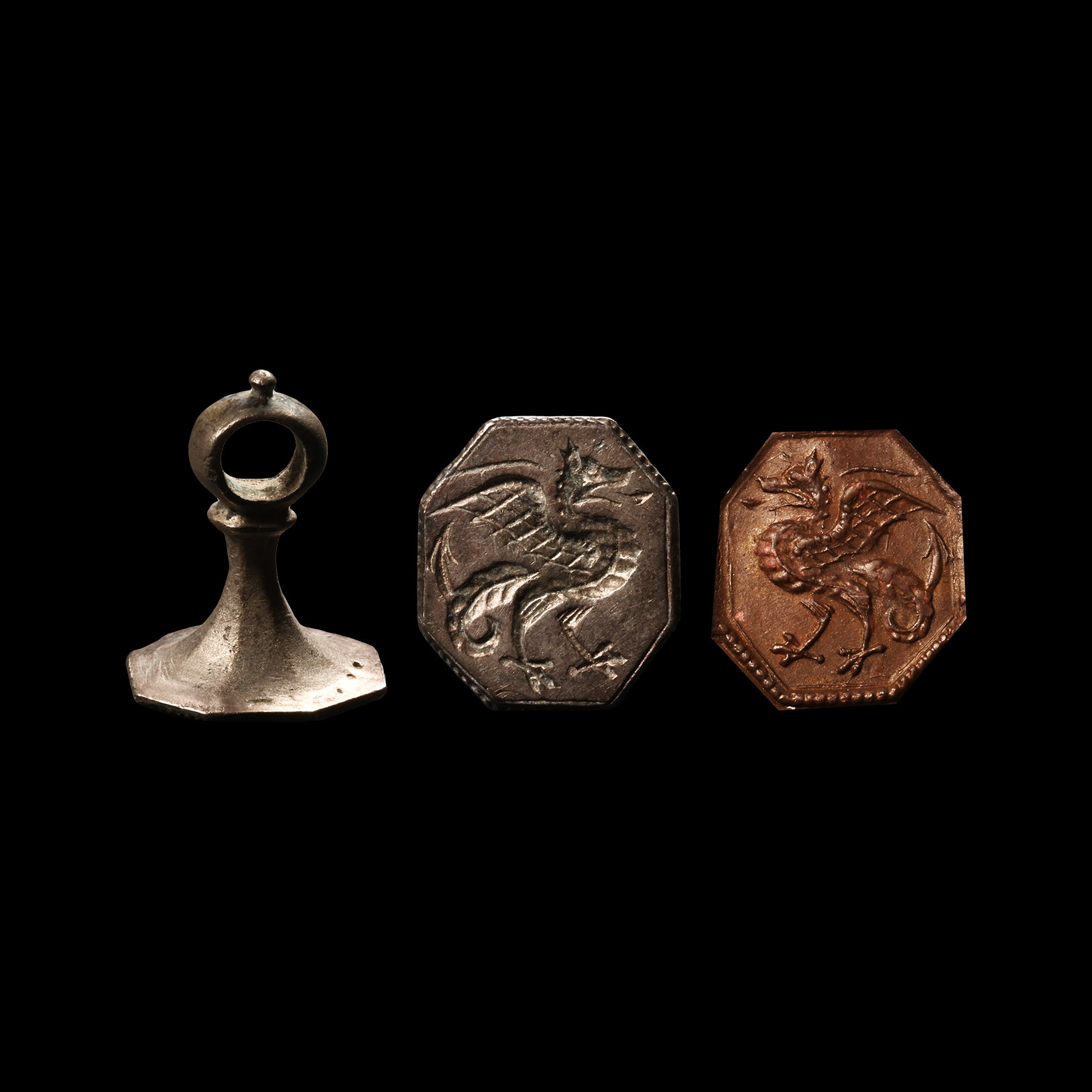
Post Medieval Silver Seal Matrix with Griffin
CIRCA 17TH CENTURY A.D.
3/4 in. (3.09 grams, 18 mm).
A silver seal with loop terminal and octagonal matrix, bearing an incuse griffin standing right to the base; accompanied by an impression. [No Reserve]
ProvenanceAcquired on the UK antiques market between 1974-1985.
Albert Ward collection, Essex, UK.
TimeLine Auctions follows a vetting process to ensure the authenticity and legality of all items, reinforcing our commitment to integrity and responsible trading. Each antiquity, antique, and coin lot undergoes thorough examination by a vetting committee of at least ten external specialists, professional trade association members, scientists, and archaeologists: Our Vetting Process
AUCTIONS:
TimeLine is a leading auction house specialising in antiquities, ancient art, collectables, natural history, coins, medals, and books. Our auctions offer museums, collectors, historians, and enthusiasts the opportunity to acquire unique and historically significant pieces.
-
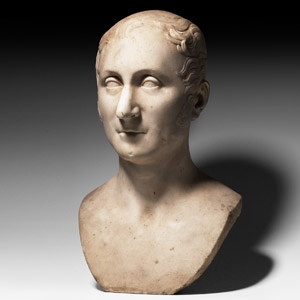
Marble Portrait Bust
19th century A.D.Estimate: £3,000 - 4,000 (+bp*)
Opening Bid: £1,500
A marble bust of a middle-aged man with short hair combed over his forehead, the face shown with a slight smile. 22.6 kg, 43 cm high
French collection, 1960s-early 2000s. From an important Paris gallery, France. with Hampel Fine Art Auctions GmbH & Co KG, 12 December 2014, lot 1919. This lot has been checked against the Interpol Database of stolen works of art and is accompanied by search certificate number no.11693-199346. -
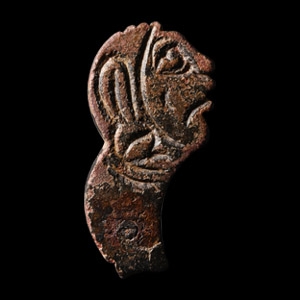
Tudor Figural Chafing Dish Mount
16th century A.D.Sold for (Inc. bp): £20
A bifacial anthropomorphic copper-alloy chafing dish mount, comprising a flat plate in the shape of a man's head and torso in profile, incised on both sides outlining stylised facial features and a hood or cap. 11.1 grams, 33 mm
Found near Brenzett, Kent, UK. Property of a Kent gentleman. Accompanied by a copy of the British Museum's Portable Antiquities Scheme (PAS) report no. KENT-561C41.
The PAS report dates this item to 1575-1650. Such supports were used in sets of three on chafing dishes. Scholars believe they were produced in Germany, Denmark and the Low Countries from 1575 onwards, remaining in use in poorer households until the middle of the 18th century A.D. Such a find is rare in England. -
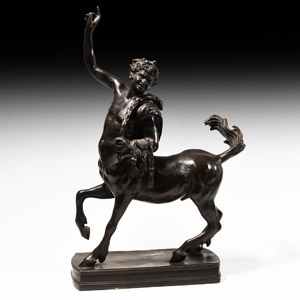
Neoclassical Bronze Young Centaur Statue
20th century A.D.Sold for (Inc. bp): £3,640
A bronze figure of a centaur in animated pose with upper body turned, right arm raised, left arm bent and hand holding a cudgel supported on the shoulder; cloak draped over the left shoulder and skin of a boar folded over the left forearm; on a tiered socle base. 10.3 kg, 53 cm high
French collection, 1960s-early 2000s. From an important Paris gallery, France.
Modelled on the so-called Capitoline Centaurs, specifically the Young Centaur, which was found as one of a pair of centaurs during the excavation of Hadrian’s Villa in 1736; the Roman Old and Young centaur pair were themselves based on Hellenistic originals.
