
Loading, please wait...
_900x900.jpg "Post Medieval Silver Ring with Cabochon")
_200x200.jpg "Post Medieval Silver Ring with Cabochon")
.jpg "Post Medieval Silver Ring with Cabochon")
LOT 2170
Post Medieval Silver Ring with Cabochon
CIRCA 18TH CENTURY A.D.
1 in. (4.18 grams, 25.94 mm overall, 18.91 mm internal diameter (approximate size British P, USA 7 1/2, Europe 16.23, Japan 15)).
With hatched shoulders, drum-shaped bezel with applied granulation, inset glass cabochon. [No Reserve]
ProvenanceEx German art market, 2000s.
Acquired from an EU collector living in London.
From the collection of a Surrey, UK, gentleman.
TimeLine Auctions follows a vetting process to ensure the authenticity and legality of all items, reinforcing our commitment to integrity and responsible trading. Each antiquity, antique, and coin lot undergoes thorough examination by a vetting committee of at least ten external specialists, professional trade association members, scientists, and archaeologists: Our Vetting Process
AUCTIONS:
TimeLine is a leading auction house specialising in antiquities, ancient art, collectables, natural history, coins, medals, and books. Our auctions offer museums, collectors, historians, and enthusiasts the opportunity to acquire unique and historically significant pieces.
-
.jpg)
Egyptian Style Seated Bronze Cat and Gilt Brooch
Early 20th century A.D.Sold for (Inc. bp): £46
Comprising: a seated cat statuette; a brooch formed as two spread wings flanking an inset scarboid with a cartouche and hieroglyphs. 122 grams total, 61-65 mm
From an old English collection, Camden, London, UK. -
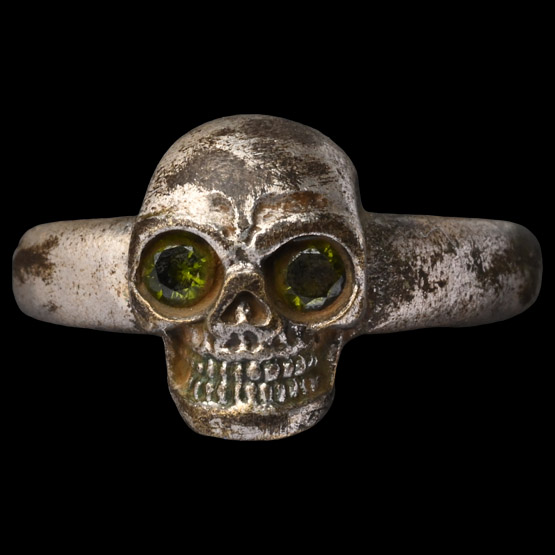
Victorian Silver Skull Ring
Late 19th century A.D.Sold for (Inc. bp): £208
D-section hop, the bezel formed as a skull with glass inserts in the eye-sockets. 5.08 grams, 25.79 mm overall, 18.5 mm internal diameter (approximate size British R, USA 8 1/2, Europe 18 3/4, Japan 18)
Ex private Warwick collection, 1980-2000. Acquired from an antique fair, Staffordshire, UK. Ex Buckinghamshire, UK, collection. -
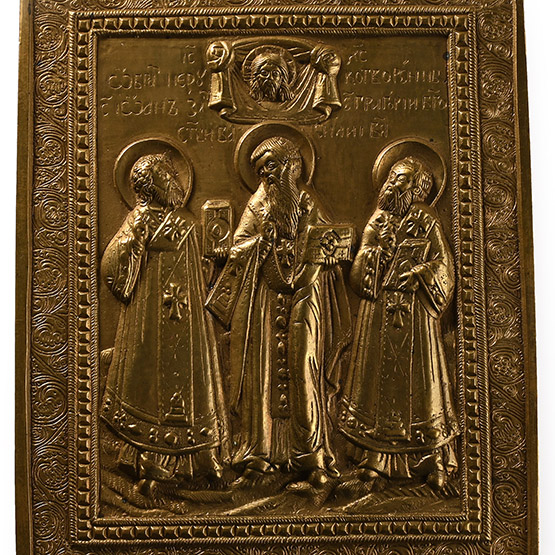
Russian Bronze Travel Icon with the Three Hierachs of Orthodoxy
19th century A.D.Estimate: £100 - 140 (+bp*)
Opening Bid: £54
Depicting Saint Basil the Great, Saint Gregory the Theologian and Saint John Chrysostomus, all nimbate and holding their holy writings, under the vision of the Holy Mandylion; Saint Basil wearing a bishop's sakkos, the other two wearing the usual orthodox priest's garb, phelonia; all three wearing a brocade band, omophorion, with four crosses; inscriptions in Old Slavonic with the names of the Saints, on the Nimbus of Jesus, the letters 'O Ѡ N' (‘I AM’); names of the Saints in the background in Old Slavonic; framed by double moulding, the first decorated with crenellated elements, the second with arabesques. 270 grams, 11.5 cm
Acquired from Chris Martin-Zakheim, Iconastas, 5 Piccadilly Arcade, London SW1. From the private collection of a West London, UK, gentleman, formed since the early 2000s.
The icon is the so-called icon of the three hierarchs, Saint Gregory the Theologian (Gregory of Nazianzus), Saint Basil the Great (Basil of Caesarea) and Saint John Chrysostom, archbishop of Constantinople. All three were important fathers of the church who strove to clarify and crystallise Dogma, for the unity of the faith, of the Liturgy and the needs of philosophy and letters.
