
Loading, please wait...
_900x900.jpg "Post Medieval Silver Apostle Paul Statuette")
_200x200.jpg "Post Medieval Silver Apostle Paul Statuette")
.jpg "Post Medieval Silver Apostle Paul Statuette")
LOT 0365
Post Medieval Silver Apostle Paul Statuette
18TH CENTURY A.D.
2 5/8 in. (58.2 grams, 66 mm high).
A silver figure modelled in the round as the Apostle Paul, standing on a polygonal base, wearing a voluminous floor-length robe, clasping the Bible to the right side of his breast, holding a sword in his left hand, semi-naturalistic detailing to his face, beard and hair. [No Reserve]
ProvenanceAustrian private collection since circa 1995.
Ex central London gallery.
TimeLine Auctions follows a vetting process to ensure the authenticity and legality of all items, reinforcing our commitment to integrity and responsible trading. Each antiquity, antique, and coin lot undergoes thorough examination by a vetting committee of at least ten external specialists, professional trade association members, scientists, and archaeologists: Our Vetting Process
AUCTIONS:
TimeLine is a leading auction house specialising in antiquities, ancient art, collectables, natural history, coins, medals, and books. Our auctions offer museums, collectors, historians, and enthusiasts the opportunity to acquire unique and historically significant pieces.
-
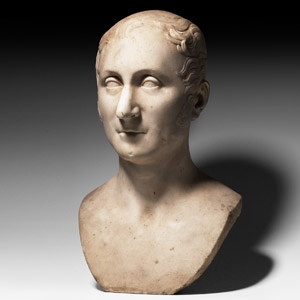
Marble Portrait Bust
19th century A.D.Estimate: £3,000 - 4,000 (+bp*)
Opening Bid: £1,500
A marble bust of a middle-aged man with short hair combed over his forehead, the face shown with a slight smile. 22.6 kg, 43 cm high
French collection, 1960s-early 2000s. From an important Paris gallery, France. with Hampel Fine Art Auctions GmbH & Co KG, 12 December 2014, lot 1919. This lot has been checked against the Interpol Database of stolen works of art and is accompanied by search certificate number no.11693-199346. -
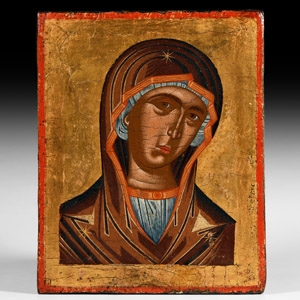
Veneto-Cretan Bust of the Virgin from a Deesis
17th century A.D.Estimate: £3,000 - 4,000 (+bp*)
Opening Bid: £1,350
A small icon from a Deesis, tempera on wood, depicting Mary on a gilt background inclining her head to the right, wearing a maphorion embroidered with gold stars, blue veil and a chiton of same colour; the reverse with a painted red cross with Greek lettering 'IC XI N K' for 'Jesus Christ is winner'. 554 grams, 20.2 x 16.5 cm
Gilding minimally worn, the border minimally restored; very fine condition.
Property of a London lady, part of her family's collection. Accompanied by an academic report by Dr Raffaele D’Amato. This lot has been checked against the Interpol Database of stolen works of art and is accompanied by searcher certificate no.11571-198600.
This splendid specimen comes most probably from a large icon, where it was part of a Deesis. The image implies that the original icon represented Christ flanked by the Mother of God and John the Baptist, all three usually represented as a full figure. The Deisis or Deesis (Деисус, Gk. for “supplication”) was the depiction of the Virgin, John the Baptist and possibly many more saints interceding with Christ on behalf of mankind. -
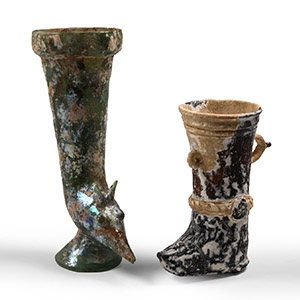
Roman Style Glass Vessel Group
20th century A.D.Sold for (Inc. bp): £46
A group of ancient Roman style glass vessels: a horn-shaped vessel with animal head base and conical foot, with iridescent surfaces; a boot-shaped vessel with anklet, flared neck and suspension loops. 206 grams total, 11.2-15.5 cm high
German collection formed before 2000. Ex private European collection.
