
Loading, please wait...
_900x900.jpg "Post Medieval Ring with Bow and Arrow")
_200x200.jpg "Post Medieval Ring with Bow and Arrow")
.jpg "Post Medieval Ring with Bow and Arrow")
LOT 1497
Post Medieval Ring with Bow and Arrow
1226 H. (1811 A.D.)
1 in. (8.88 grams, 24.70 mm overall, 21.66 mm internal diameter (approximate size British V 1/2, USA 10 3/4, Europe 24.4, Japan 23)).
A copper-alloy ring composed of a broad hoop with slightly convex outer face, large oval-shaped bezel engraved with an archer's bow with nocked arrow, separating the numbers '12 / 26' and aimed towards the letters 'KΛTΛ'. [No Reserve]
ProvenancePrivate collection formed since the 1940s.
UK art market.
Property of an Essex gentleman.
TimeLine Auctions follows a vetting process to ensure the authenticity and legality of all items, reinforcing our commitment to integrity and responsible trading. Each antiquity, antique, and coin lot undergoes thorough examination by a vetting committee of at least ten external specialists, professional trade association members, scientists, and archaeologists: Our Vetting Process
AUCTIONS:
TimeLine is a leading auction house specialising in antiquities, ancient art, collectables, natural history, coins, medals, and books. Our auctions offer museums, collectors, historians, and enthusiasts the opportunity to acquire unique and historically significant pieces.
-
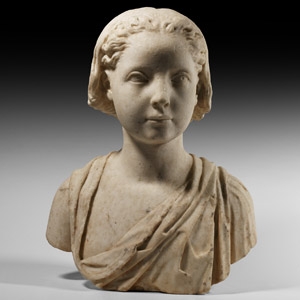
Post Medieval Marble Bust of a Young Female
16th-17th century A.D. or laterEstimate: £4,000 - 6,000 (+bp*)
Opening Bid: £2,000
A naturalistic bust of a young female figure modelled facing, wearing a thin band in her cropped hair, deep folds in her garments; hollowed to reverse of base. 19 kg total, 41 cm high including stand
English private collection. This lot has been checked against the Interpol Database of stolen works of art and is accompanied by search certificate number no.11680-199822 -
.jpg)
Georgian Gold Poison Ring
18th-19th century A.D.Sold for (Inc. bp): £5,720
A Georgian-era 15 carat gold and silver 'poison' ring, composed of a slender hoop of scrolls and crescents with a plain panel at the base, expanding shoulders formed as openwork foliate flourishes set with small stones; oval cluster bezel set with a central cushion-cut emerald weighing approximately 4.06 cts, held in a pierced setting with twisted gold wire collar, and surrounded by rose-cut diamonds; hinged bezel revealing a secret compartment beneath, the reverse domed and engraved with a stylised shell motif. 10.02 grams, 28.41 mm overall, 17.91 mm internal diameter (approximate size British O, USA 7, Europe 14.98, Japan 14)
Acquired from Platt Boutique Jewelry, Inc., West Hollywood, California, USA, 2016. Property of an East Sussex collector. Accompanied by a copy of the Platt Boutique Jewelry invoice. This lot has been checked against the Interpol Database of stolen works of art and is accompanied by search certificate no.11668-197586.
'Poison rings' became popular in Europe during the 16th century, and Lucrezia Borgia is popularly believed to have used one. The compartment within the bezel was used to conceal poison, a lock of hair or other substances. -
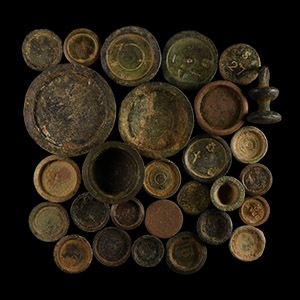
Post Medieval Weight Group
18th-20th century A.D.Sold for (Inc. bp): £39
A mixed group of bronze trade and chemists' weights, many with a stamped value, verification marks (e.g. sword for City of London), heater shield and others. 438 grams total, 15-44 mm
Found Suffolk.
