
Loading, please wait...
LOT 0380
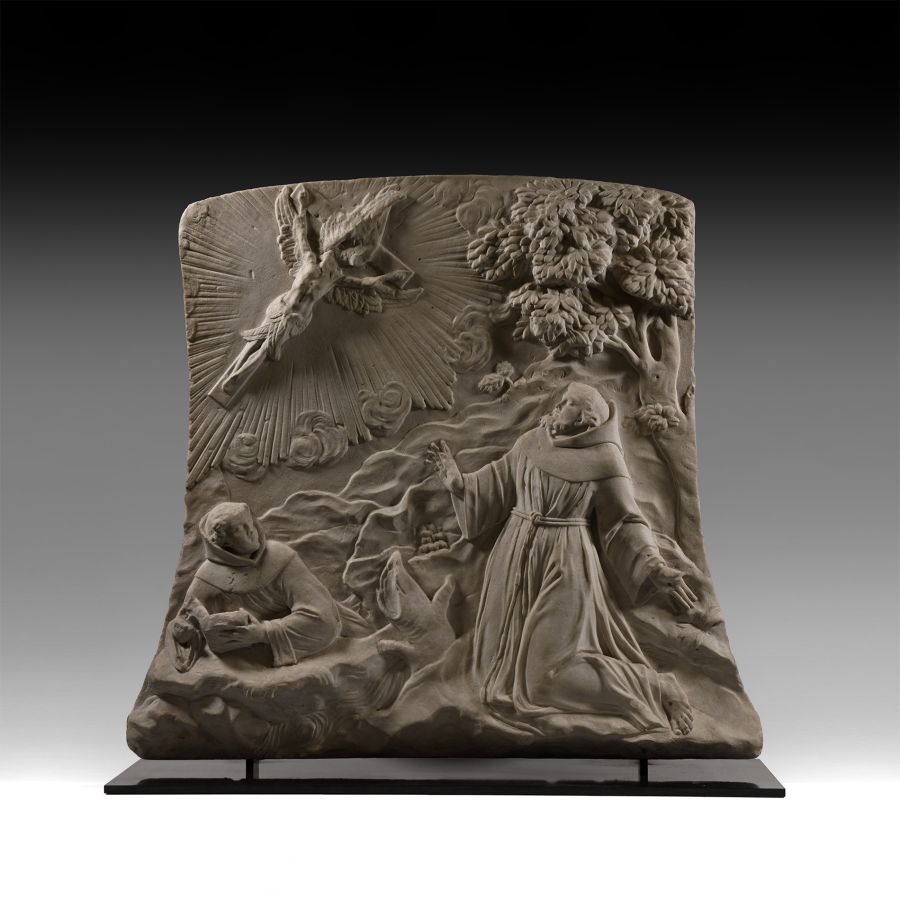
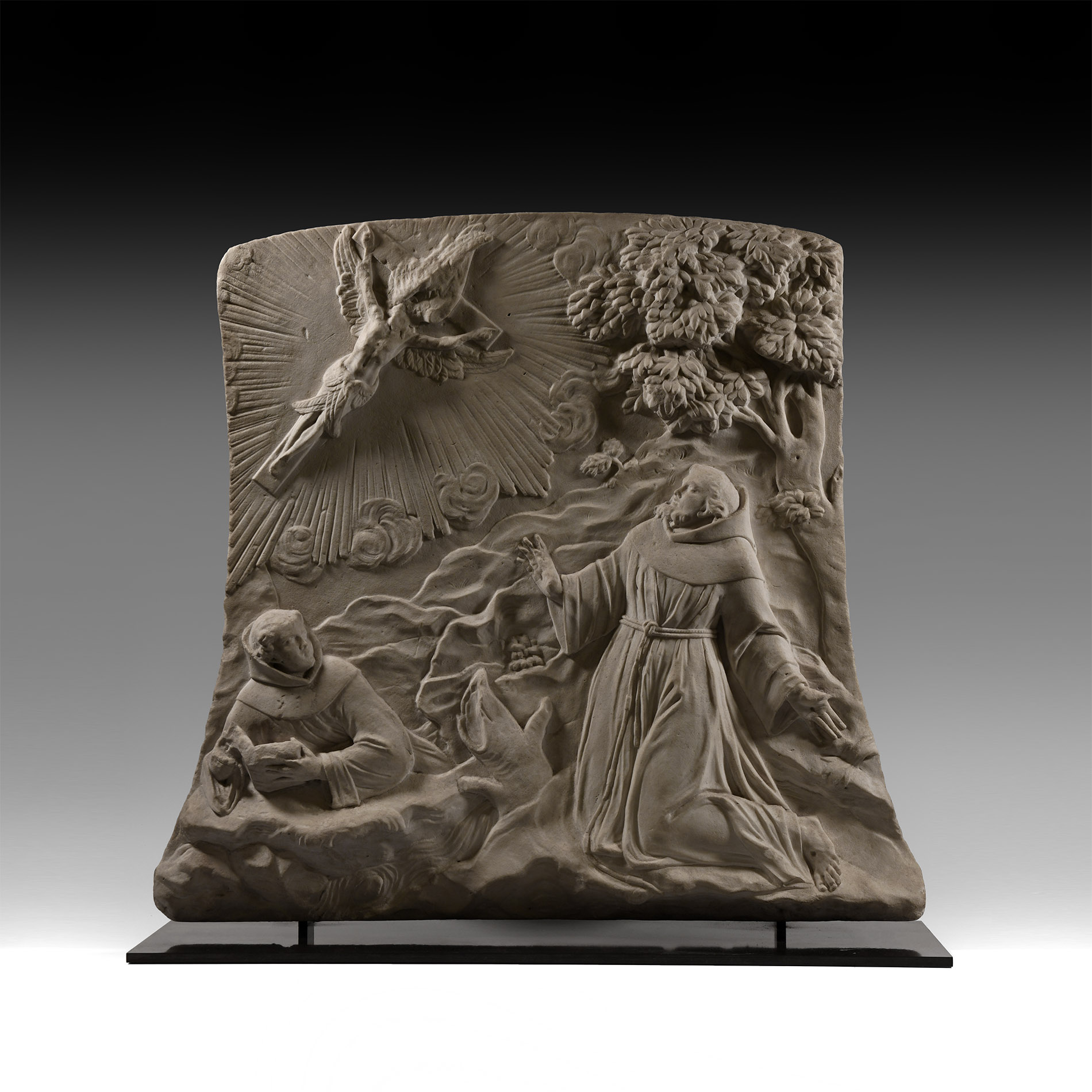
Post Medieval Relief with St Francis Scene
ITALIAN, 18TH CENTURY A.D. OR LATER
29 1/2 in. (75 cm high including stand).
A carved marble figural panel depicting a religious scene, probably St. Francis of Assisi receiving the Holy Stigmata; a kneeling figure in loose-fitting cowl and habit with knotted cord to the waist, arms spread and head raised towards a chiaroscuro sunburst with a figure at the centre, wearing a loincloth and affixed to a plain cross, borne up by three pairs of wings attached to the shoulders and thighs; below, a second, smaller figure holding a book; all in a landscape with a tree at right behind the larger figure; mounted on a custom-made stand.
ProvenanceEnglish private collection.
FootnotesThe scene probably represents the events just prior to the end of the life of St. Francis of Assisi: while he was praying on a mountain with his companion, Brother Leo, he is said to have had a vision of a seraph (a six-winged angel on a cross) which gave him the gift of the stigmata, the five wounds of Christ. The apparition caused a deterioration in Francis's health and no cure could be found, so the saint spent the remaining days of his life dictating his spiritual message to Leo, who preserved the record of these events.
CONDITIONTimeLine Auctions follows a vetting process to ensure the authenticity and legality of all items, reinforcing our commitment to integrity and responsible trading. Each antiquity, antique, and coin lot undergoes thorough examination by a vetting committee of at least ten external specialists, professional trade association members, scientists, and archaeologists: Our Vetting Process
AUCTIONS:
TimeLine is a leading auction house specialising in antiquities, ancient art, collectables, natural history, coins, medals, and books. Our auctions offer museums, collectors, historians, and enthusiasts the opportunity to acquire unique and historically significant pieces.
LOT 0380
Post Medieval Relief with St Francis Scene
Estimate £1,200 - 1,700€1,390 - 1,970 (for guidance only)$1,620 - 2,300 (for guidance only)
-
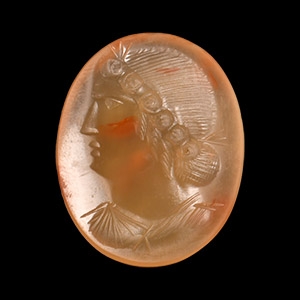
Post Medieval Apollo Gemstone
19th century A.D.Sold for (Inc. bp): £33
A carnelian intaglio bust of Apollo in profile with chlamys to the shoulder, diadem to the brow. 4.54 grams, 26 mm
Acquired in the late 1980s-early 1990s. Important North West London collection. -
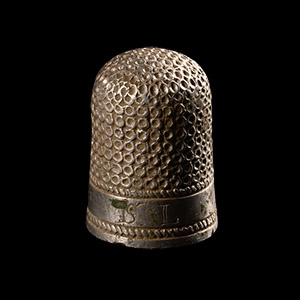
Georgian Silver Thimble with 'S L'
18th century A.D.Sold for (Inc. bp): £33
A silver thimble with annulets to the upper body and ropework bands to the lower body, framing a 'plain' band engraved with the initials 'S.L'. 5.54 grams, 21 mm
Found Suffolk. -
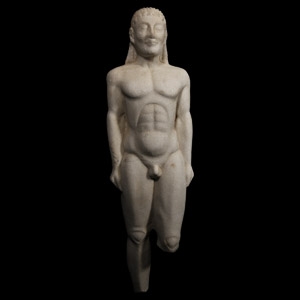
Marble Archaic Kouros Statue
20th century A.D.Sold for (Inc. bp): £1,690
A Greek style marble archaic kouros statue carved with braided hair held by a diadem, arms held straight at the sides, legs in advancing pose. 16.5 kg, 71 cm high
French collection, 1960s-early 2000s. From an important Paris gallery, France.
The kouros (free-standing nude male youth) first appeared in ancient Greece in the Archaic Greek period; kouros figures have been found across the Greek-speaking world, concentrated mainly in sanctuaries of Apollo. The term means ‘male youth, particularly one of noble rank’; when a pubescent boy came of age in ancient Greece, he was known as a kouros, at which point he could participate in the initiation feast of the brotherhood. The god Apollo was known as the greatest kouros. Typically life-sized, these figures were produced in marble, but have also been found in limestone, wood, bronze and terracotta. The female counterpart is the kore.
