
Loading, please wait...
LOT 0389
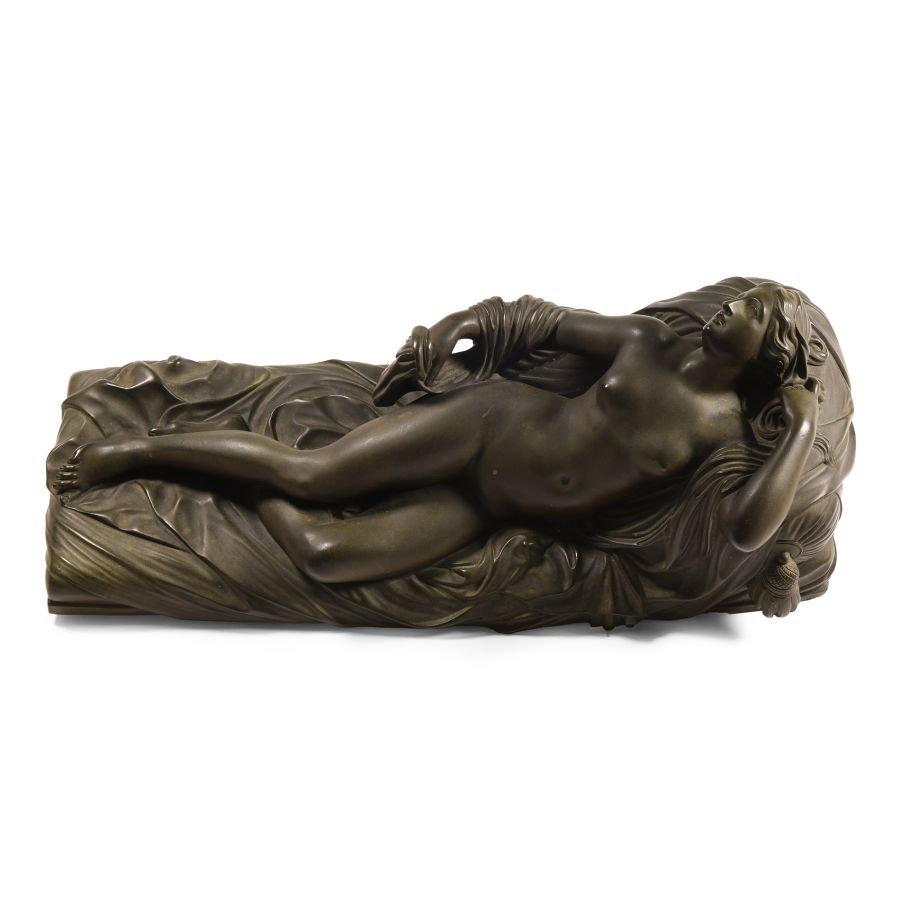
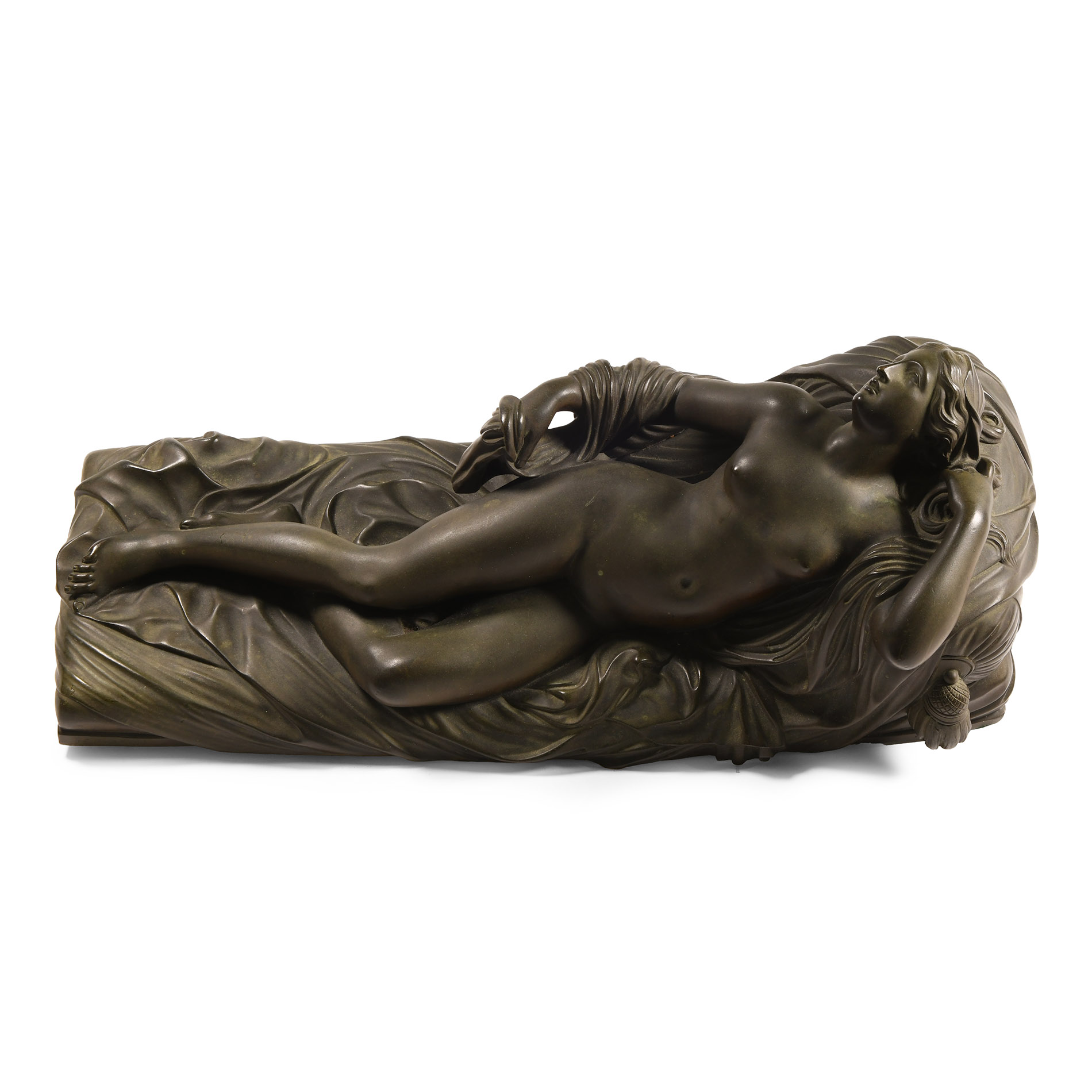
Post Medieval Reclining Female Statue
LATE 19TH-EARLY 20TH CENTURY A.D.
13 3/8 in. (5.4 kg, 34 cm long).
A bronze study of a reclining nymph on a draped chaise longue, nude with head tilted back and lips sensuously parted, left hand stroking her luxuriant hair, right hand lifting a fold of the cloth cover, left leg bent and held beneath the right leg, cushioned headrest with tassel; hollow to the underside; unsigned.
ProvenanceEnglish private collection.
CONDITIONTimeLine Auctions follows a vetting process to ensure the authenticity and legality of all items, reinforcing our commitment to integrity and responsible trading. Each antiquity, antique, and coin lot undergoes thorough examination by a vetting committee of at least ten external specialists, professional trade association members, scientists, and archaeologists: Our Vetting Process
AUCTIONS:
TimeLine is a leading auction house specialising in antiquities, ancient art, collectables, natural history, coins, medals, and books. Our auctions offer museums, collectors, historians, and enthusiasts the opportunity to acquire unique and historically significant pieces.
-
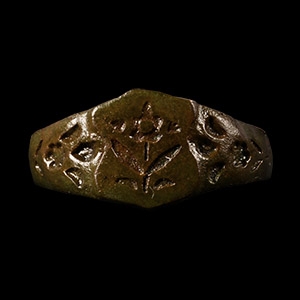
Post Medieval Ring with Flower on Shield
18th century A.D.Sold for (Inc. bp): £46
A copper-alloy ring composed of a slightly convex hoop, expanding shoulders and shield-shaped bezel, the shoulders and bezel engraved with flowering plants. 3.50 grams, 24.25 mm overall, 22.11 mm internal diameter (approximate size British W 1/2, USA 11 1/4, Europe 25.66, Japan 24)
Private collection formed since the 1940s. UK art market. Property of an Essex gentleman. -
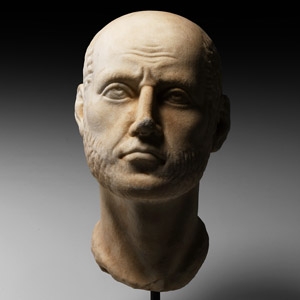
Marble Head of a Roman Emperor
20th century A.D.Estimate: £4,000 - 6,000 (+bp*)
Opening Bid: £2,000
A carved marble bust of a mature male with stern features, likely the emperor Carus, shown with short, neatly-dressed hair and beard; mounted on a custom-made display stand. 10.4 kg, 38 cm high including stand
French collection, 1960s-early 2000s. From an important Paris gallery, France. This lot has been checked against the Interpol Database of stolen works of art and is accompanied by search certificate number no.11694-199338.
Carus reigned 282-283 A.D. He served as a prefect of the guard to emperor Probus, whom he succeeded. Whilst leading a campaign against the Sassanians, Carus died suddenly and under mysterious circumstances, leading to the belief that he was struck by lightning. Little is known of his life, owing to the relative instability of that time period. Whether he had Probus murdered, or whether he was killed by mutinous troops was disputed even by his contemporaries. Carus was succeeded by his sons Carinus and Numerian, although their reigns were short-lived and his dynasty was soon supplanted. Carinus’ lasting legacy was principally the suppression of the authority of the senate. He has gone down in history as one of the tyrants of ancient Rome. -
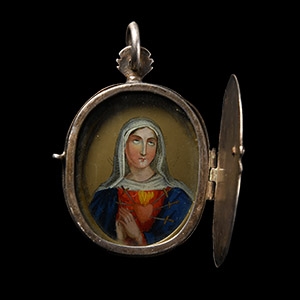
Post Medieval Papal Silver Reliquary Pendant with Portrait
18th-19th century A.D.Estimate: £300 - 400 (+bp*)
Opening Bid: £150
A silver reliquary pendant composed of a hinged oval-shaped locket with articulate swivel clasp and perforated suspension loop; the upper face engraved with a bleeding heart wearing a crown of barbed wire and surmounted by a Christian cross, framed by two scrolled bars; reverse engraved with similar bars framing the initials 'MRA' (possibly 'Maria Regina Angelorum') with leaf below; the interior with polychrome bust of the Virgin glancing skywards, her hands clasped in front of her body to her right, a flaming heart impaled with five swords in front of her chest, painted onto glass; glass panel with fabric backing sewn with the papal insignia of crossed keys beneath cross-topped triple crown (tiara) in what appears to be gold and silver thread; possible inscription to upper face of the (articulate) hinge. 50.36 grams, 70 mm high
Fine condition.
Property of a Colchester, UK, collector.
