Loading, please wait...
Details
LOT 2027
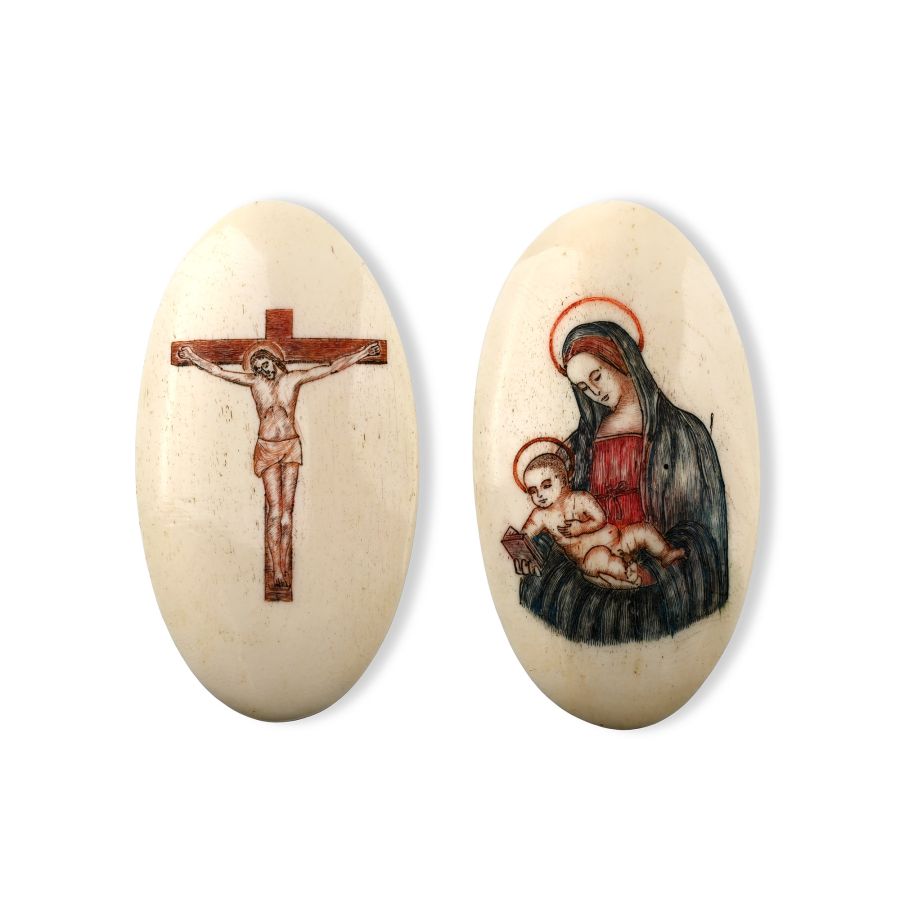
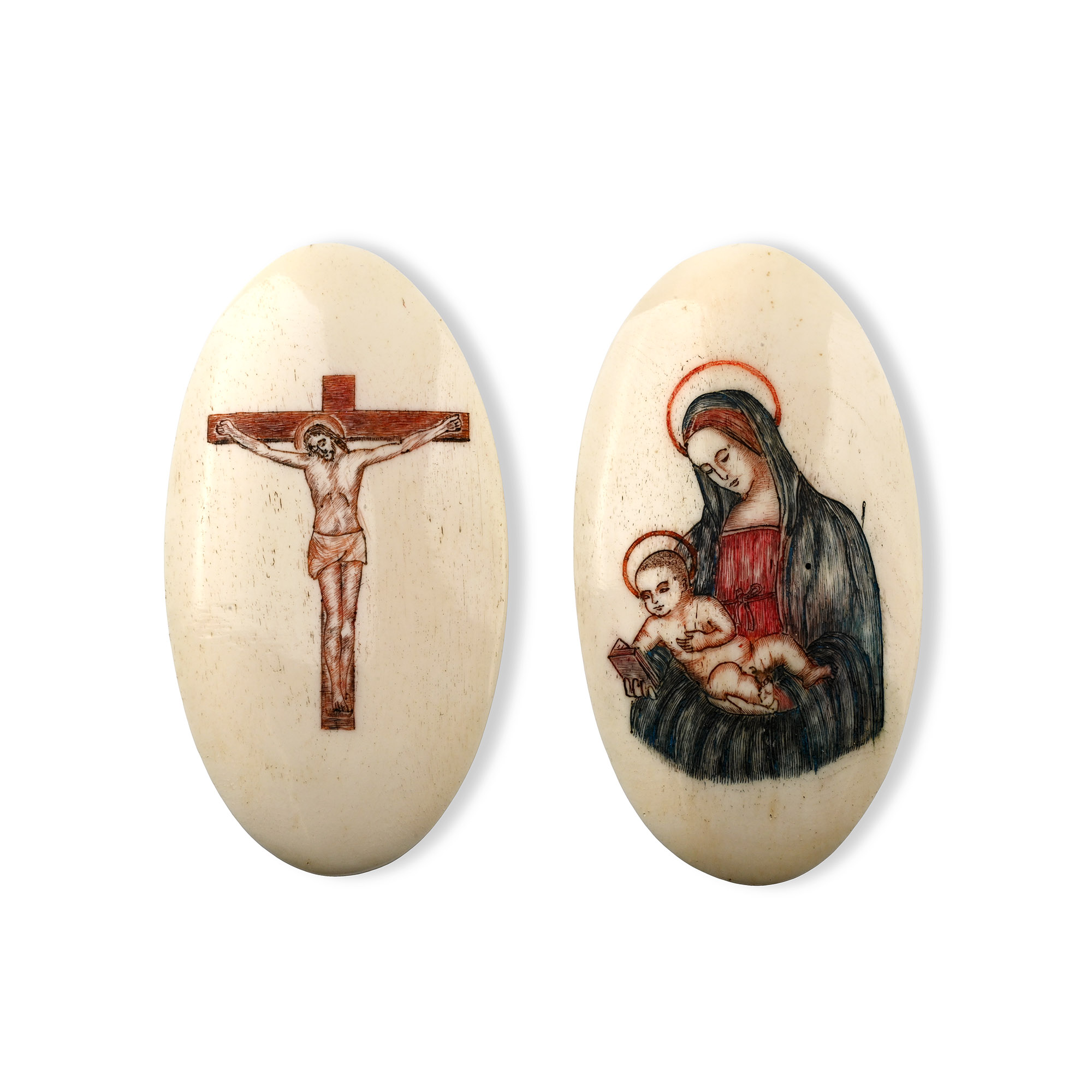
Post Medieval Painted Bone Plaque Pair
19TH-EARLY 20TH CENTURY A.D.
2 3/4 in. (35.24 grams total, 69 mm each).
Each ellipsoid in plan and plano-convex in section with painted image to the obverse: Mary with infant Jesus; Corpus Christi. [2, No Reserve]
Provenance
Acquired on the UK art market in the early 2000s.
This lot is accompanied by an illustrated lot declaration signed by the Head of the Antiquities Department, Dr Raffaele D'Amato.
VETTING:
TimeLine Auctions follows a vetting process to ensure the authenticity and legality of all items, reinforcing our commitment to integrity and responsible trading. Each antiquity, antique, and coin lot undergoes thorough examination by a vetting committee of at least ten external specialists, professional trade association members, scientists, and archaeologists: Our Vetting Process
AUCTIONS:
TimeLine is a leading auction house specialising in antiquities, ancient art, collectables, natural history, coins, medals, and books. Our auctions offer museums, collectors, historians, and enthusiasts the opportunity to acquire unique and historically significant pieces.
RELATED LOTS
-
Gold Fede Ring with Hands Holding a Heart
Mid-17th century A.D.Sold for (Inc. bp): £1,690
With a gold flat-section hoop, bezel formed as two hands supporting a heart, a flower ornament to each shoulder with traces of white enamel. 3.24 grams, 21.13 mm overall, 18.50 mm internal diameter (approximate size British O 1/2, USA 7 1/4, Europe 15.61, Japan 15)
From an old European collection, 1990s. From a Cambridgeshire, UK, private collection. This lot is accompanied by an illustrated lot declaration signed by the Head of the Antiquities Department, Dr Raffaele D'Amato.
The fine craftsmanship and design suggest it could have been a ring commemorating the wedding of Charles II and Catherine of Braganza in 1662. -
Bronze Grand Tour Statue of Augustus of Prima Porta
Italy, circa 1870 A.D.Sold for (Inc. bp): £1,300
Replica of marble statue of Augustus discovered in 1863 in Prima Porta, depicted in advancing pose wearing a military cuirass with mythological scenes, toga draped from the waist over the left arm, barefoot with statuette of Cupid seated on a dolphin beside his right leg; mounted on a custom-made tiered stand. 6.45 kg total, 40.8 cm high including stand
From the private collection of a S.W. London gentleman, acquired in the 1970s. This lot is accompanied by an illustrated lot declaration signed by the Head of the Antiquities Department, Dr Raffaele D'Amato.
An elegant 19th century detailed replica of the marble statue of Augustus discovered in 1863 during archaeological excavations at the Villa Livia owned by Augustus's wife, Livia Drusilla, at Prima Porta on the Via Flaminia, 12km north of Rome. The original full-length statue portrays an idealised image of Augustus in the role of imperator, commander of military forces, in contrapposto stance derived from Greek athletic statues of the 5th century BC. This statue represents Augustus in the act of adlocutio, addressing his troops, also seen on the reverse of the dupondii of Germanicus (RIC Gaius 57). Augustus is represented as a great general, a powerful orator, eternally youthful, with the body of a Greek athlete, with a support statuette of Cupid seated on a dolphin alluding to his divine ancestry from Venus through his formal adoption by Julius Caesar. The main element of the statue is the highly decorated cuirass with sphinx-decorated shoulder straps and paludamentum covered with figures arranged in three sections: Caelus, or sky-god at the apex; below him the sun-god Sol in his four-horse chariot and Aurora riding on the back of a female celestial personification; central section with figures of Hispania on the extreme left and another captive female, possibly Gallia, to the right; beneath, Apollo with lyre riding on a winged griffin and Diana on the back of a stag, with Tellus (Mother Earth) cradling two babies below, all framing the most important figures of the cuirass: on the right a Parthian military warrior (identified as Phraates IV) holding a Roman standard towards a helmeted and cuirassed Roman soldier accompanied by a she-wolf or dog (identified as Augustus-Aeneas, Tiberius, Mars or the personification of exercitus Romanus, the Roman army, an allusion to the return of the Roman standards in 20 BC, captured by the Parthians from the Roman general Marcus Licinius Crassus after his ignominious defeat at Carrhae in 53 BC. The statue thus commemorates Augustus’s victory over Parthia. Augustus made much of this, the first significant victory after Actium in 31 BC. Historical sources state that Phraates IV restored the standards to Augustus in 20 BC, although Suetonius reports that it was Tiberius who served as the intermediary for the transfer (Tiberius 9.1). -
Post Medieval Pewter Measure Set
18th-early 19th century A.D.Sold for (Inc. bp): £26
Stamped 'demi-decilitre', 'deci-litre', 'double decilitre' and 'demi-litre', together with other stamped marks. 1.31 kg total, 7-14.4 cm
Acquired 1990s-early 2000s. East Anglian private collection. From the private collection of a Kent, UK, gentleman. This lot is accompanied by an illustrated lot declaration signed by the Head of the Antiquities Department, Dr Raffaele D'Amato.