
Loading, please wait...
LOT 1462
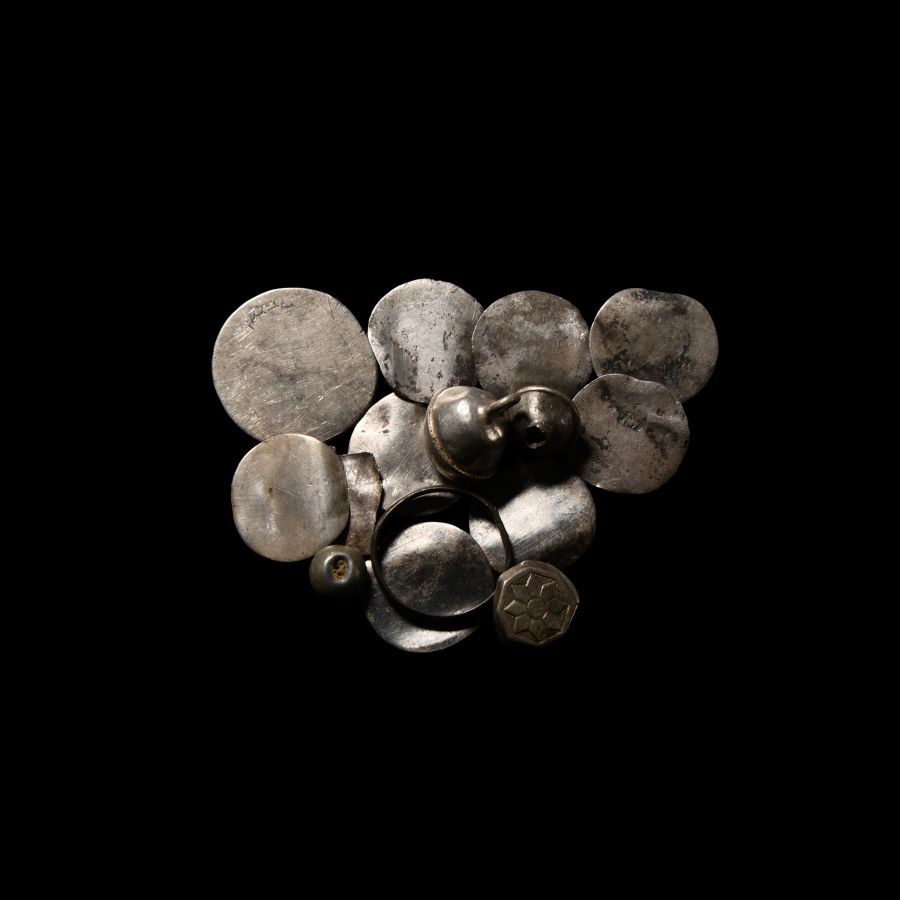
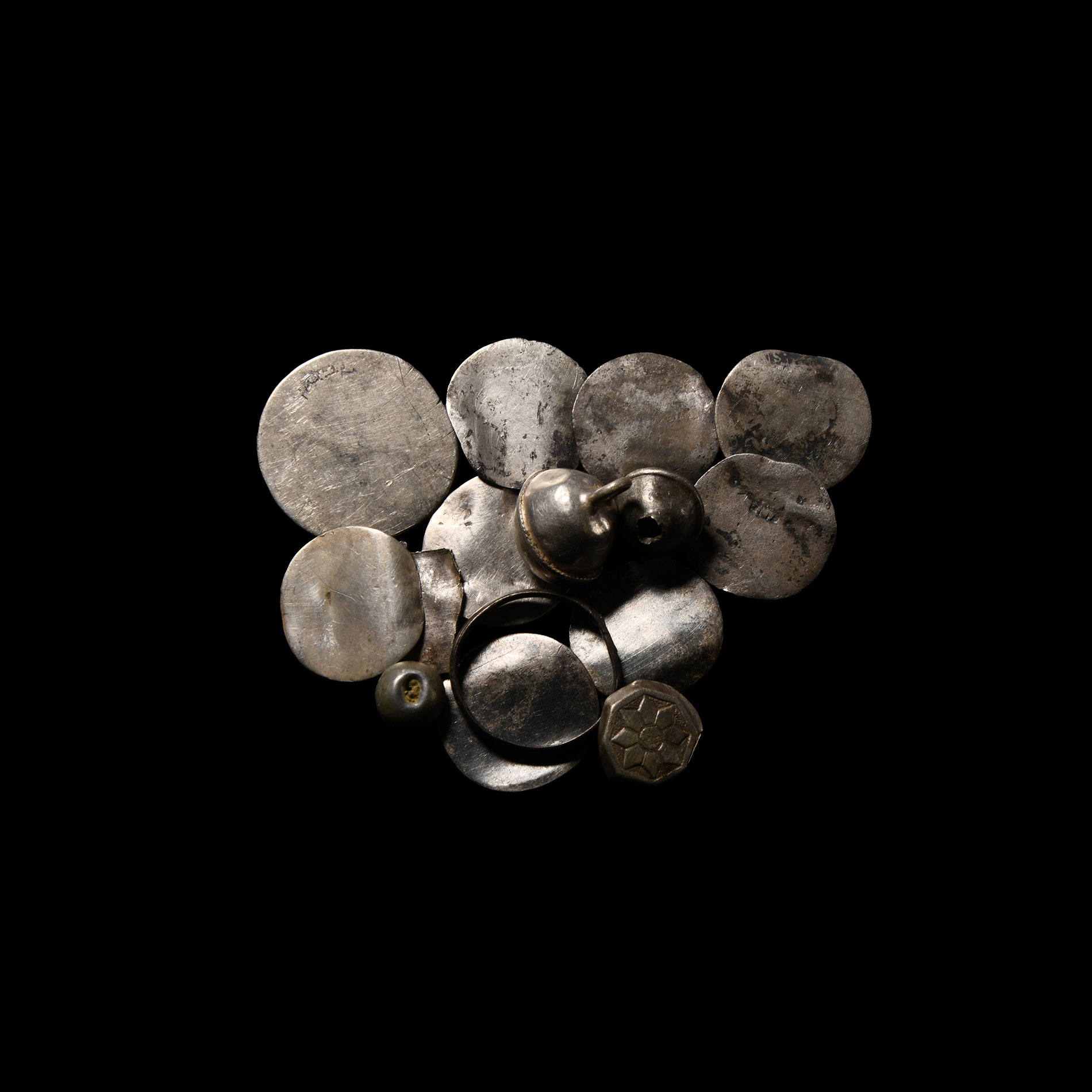
Post Medieval Love Token and Other Silver Artefact Group
18TH-19TH CENTURY A.D.
1/4 - 1 in. (28.7 grams total, 8-25 mm).
A mixed group of silver artefacts comprising; coins bent into 'love tokens'; worn coins; a plain finger ring; two crotal bell fragments; bulbous button fragment; button with geometric floral motif; fragment of a thimble. [15, No Reserve]
ProvenanceFound Wiltshire, UK.
CONDITIONTimeLine Auctions follows a vetting process to ensure the authenticity and legality of all items, reinforcing our commitment to integrity and responsible trading. Each antiquity, antique, and coin lot undergoes thorough examination by a vetting committee of at least ten external specialists, professional trade association members, scientists, and archaeologists: Our Vetting Process
AUCTIONS:
TimeLine is a leading auction house specialising in antiquities, ancient art, collectables, natural history, coins, medals, and books. Our auctions offer museums, collectors, historians, and enthusiasts the opportunity to acquire unique and historically significant pieces.
LOT 1462
Post Medieval Love Token and Other Silver Artefact Group
Sold for (Inc. bp): £21
-
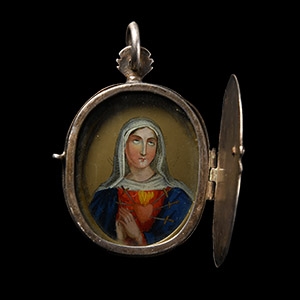
Post Medieval Papal Silver Reliquary Pendant with Portrait
18th-19th century A.D.Estimate: £300 - 400 (+bp*)
Opening Bid: £150
A silver reliquary pendant composed of a hinged oval-shaped locket with articulate swivel clasp and perforated suspension loop; the upper face engraved with a bleeding heart wearing a crown of barbed wire and surmounted by a Christian cross, framed by two scrolled bars; reverse engraved with similar bars framing the initials 'MRA' (possibly 'Maria Regina Angelorum') with leaf below; the interior with polychrome bust of the Virgin glancing skywards, her hands clasped in front of her body to her right, a flaming heart impaled with five swords in front of her chest, painted onto glass; glass panel with fabric backing sewn with the papal insignia of crossed keys beneath cross-topped triple crown (tiara) in what appears to be gold and silver thread; possible inscription to upper face of the (articulate) hinge. 50.36 grams, 70 mm high
Fine condition.
Property of a Colchester, UK, collector. -
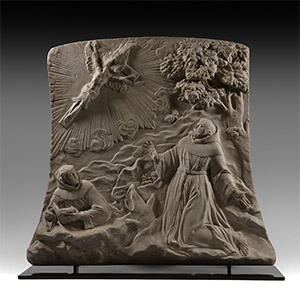
Post Medieval Relief with St Francis Scene
Italian, 18th century A.D. or laterEstimate: £1,200 - 1,700 (+bp*)
Opening Bid: £600
A carved marble figural panel depicting a religious scene, probably St. Francis of Assisi receiving the Holy Stigmata; a kneeling figure in loose-fitting cowl and habit with knotted cord to the waist, arms spread and head raised towards a chiaroscuro sunburst with a figure at the centre, wearing a loincloth and affixed to a plain cross, borne up by three pairs of wings attached to the shoulders and thighs; below, a second, smaller figure holding a book; all in a landscape with a tree at right behind the larger figure; mounted on a custom-made stand. 75 cm high including stand
English private collection.
The scene probably represents the events just prior to the end of the life of St. Francis of Assisi: while he was praying on a mountain with his companion, Brother Leo, he is said to have had a vision of a seraph (a six-winged angel on a cross) which gave him the gift of the stigmata, the five wounds of Christ. The apparition caused a deterioration in Francis's health and no cure could be found, so the saint spent the remaining days of his life dictating his spiritual message to Leo, who preserved the record of these events. -
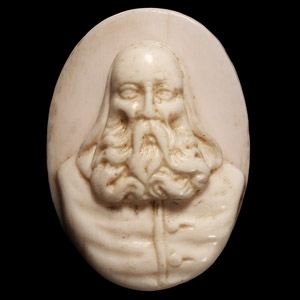
Shell Cameo of a Wealthy Merchant
18th-19th century A.D.Estimate: £120 - 170 (+bp*)
Opening Bid: £60
A carved shell facing bust of a bearded male with long hair, probably a German merchant. 3.04 grams, 23 mm
Acquired from Artermide Aste, auction 39E, lot 426. From the collection of G.M.R.H., London, UK.
