
Loading, please wait...
_900x900.jpg "Post Medieval Lock and Other Mechanism Group")
_200x200.jpg "Post Medieval Lock and Other Mechanism Group")
.jpg "Post Medieval Lock and Other Mechanism Group")
LOT 1475
Post Medieval Lock and Other Mechanism Group
MAINLY 19TH CENTURY A.D.
6 1/4 - 10 1/4 in. (2.2 kg total, 16-26 cm).
Including a pair of brass drop-handles, a mechanical bell and a multiple lock. [4, No Reserve]
ProvenanceAcquired on the UK art market.
Property of a European gentleman living in London.
TimeLine Auctions follows a vetting process to ensure the authenticity and legality of all items, reinforcing our commitment to integrity and responsible trading. Each antiquity, antique, and coin lot undergoes thorough examination by a vetting committee of at least ten external specialists, professional trade association members, scientists, and archaeologists: Our Vetting Process
AUCTIONS:
TimeLine is a leading auction house specialising in antiquities, ancient art, collectables, natural history, coins, medals, and books. Our auctions offer museums, collectors, historians, and enthusiasts the opportunity to acquire unique and historically significant pieces.
-
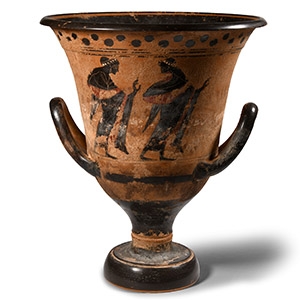
Large Greek Style Vessel
20th century A.D.Sold for (Inc. bp): £39
Bell krater with stepped disc foot an broad rounded rim, two lateral loop handles; painted designs to the body: Side A - a nude satyr fleeing, carrying a musical instrument; Side B - two courtly ladies advancing each wearing a himation and stephane, one hand extended, the leading lady looking backwards towards the other; after the antique. 3.8 kg, 42 cm high
From a family collection formed in the 1970s-1980s. From the Inglismaldie Castle estate, Angus, Scotland, by descent to the current owner. -
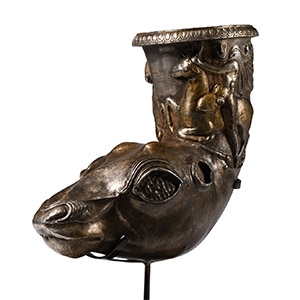
Greek Style Silver Ram-Headed Rhyton
20th century A.D. or earlierSold for (Inc. bp): £1,690
Substantial rhyton comprising a turned rim with lotus-flower ornament, two repoussé figures modelled in the half-round of Mithras grappling with the bull, one with billowing cloak and the other with a leaping lion behind the cloak; bull-head finial with lateral cells to accept horns and keyed eye-sockets to accept inserts; pouring hole at the chin; mounted on a custom-made stand. 561 grams, 16.5 cm wide (882 grams, 20 cm high including stand)
From a UK private collection, before 1980. -
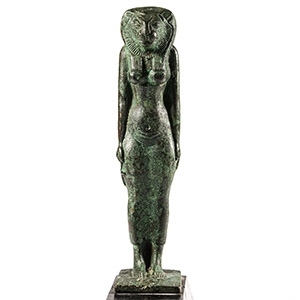
Bronze Statue of the Egyptian God Sekhmet
Late 19th-early 20th century A.D.Estimate: £800 - 1,000 (+bp*)
Opening Bid: £400
Modelled in the round, standing with hands at her sides, lion-headed, wearing an ankle-length skirt, holding an ankh in her right hand, hieroglyphic text to the base, mounted on a custom-made stand; after the antique. 2.17 kg total, 27 cm high including stand
Ex Paris collection. French gallery, Paris, 1990-2000s.
