
Loading, please wait...


LOT 1395
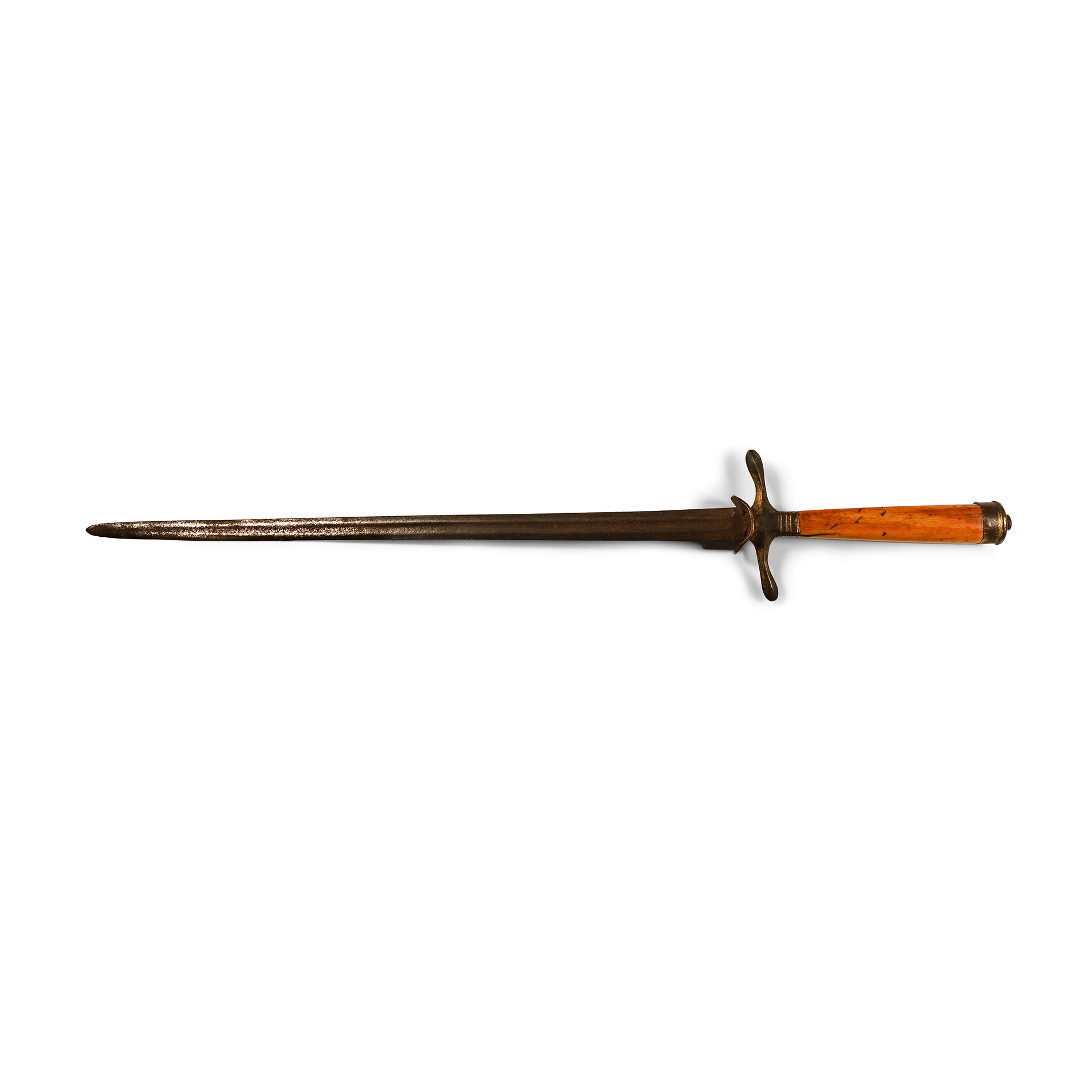
Post Medieval Iron Dagger with Gilt Bronze and Bone Hilt
17TH-18TH CENTURY A.D.
16 3/4 in. (138 grams, 42.5 cm).
Stiletto-type with slender two-edged blade, central fuller, dished bolster, gilt S-curved quillons, bone grip and pommel-cap with knop finial. [No Reserve]
ProvenanceAcquired on the UK art market circa 2005.
From an old North Country, UK, collection.
Cf. Dufty, A.R., European Swords and Daggers in the Tower of London, London, 1974, pl.98 and 104(c).
CONDITIONTimeLine Auctions follows a vetting process to ensure the authenticity and legality of all items, reinforcing our commitment to integrity and responsible trading. Each antiquity, antique, and coin lot undergoes thorough examination by a vetting committee of at least ten external specialists, professional trade association members, scientists, and archaeologists: Our Vetting Process
AUCTIONS:
TimeLine is a leading auction house specialising in antiquities, ancient art, collectables, natural history, coins, medals, and books. Our auctions offer museums, collectors, historians, and enthusiasts the opportunity to acquire unique and historically significant pieces.
LOT 1395
Post Medieval Iron Dagger with Gilt Bronze and Bone Hilt
Sold for (Inc. bp): £494
-
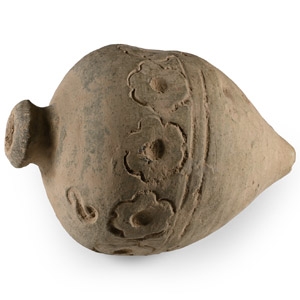
Byzantine 'Greek Fire' Ceramic Fire Bomb or Hand Grenade
9th-11th century A.D.Sold for (Inc. bp): £78
Piriform in profile with domed mouth, circumferential band of impressed rosettes to the equator. 459 grams, 13 cm
From a specialist collection of militaria, London, UK, collected 1990s onwards. Accompanied by an academic paper by military specialist Dr Raffaele D'Amato, dated 15 July 2019 and titled 'Eastern Roman Empire - Greek Fire Bomb or Hand Grenade (μεσαίον kακάβιον) 9th-11th century AD'.
Apart from the use of siphons or manual flame-throwers called cheirosiphona, special corps of Roman soldiers employed terracotta grenades, in the form of small jars, abundantly evidenced in archaeological excavations. They were called μεσαία kακαβιά or κυτροκακάβια where the former had a bulbous shape and the latter a more cylindrical form. -
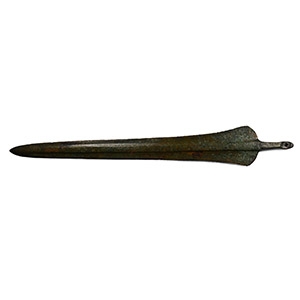
Luristan Bronze Spearhead Blade
14th-10th century B.C.Estimate: £250 - 350 (+bp*)
Opening Bid: £130
With rounded shoulders and square-sectioned mid-rib running to the blade tip; short tang with fastening hole. 45 grams, 46.5 cm
Acquired 1980-2015. Ex Abelita family collection.
The spearhead belongs to the type VI spearhead of the Khorasani classification. It is characterised by a long blade and short tang, slightly rounded shoulders and pronounced midrib. Similar weapons were excavated by Prof. Negahban in the royal cemetery of Marlik. -
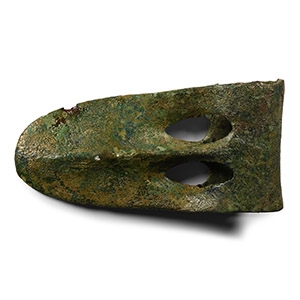
Old Babylonian Bronze Duckbilled Axehead
Early 2nd millennium B.C.Sold for (Inc. bp): £208
With a curved, beak-shaped blade and two pierced eyes flanking a raised median ridge ellipsoid-section socket; repaired. 147 grams, 10.5 cm
From the private collection of Kenneth Machin (1936-2020), Buckinghamshire, UK; with collection no.BA27; his collection of antiquities and natural history was formed since 1948; thence by descent.
This axe corresponds to the type H4B of the Gernez classification. Several of these models, with their moulds, are known from the Levant, like those in Byblos, Ras Shamra, and Tell Arqa. On the other hand, a workshop level II of the Kültepe karum delivered two moulds, showing a local production of arms intended either for export or for the inhabitants originating from Mesopotamia or the Levant. This sub-type of eye-axes is characteristic of the Middle Bronze Age 1 (2050-1750 B.C.).
